LanguageCert Academic
LanguageCert Academic Speaking Part 2: Role Play Task Format, Scoring, and Strategies
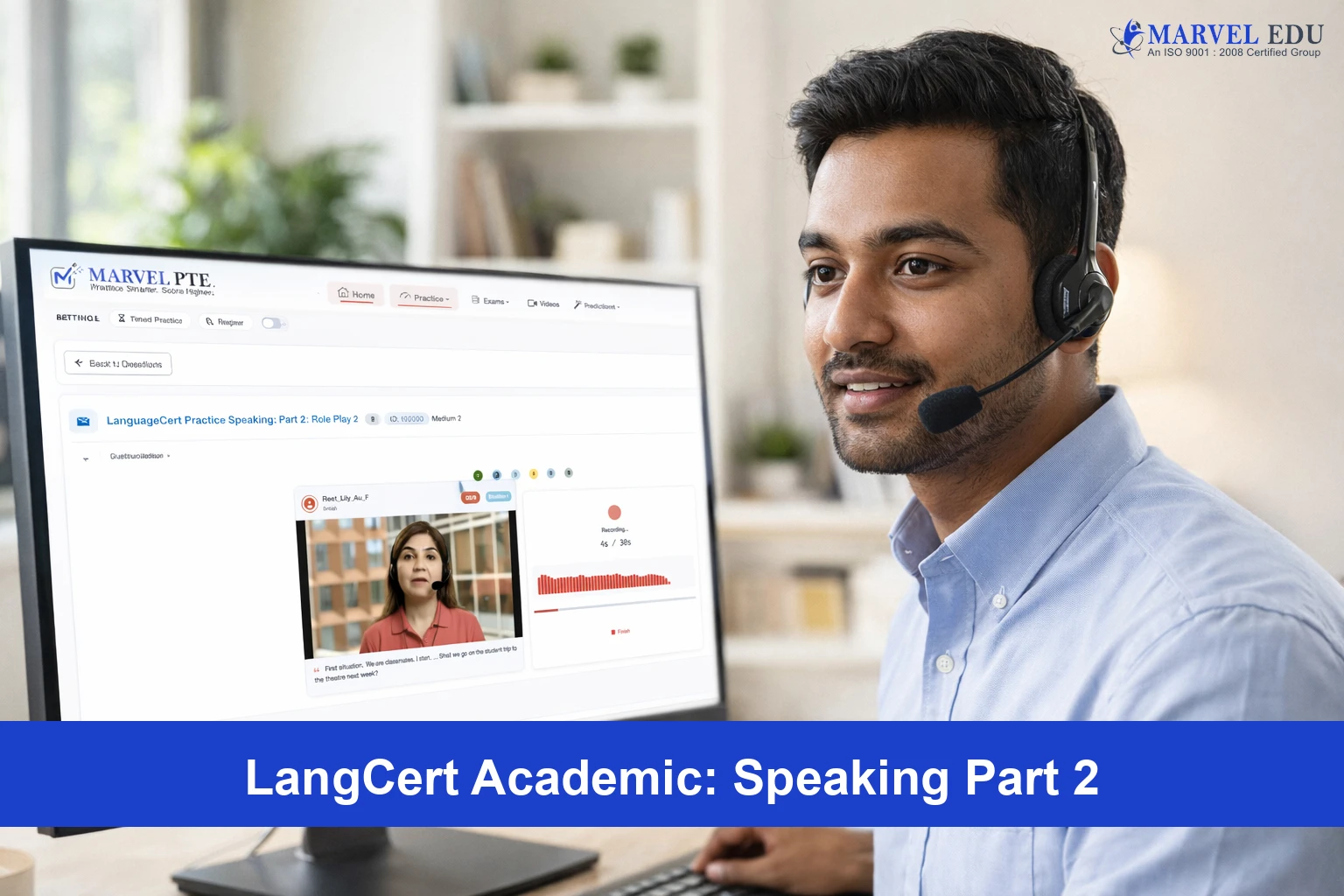
LanguageCert Academic Speaking Part 2 tests your ability to handle real conversations in academic settings. …

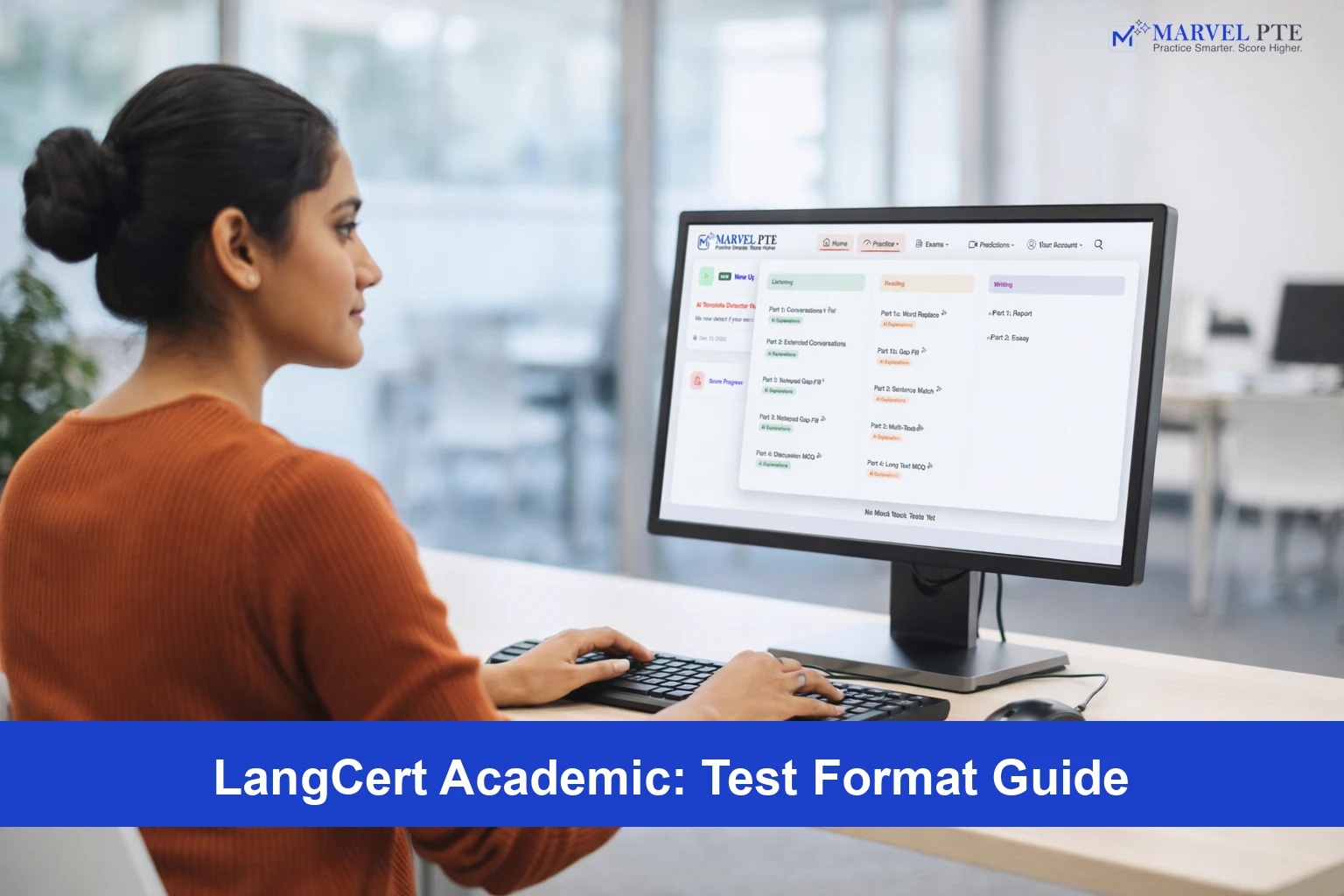
The LanguageCert Academic test takes 2 hours 34 minutes and has 4 sections: Listening, Reading, Writing, and Speaking. It’s approved by the Australian Department of Home Affairs for all visa types, and many test-takers find it more approachable than PTE or IELTS. Here’s what you need to know about each section.
LanguageCert Academic is a computer-based English proficiency test you take at authorised test centres worldwide. It uses CEFR levels (B1 to C2) to measure your English, which maps directly to Australian visa requirements.
Here’s what makes it different from other tests:
The test is accepted for Australian skilled migration visas including subclass 189, 190, and 491. Results come within 5 working days.
Experience a sample test to understand what to expect.
| Section | Duration | Questions | Key Feature |
|---|---|---|---|
| Speaking | 14 min | 4 parts | Human examiner via video |
| Writing | 50 min | 2 tasks | Flexible time allocation |
| Reading | 50 min | 30 questions | 5 distinct parts |
| Listening | 40 min | 30 questions | Audio plays twice |
Total: 2 hours 34 minutes
Explore each section in detail:
One thing I really like about this test: you can take the written sections (Listening, Reading, Writing) on one day and Speaking on another. Handy if you need time to prepare separately.
Pro Tip: The written sections are computer-delivered at the test centre. Speaking happens via video call with a trained examiner, not AI.
Get your estimated score and see where you need to improve.
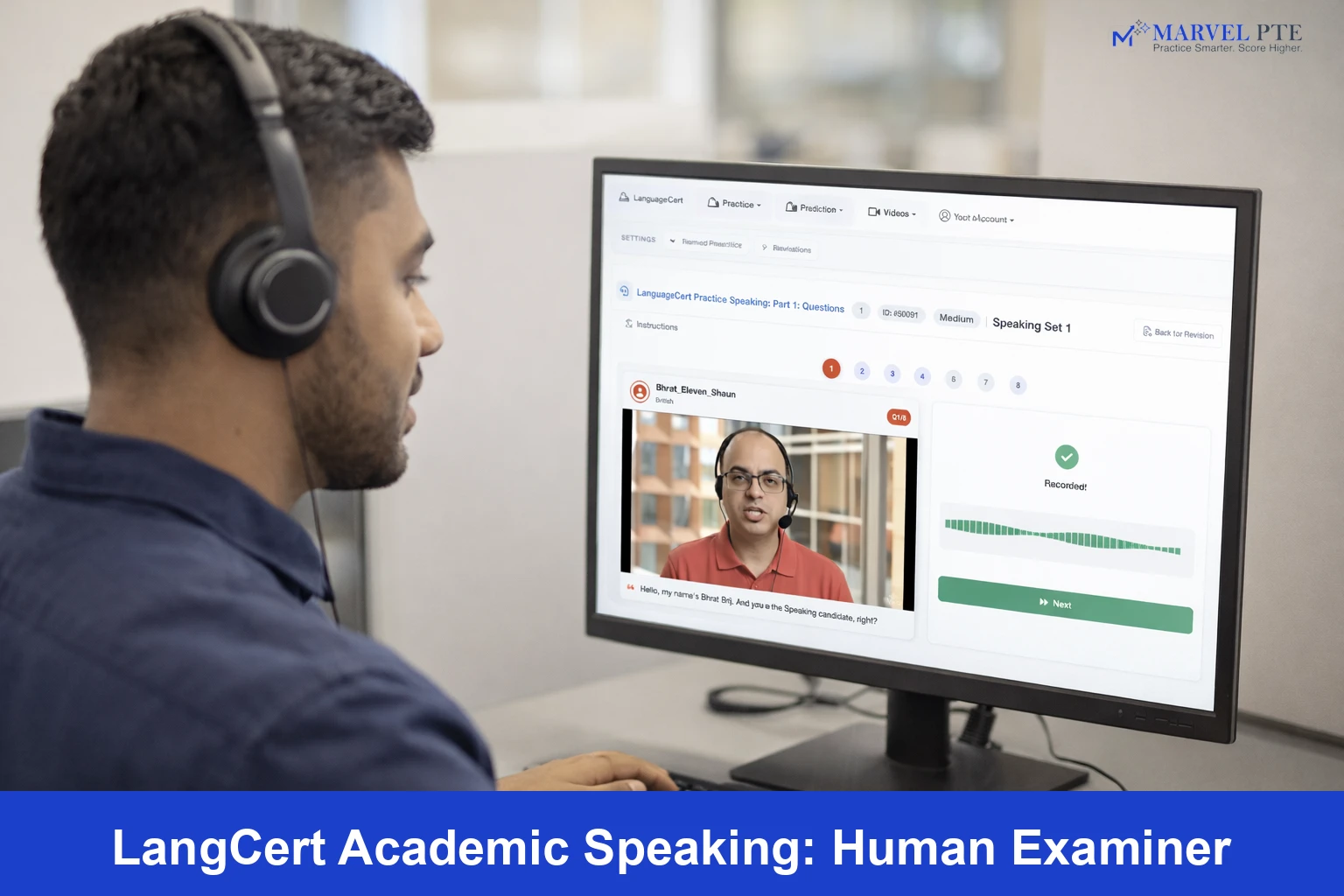
This is where LanguageCert really stands out. You’re not talking to a computer. You’re having a conversation with an actual human examiner.
The Speaking section has 4 parts:
| Part | What You Do | What’s Tested |
|---|---|---|
| Part 1 | Answer personal questions (up to 5) | Fluency, natural responses |
| Part 2 | Complete 2 role plays | Interactive communication |
| Part 3 | Read aloud + answer questions | Pronunciation, comprehension |
| Part 4 | Give a 2-minute presentation | Coherence, range |
With a human examiner, you can self-correct if you make a mistake. Say something unclear? Just rephrase it. The examiner understands context and natural hesitations.
Compare that to PTE where you’re speaking into a microphone and an algorithm decides if your pause was too long. Many students find the human interaction less stressful.
Key Point: The examiner scores your communicative effect, not just your pronunciation. If you get your message across clearly, that counts.
You get 50 minutes total for 2 writing tasks. And here’s the thing: you decide how to split that time.
| Part | Task | Word Count | Weight |
|---|---|---|---|
| Part 1 | Report based on infographic | 150-200 words | 40% |
| Part 2 | Discursive essay | 250 words | 60% |
Part 1 gives you an infographic (chart, graph, or diagram) and asks you to write a report describing the data. You need to identify trends, make comparisons, and draw conclusions.
Part 2 is a classic academic essay. You’ll discuss a topic, present arguments, and give your opinion. Standard essay structure works well here: introduction, two body paragraphs, conclusion.
Unlike PTE where Writing affects your Reading score (yes, really), LanguageCert keeps things separate. Your Writing score is just about your writing. Makes preparation more straightforward.
Pro Tip: Most students spend about 15 minutes on Part 1 and 35 minutes on Part 2. But if you’re faster at essays, adjust accordingly.
Access questions for all test sections with AI explanations.
Reading has 30 questions across 5 parts. Each part tests different skills.
| Part | Questions | What It Tests |
|---|---|---|
| Part 1a | 5 | Vocabulary in context |
| Part 1b | 5 | Grammar gap-fill |
| Part 2 | 6 | Sentence matching (cohesion) |
| Part 3 | 7 | Information from multiple texts |
| Part 4 | 7 | Long text comprehension |
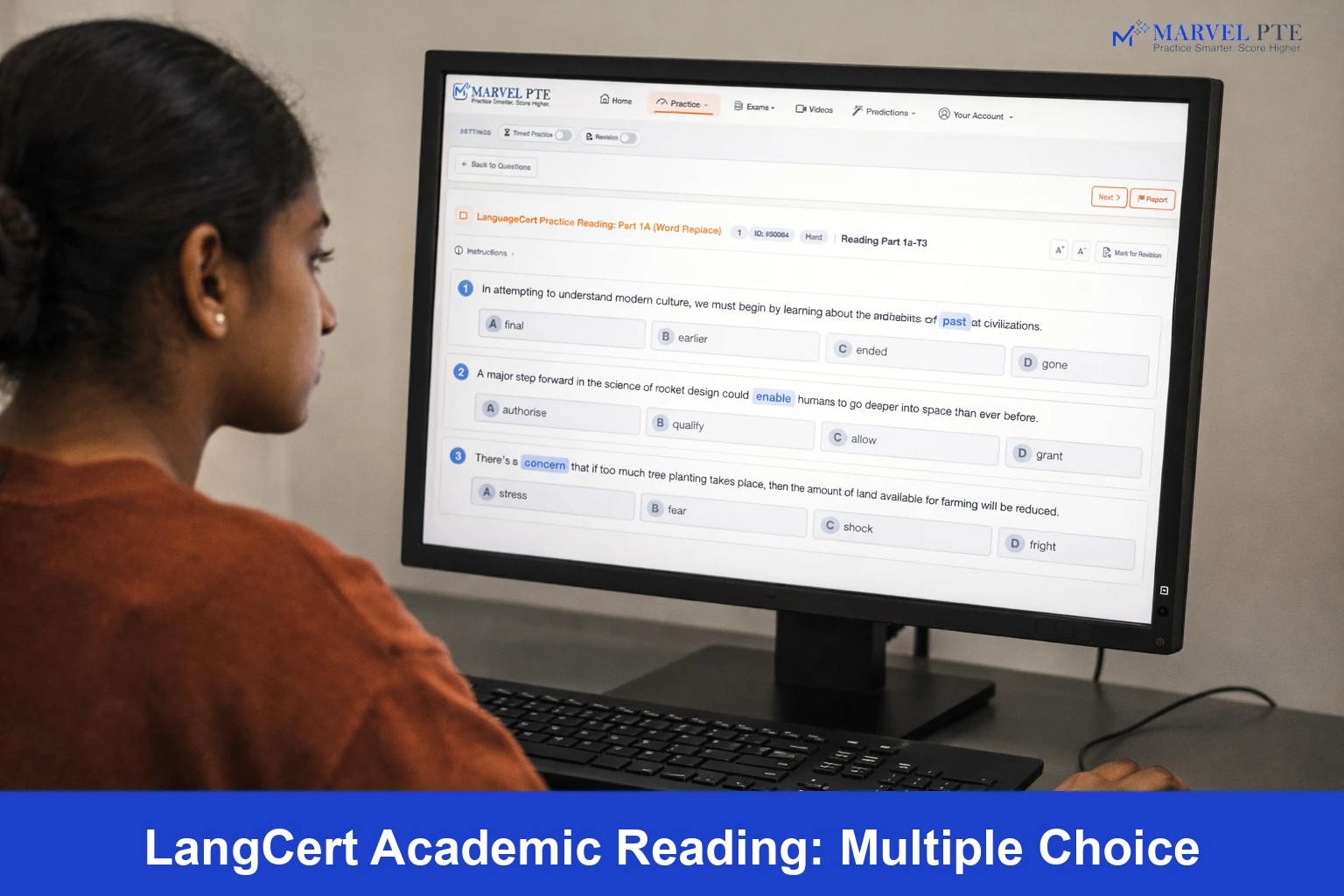
Part 1a shows highlighted words in a text. You choose the best synonym from 3 options. This is pure vocabulary, so read the sentence carefully for context.
Part 1b is gap-fill with 3 options per gap. Grammar focused. Think prepositions, articles, verb forms.
Part 2 gives you a text with 6 removed sentences. You match them from 8 options (2 are distractors). Look for pronouns and linking words that connect sentences.
Part 3 has 4 short texts on a common theme. Questions ask you to find specific information. Scanning skills matter here.
Part 4 is one longer academic text with multiple-choice questions. This tests detailed comprehension and inference. The trickiest part for most students.
The Listening section has 30 questions in 4 parts. And here’s the best part: every audio clip plays twice.
| Part | Questions | Audio Type |
|---|---|---|
| Part 1 | 7 | Short dialogues |
| Part 2 | 10 | Academic conversations |
| Part 3 | 7 | Lecture (note-taking) |
| Part 4 | 6 | Group discussion |
In PTE, audio plays once. Miss something? Too bad. In LanguageCert, you get a second chance. Use the first listening to get the general idea, then the second to confirm your answers.
Part 3 note-taking tip: You fill gaps with a maximum of 3 words each. Write exactly what you hear. Spelling matters.
Part 4 features 3 different speakers in a debate or discussion. You need to identify who says what and track different viewpoints. Tricky, but the double listening helps.
Key Point: Use the time before each audio to read the questions. Know what you’re listening for before the clip starts.
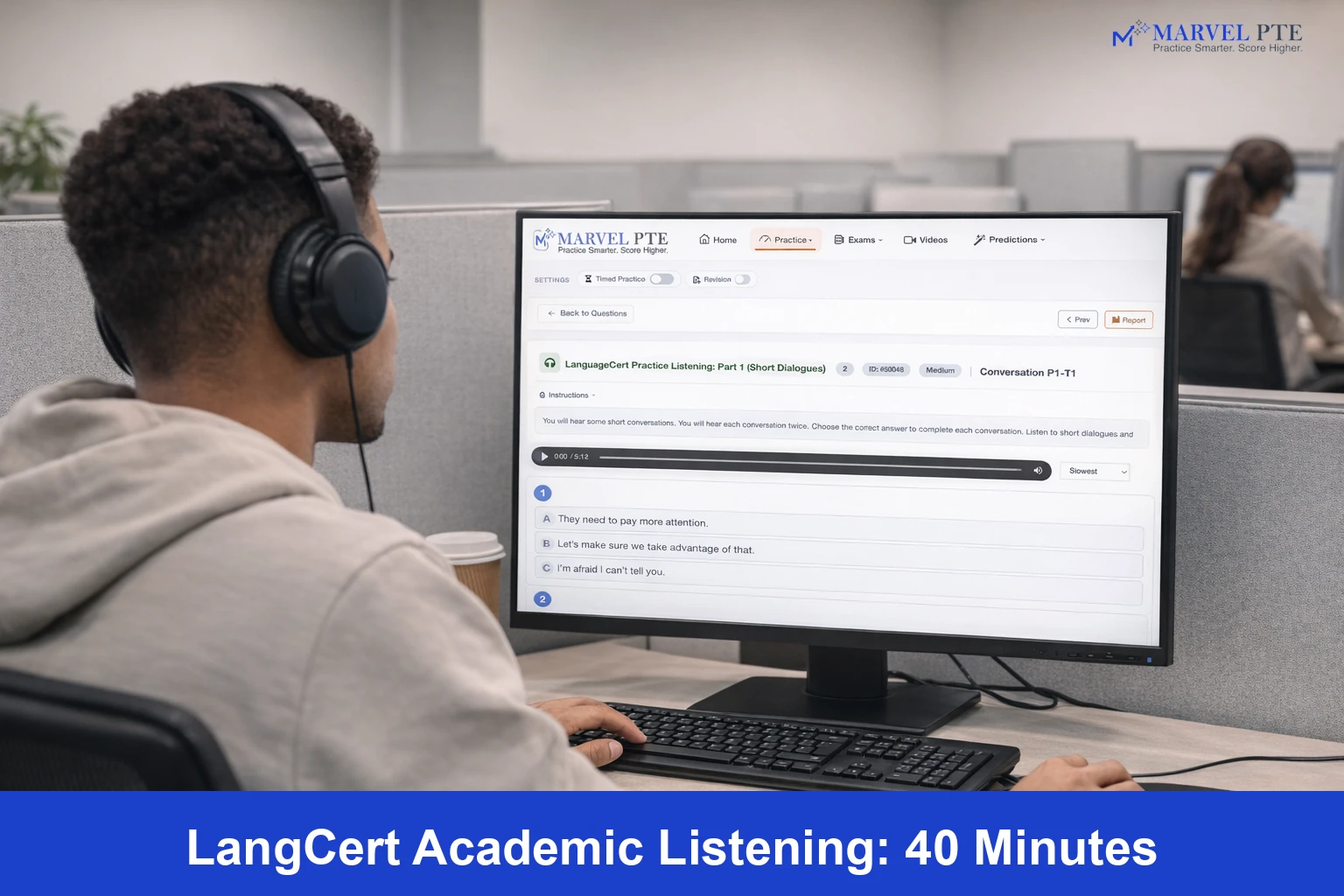
Here’s your test day at a glance:
| Section | Time | What to Expect |
|---|---|---|
| Listening | 40 min | Audio twice, note-taking in Part 3 |
| Reading | 50 min | 5 parts, manage time across all |
| Writing | 50 min | 2 tasks, you control time split |
| Speaking | 14 min | Video call with examiner |
| Total | 2h 34m |
You’ll take Listening, Reading, and Writing back-to-back at the test centre. Speaking can be same day or scheduled separately.
No breaks between written sections, so pace yourself. And drink water before, not during.
Many students ask which test is “easier.” Honestly? It depends on your strengths. But here’s how they compare:
| Aspect | LanguageCert | PTE Academic | IELTS Academic |
|---|---|---|---|
| Speaking | Human examiner | AI (microphone) | Human examiner |
| Listening audio | Plays twice | Plays once | Plays once |
| Writing time | 50 min (flexible) | 40 min (fixed) | 60 min |
| Scoring | CEFR + points | 10-90 scale | Band 0-9 |
| Results | 5 working days | 1-5 days | 13 days |
| Integrated scoring | No | Yes | No |
If you’re uncomfortable talking to a computer for Speaking, LanguageCert’s human examiner is a relief. If you struggle with Listening because audio goes too fast, the double playback helps.
But if you want the fastest results or prefer fully computer-based testing without video calls, PTE might suit you better.
The Bottom Line: LanguageCert removes some of the pressure points that trip students up in other tests. The human Speaking examiner and double Listening audio make it feel less like a race against the clock.
The LanguageCert Academic test format follows a clear structure designed to assess your English language proficiency across all four skills: listening, reading, writing, and speaking. Unlike some other English language tests, this LanguageCert exam separates the written exam from the spoken exam, giving you flexibility in your preparation and test booking.
Before your test date, you’ll want to review the qualification handbook which outlines exactly how each section works. The LanguageCert Academic exam format is straightforward: you complete the written exam (listening, reading, writing) at a test centre, then schedule your spoken exam via video call.
Marvel Edu’s LanguageCert platform gives you everything you need to prepare effectively:
| Feature | What You Get |
|---|---|
| AI-Powered Scoring | Instant, accurate scores aligned with LanguageCert marking criteria |
| Speaking Practice | AI feedback on fluency, pronunciation, and content |
| Writing Analysis | Detailed feedback on structure, vocabulary, and grammar |
| Full Mock Tests | Complete practice tests under real exam conditions |
| Expert Templates | Proven structures for Writing Part 1 and Part 2 |
| Strategy Videos | Step-by-step guidance from 90-score achievers |
The platform covers all 13 question types across Listening, Reading, Writing, and Speaking. Practice mode lets you focus on weak areas, while timed mode builds exam-day stamina.
Why Marvel Edu? The same AI technology trusted by 85,000+ PTE test takers is now available for LanguageCert Academic.
Proper preparation makes all the difference for any English test. Here’s how to approach your LanguageCert Academic exam preparation:
Start with mock tests to understand the LanguageCert test format. Practice papers help you get familiar with question types and timing. Many test takers find that doing timed practice under exam conditions builds confidence.
Focus your preparation on areas where you need improvement. If listening is your weak point, practice with academic conversations and lectures. For writing, work on structuring reports and essays within the time limits.
On exam day, arrive at the test centre early. Bring your identification and test booking confirmation. The written exam takes about 2 hours 20 minutes, so pace yourself through each section.
After completing the LanguageCert exam, you’ll receive your test results within 5 working days. Your test report shows CEFR levels for each skill, which maps directly to Australian immigration requirements for English language proficiency.
For visa application purposes, you need to demonstrate competent English at minimum. Higher education institutions and immigration authorities recognise LanguageCert Academic as proof of language proficiency for academic English requirements.
Unlike LanguageCert International ESOL exams or LanguageCert ESOL tests designed for general purposes, the LanguageCert Academic exam specifically targets those needing English proficiency for university admission or skilled migration.
When choosing between different English language tests, consider your strengths. PTE Academic uses computer scoring. IELTS Academic has human examiners. The Pearson Test of English and Cambridge English exams each have their own formats.
LanguageCert Academic stands out because it combines human examiner interaction in speaking with the efficiency of computer-based written sections. The Occupational English Test serves healthcare professionals specifically, while LanguageCert Academic works for general skilled migration and higher education institution admission.
Whether you’re applying for a UK visa, Australian PR, or university admission, understanding the LanguageCert Academic test format helps you prepare effectively. With proper exam preparation, mock tests, and focused practice, you can achieve the English proficiency scores you need.
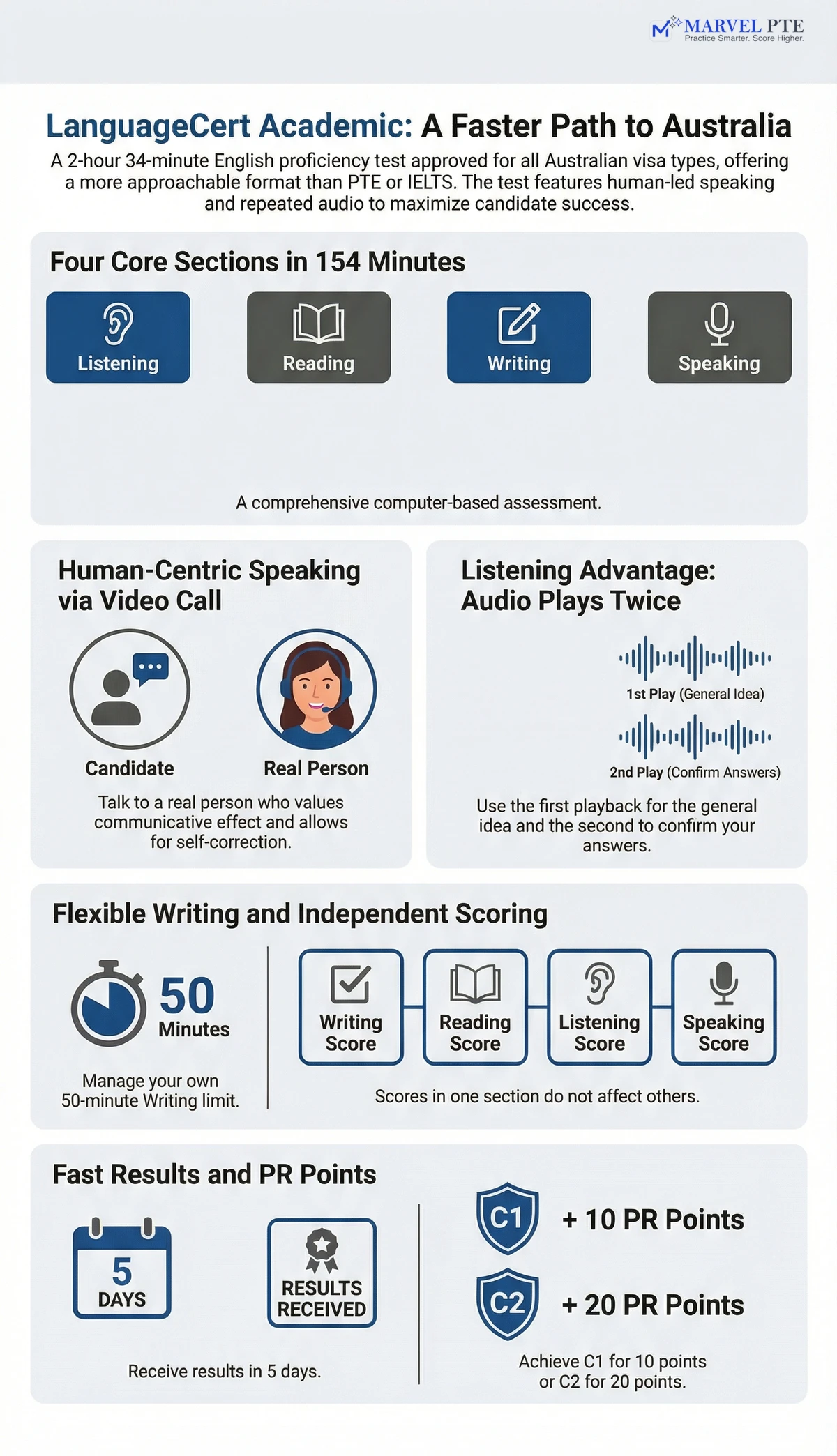
Here’s what to remember about the LanguageCert Academic format:
✅ Total test time: 2 hours 34 minutes
✅ 4 sections: Listening, Reading, Writing, Speaking
✅ Speaking is with a human examiner via video call
✅ Listening audio plays twice in every part
✅ Writing has flexible time allocation (you decide)
✅ No integrated scoring between sections
✅ Results in 5 working days
✅ Accepted for Australian skilled migration visas
❌ Don’t confuse with LanguageCert ESOL (different test)
❌ Don’t expect home-based testing for visa purposes (test centre only)
❌ Don’t assume PTE timing applies here
What is the total duration of the LanguageCert Academic test?
Which feature distinguishes the LanguageCert Academic Speaking section from PTE?
How many times does each audio clip play in the Listening section?
How is the 50-minute Writing time managed?
What does 'no integrated scoring' mean in LanguageCert Academic?
What is the total duration of the LanguageCert Academic test?
2 hours 34 minutes
Which four sections comprise the LanguageCert Academic test?
Listening, Reading, Writing, and Speaking
Which Australian government body approves LanguageCert Academic for visa purposes?
The Department of Home Affairs
What proficiency framework does LanguageCert Academic map to?
Common European Framework of Reference (CEFR) levels B1 to C2
For which Australian visa subclasses is LanguageCert Academic accepted?
Subclasses 189, 190, and 491
How long does it take to receive LanguageCert Academic results?
Within 5 working days
What is the delivery format for the Speaking section?
A video call with a human examiner
How many times does the audio play in the Listening section?
Twice
How is time managed during the Writing section?
You have 50 minutes total and can split the time flexibly between the two tasks
What does 'no integrated scoring' mean?
Each section is scored independently, so performance in one section does not impact the score of another
Video strategies, mock tests, and practice questions in one package.

LanguageCert Academic Speaking Part 2 tests your ability to handle real conversations in academic settings. …
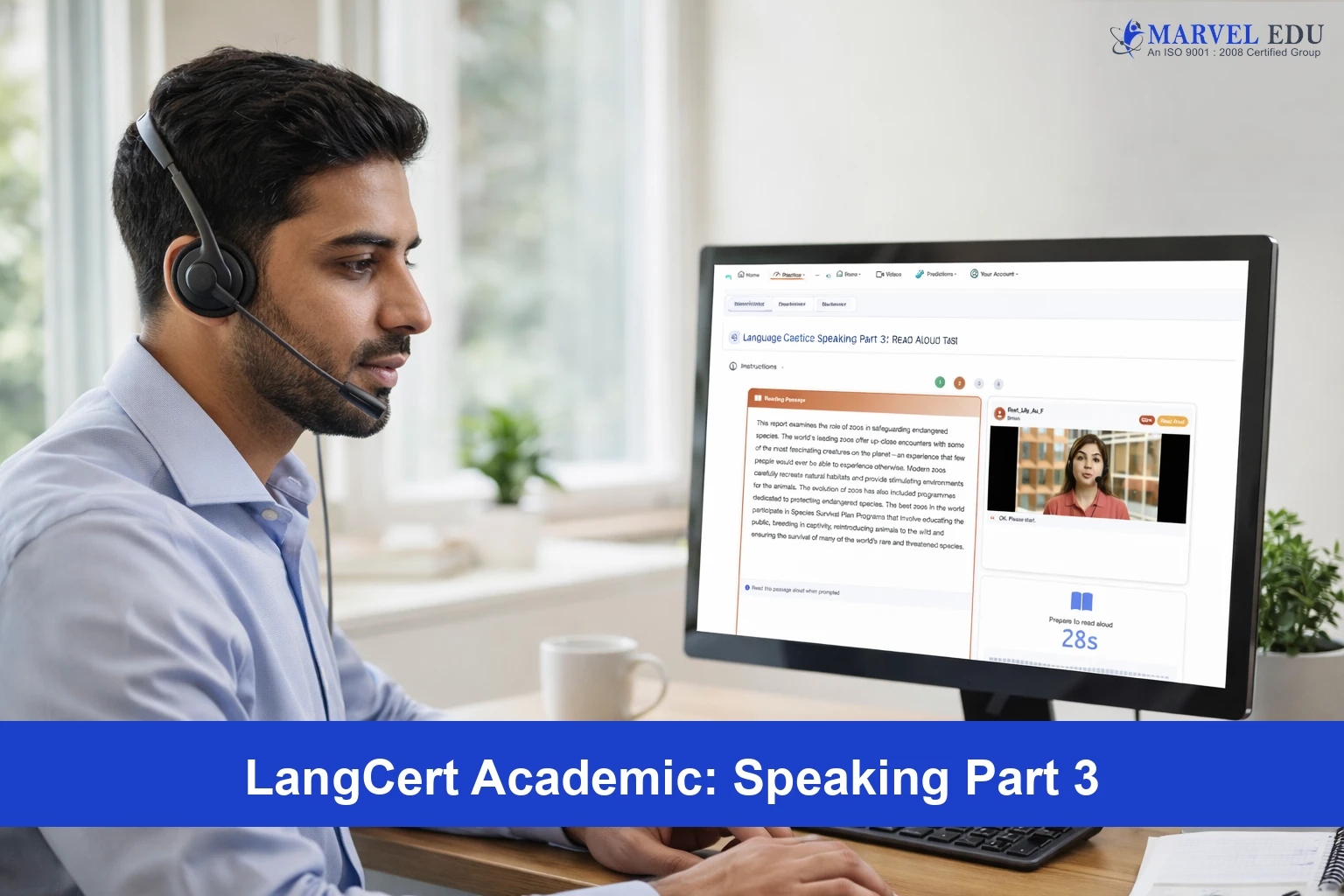
LanguageCert Academic Speaking Part 3 tests two skills in one task: reading aloud and expressing an opinion. …

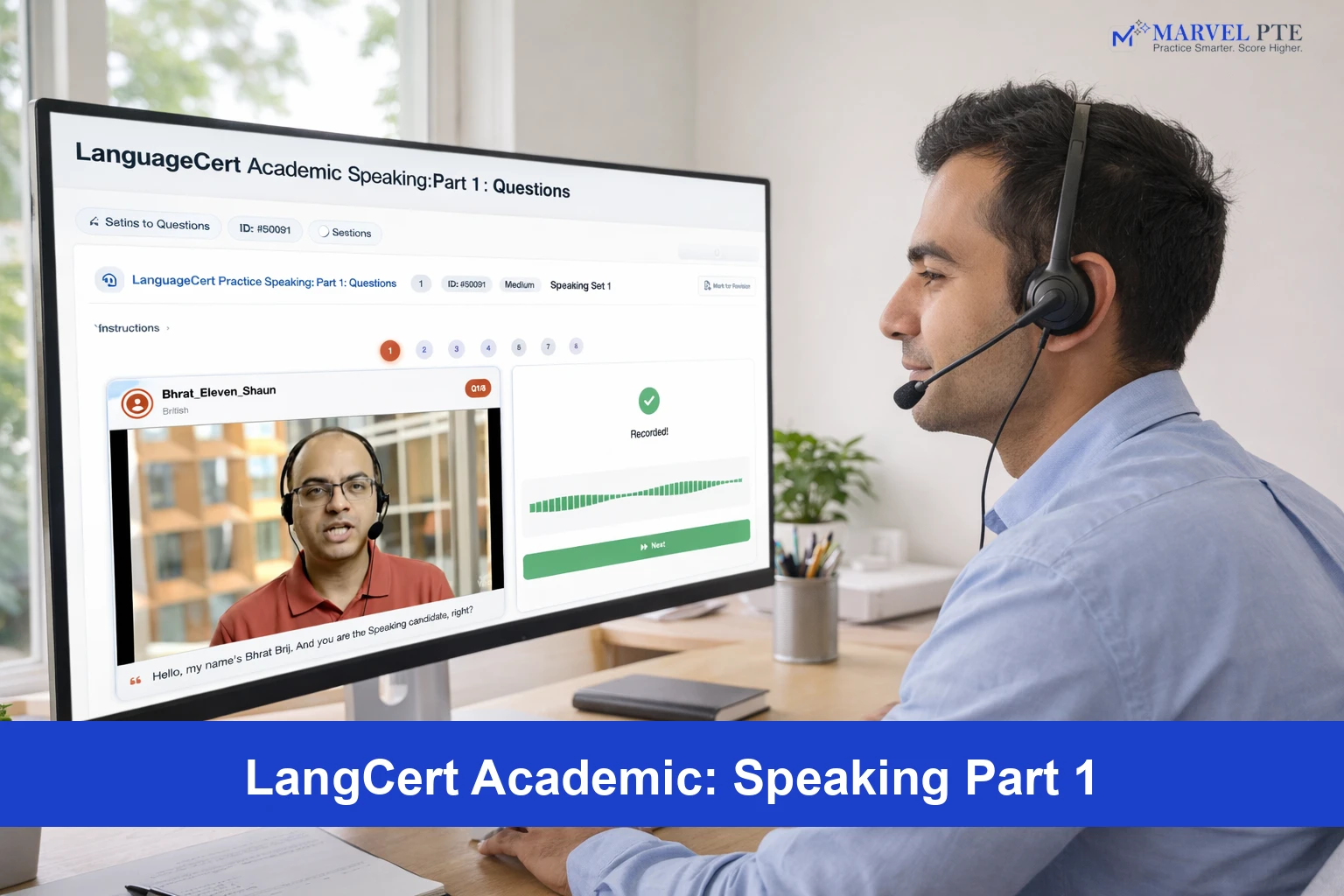
LanguageCert Academic Speaking Part 1 is the opening section of the speaking test, where the examiner asks you …
