
LanguageCert Academic
LanguageCert Academic Speaking Part 2: Role Play Task Format, Scoring, and Strategies
LanguageCert Academic Speaking Part 2 tests your ability to handle real conversations in academic settings. …

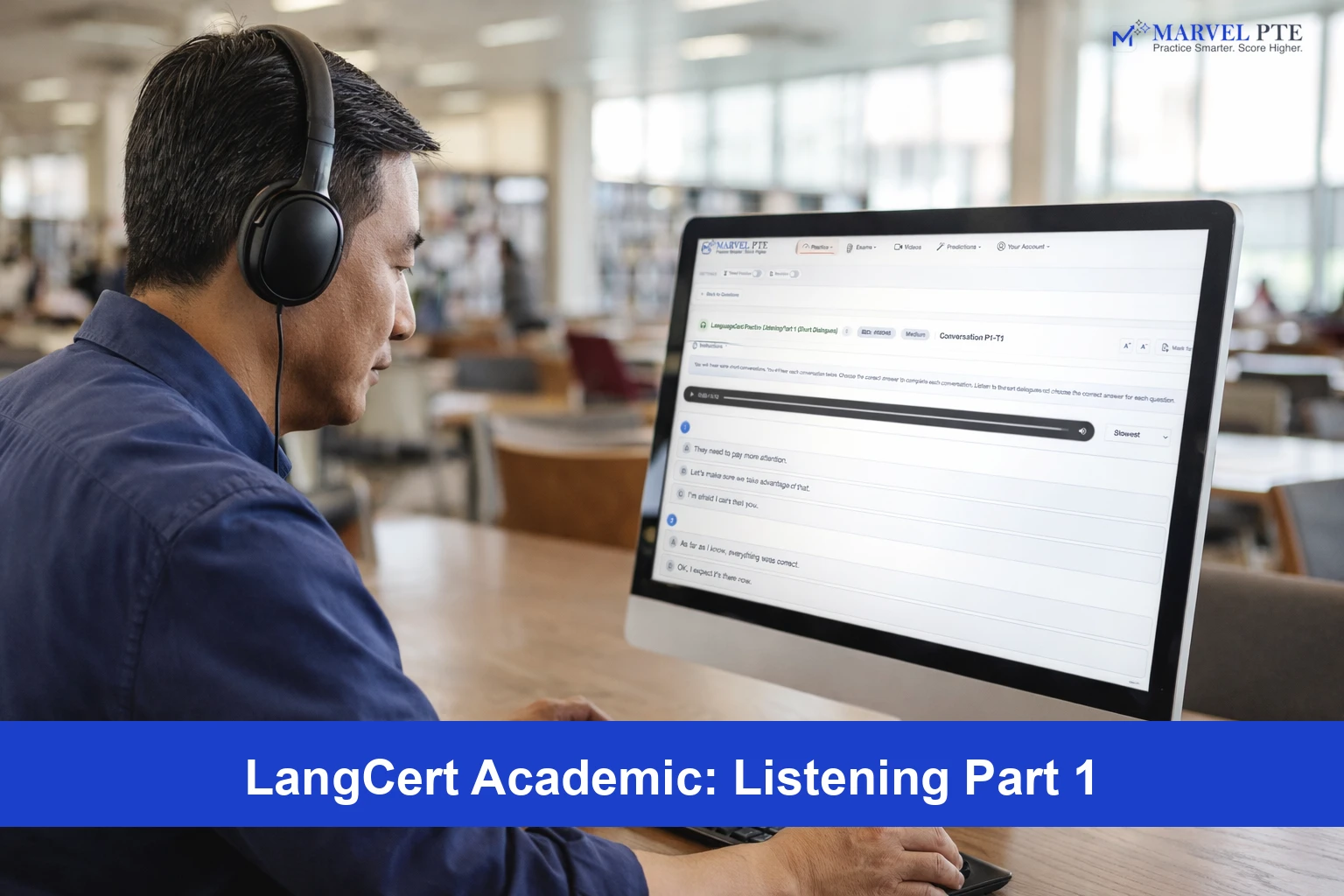
LanguageCert Academic Listening Part 1 is your introduction to the 40 minute Listening section. With 7 questions testing your ability to understand short conversational exchanges, this part sets the tone for the rest of the test. The good news? Every audio clip plays twice, and there is no negative marking for wrong answers.
I had a student who struggled with PTE Listening because the single playback left him scrambling. When he switched to LanguageCert, he told me the double playback felt like having a safety net. He could listen for meaning first, then confirm his choice on the second play. That shift in pressure made all the difference.
This guide covers exactly how Part 1 works, what the questions look like, how to approach them strategically, and how this differs from PTE Listening. Whether you are preparing for the LanguageCert exam to meet an English language requirement for Australian immigration or to study at an English speaking university, understanding Part 1 is essential for strong test results.
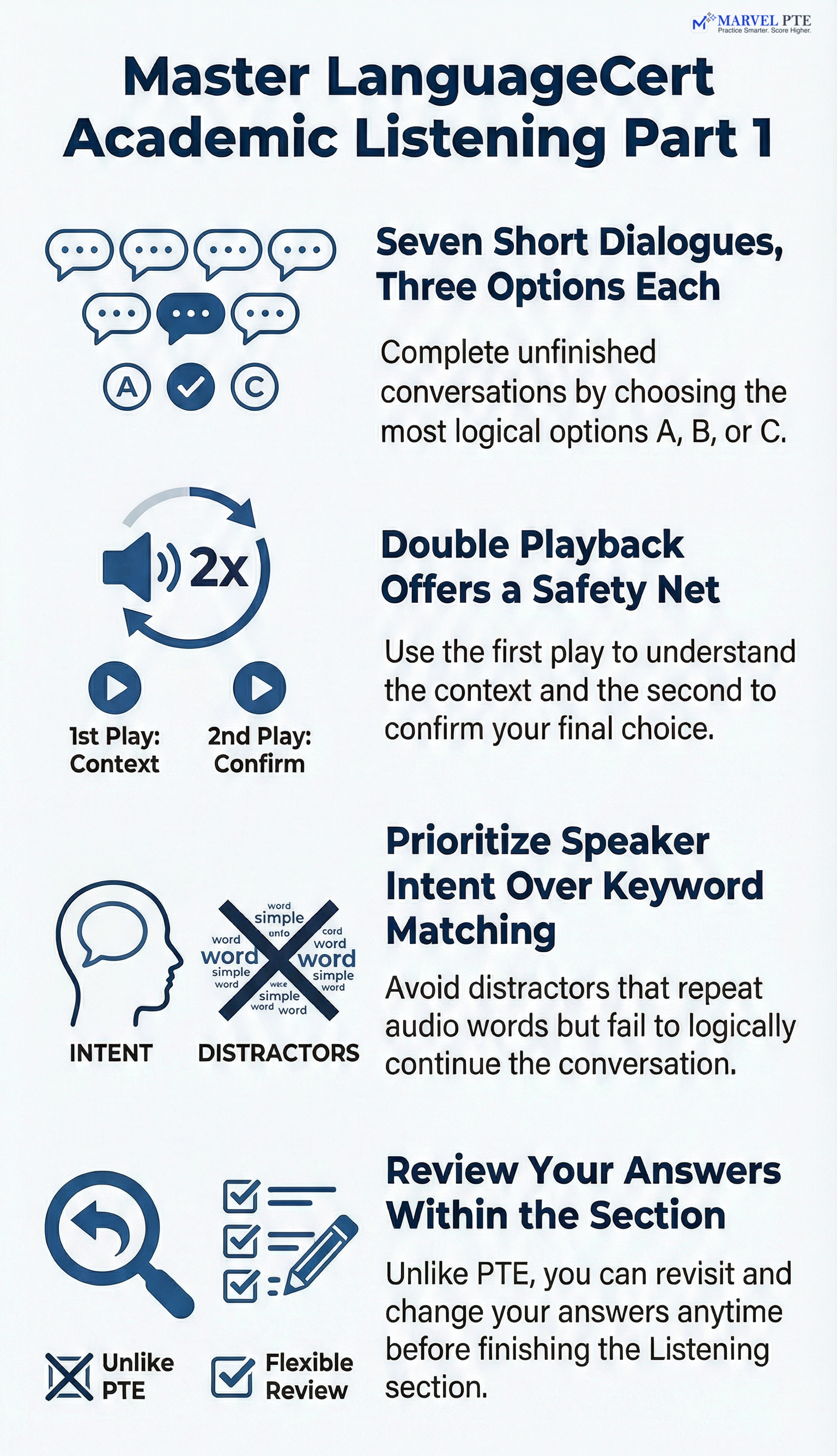
Part 1 is the first of four parts in the LanguageCert Academic Listening section. You will hear seven short dialogues, each ending with an incomplete statement or question. Your task is to choose the most appropriate completion from three options.
| Aspect | Details |
|---|---|
| Question Count | 7 |
| Options per Question | 3 (A, B, C) |
| Question Type | Unfinished dialogues |
| Audio Playback | Twice |
| Marks per Question | 1 |
These dialogues simulate everyday academic or professional situations. You might hear a student asking a professor about an assignment, or colleagues discussing a project timeline. The conversations are short, typically 15 to 30 seconds, making them easier to follow than the longer exchanges in later parts.
Part 1 matters because it builds your confidence early. If you perform well here, you enter Parts 2, 3, and 4 with momentum rather than anxiety. Strong performance in this first part demonstrates your listening skill and sets a positive tone before you move to the spoken component of the exam.
Listen to exam-style audio and test your comprehension.
Each Part 1 question follows a predictable pattern. You hear a short conversation between two speakers. The conversation stops before a natural conclusion, and you must choose what the second speaker would most likely say next.
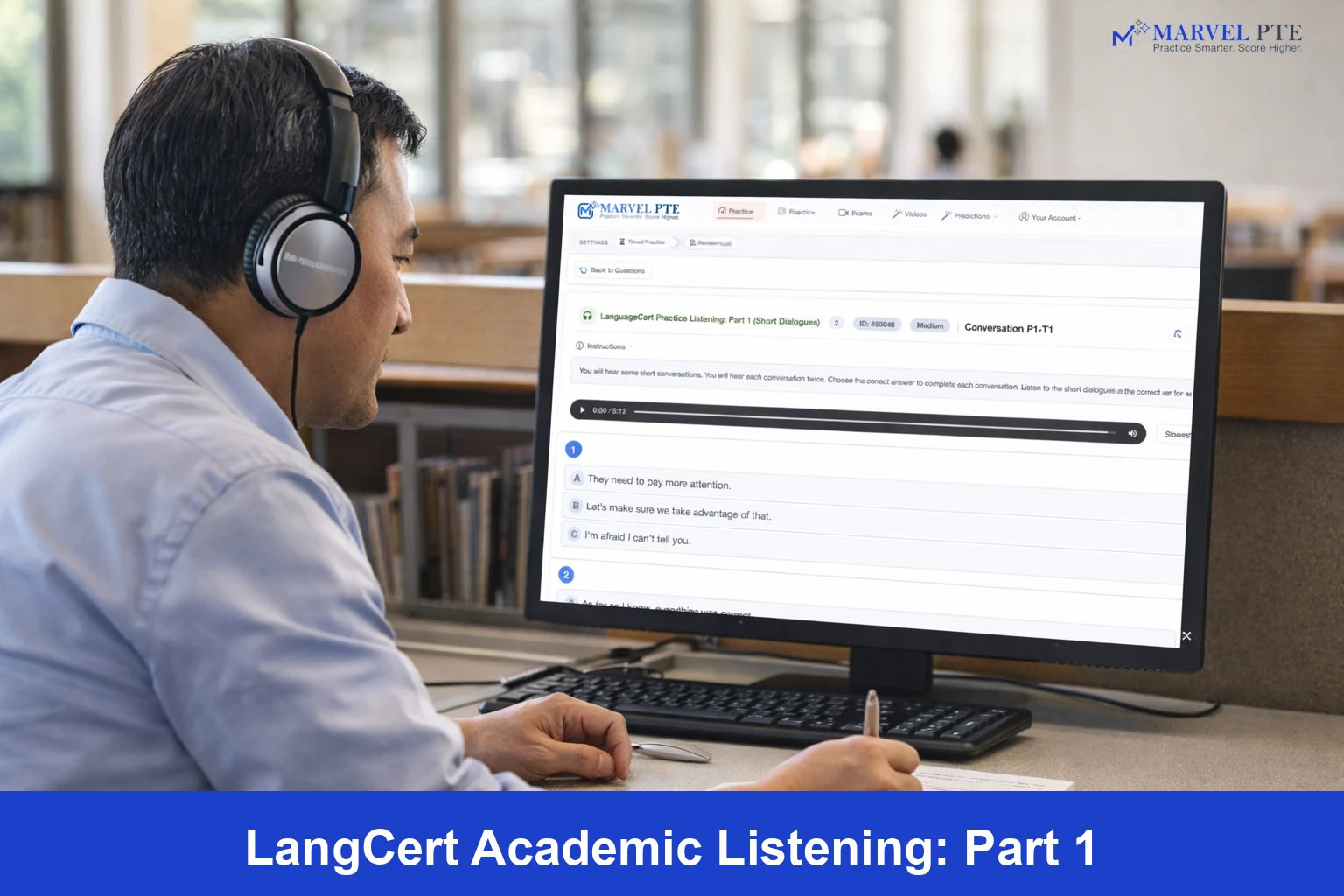
Here is how the task appears on screen:
The key skill being tested is not vocabulary or grammar. It is your ability to understand speaker intention. What does the first speaker actually want? What response would make sense in this context?
Many students fall into the trap of matching words they hear to words in the options. This approach often fails because the correct answer paraphrases the expected response rather than repeating exact words. The test deliberately includes distractors that contain words from the audio but do not logically continue the conversation.
Take a mock listening section with real exam conditions.
Scoring in Part 1 is straightforward:
| Scoring Rule | Details |
|---|---|
| Correct Answer | 1 mark |
| Wrong Answer | 0 marks |
| No Answer | 0 marks |
| Partial Credit | Not available |
| Negative Marking | None |
There is no penalty for guessing. If you are unsure between two options, eliminate the one that seems least logical and commit to your choice. Leaving questions blank never helps your score.
Part 1 contributes to your overall Listening score, which is reported separately from Reading, Writing, and Speaking. Unlike PTE, LanguageCert does not use integrated scoring. Your Listening performance does not affect your Writing or Speaking scores.
Consider this simplified example:
Audio: A student approaches a librarian and says, “I reserved a book last week, but I have not received any notification.”
Options:
The correct answer is B. The student has raised a specific concern about a reservation, and the logical response is to address that concern directly. Options A and C contain library related information but do not respond to what the student actually said.
Test writers use several techniques to create attractive but incorrect options:
Access our full listening library with transcripts and answers.
Use the few seconds before each clip to read all three options. Identify what kind of response each option represents. Is option A an offer of help? Is option B a clarification? Is option C a refusal?
Focus on understanding the situation. Who is speaking? What do they want? Do not try to make your final decision yet. Let the conversation flow and absorb the context.
Now you know what to listen for. Pay attention to the tone and emphasis of the final statement. Does the speaker sound frustrated, confused, or neutral? Match your answer to what would logically follow.
Remove options that:
Pro Tip: Trust your instinct on short exchanges. If an option sounds natural and directly addresses what was said, it is probably correct. Overthinking simple dialogues often leads to errors.
Part 1 is relatively fast paced. Each dialogue is short, and you have limited time between questions. Here is how to stay on track:
| Tip | Why It Matters |
|---|---|
| Read options immediately | You need context before the audio starts |
| Use first play for understanding | Do not rush to answer |
| Use second play for confirmation | Verify your instinct |
| Move on quickly if unsure | Do not let one question affect the next |
The double playback is your advantage. Use the first play to understand the situation and the second to confirm your choice. If you are still unsure after both plays, make your best guess and move forward. Dwelling on one question will only create pressure for the next.
Yes, within the Listening section, you can go back and change your answers. This is a significant advantage over PTE, where once you move to the next question, you cannot return.
However, once you click to proceed to the Writing section, you cannot go back to Listening or Reading. A 15 minute warning appears before the Listening section ends, reminding you to review any flagged answers. The qualification handbook confirms this navigation rule applies whether you take the exam at a test centre or via remote proctoring.
Change your answer only if you have a clear reason. Random second guessing often turns correct answers into wrong ones. If your first instinct was based on understanding the conversation, trust it unless the second playback revealed something you genuinely missed.
If you have prepared for PTE, you need to adjust your approach for LanguageCert. The differences are significant:
| Feature | LanguageCert Part 1 | PTE Listening |
|---|---|---|
| Audio Playback | Twice | Once only |
| Answer Review | Can go back within section | Cannot go back |
| Negative Marking | None | None |
| Scoring Type | Standalone | Integrated with other skills |
| Focus | Dialogue logic and intent | Memory under pressure |
PTE trains you to capture everything on the first and only playback. This creates a habit of rushing to note key words before they disappear. In LanguageCert, this urgency is unnecessary. You have a second chance to hear everything.
Students who transfer from PTE often make decisions too quickly on the first play, missing the advantage of using the second play strategically. Slow down. Let the double playback work for you.
Struggling to simulate real exam conditions? Marvel Edu provides:
| Feature | Benefit |
|---|---|
| Real LanguageCert style dialogues | Practice with authentic question types |
| Double playback audio | Matches exact exam rules |
| Timed practice mode | Build stamina for 40 minute sessions |
| AI feedback on answer logic | Understand why options are right or wrong |
Our platform replicates the actual test experience. You will hear each audio twice, face the same time pressure, and receive detailed analysis of your answer patterns. Use our practice paper simulations to build familiarity with the exam format before your test day.
Before test day, confirm you can answer yes to these questions:
If you are taking LanguageCert for Australian immigration, here are the Listening scores you need:
| Level | Listening Score | PR Points |
|---|---|---|
| Competent | 57 | 0 |
| Proficient | 67 | 10 |
| Superior | 80 | 20 |
Competent level meets the minimum English requirement but does not add points. Proficient adds 10 points, and Superior adds 20 points to your Expression of Interest.
What is the primary reason why 'keyword matching' is an ineffective strategy in LanguageCert Academic Listening Part 1?
Unlike the PTE, how does LanguageCert handle the scoring of the Listening section in relation to other skills?
What should a student focus on during the first playback of the audio clip in Part 1?
In the context of Part 1, what does a 'tone mismatch' distractor refer to?
Which score is required in the LanguageCert Academic Listening section to achieve the 'Superior' level for Australian immigration purposes?
How many questions are in LanguageCert Academic Listening Part 1?
7 questions.
How many answer options are provided for each question in Part 1?
3 options (A, B, C).
How many times does the audio play in LanguageCert Listening?
Twice for every question.
Is there negative marking for wrong answers in LanguageCert Listening?
No, there is no penalty for wrong answers.
How long are the short dialogues in Part 1?
Typically 15 to 30 seconds.
What core skill is primarily tested in Part 1?
Understanding speaker intention, not vocabulary or grammar.
Why does keyword matching fail as a strategy in Part 1?
Correct answers paraphrase rather than repeating exact words, while distractors contain keywords from the audio.
How many marks is each correct answer worth in Part 1?
1 mark per correct answer.
Does Listening performance affect Writing or Speaking scores in LanguageCert?
No, LanguageCert uses standalone scoring unlike PTE's integrated scoring.
What is a 'topic shift' distractor?
An option that mentions something related to the setting but not the specific issue raised.
Watch expert strategies for catching key details.

LanguageCert Academic Speaking Part 2 tests your ability to handle real conversations in academic settings. …
LanguageCert Academic Speaking Part 3 tests two skills in one task: reading aloud and expressing an opinion. …

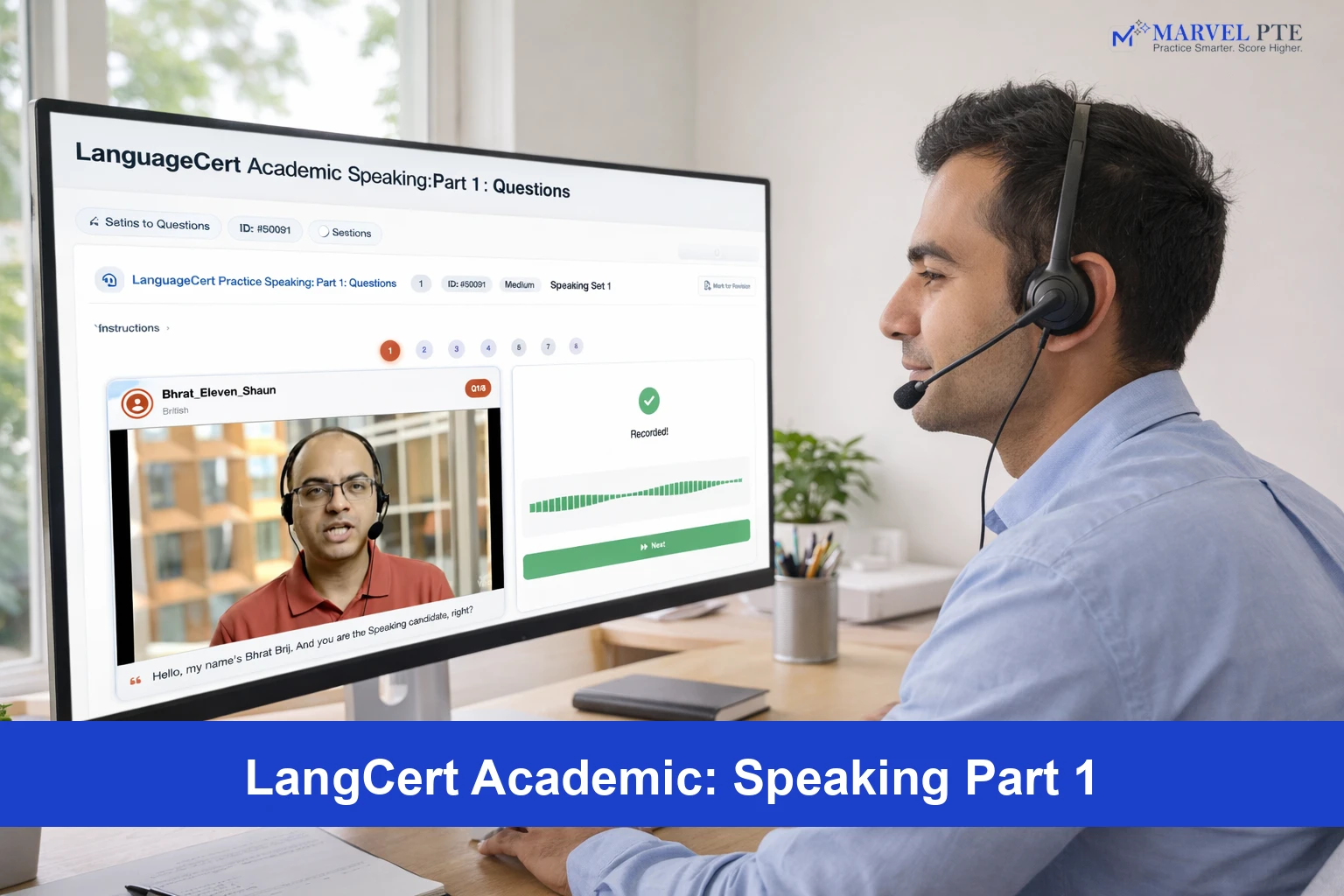
LanguageCert Academic Speaking Part 1 is the opening section of the speaking test, where the examiner asks you …
