
LanguageCert Academic
LanguageCert Academic Speaking Part 2: Role Play Task Format, Scoring, and Strategies
LanguageCert Academic Speaking Part 2 tests your ability to handle real conversations in academic settings. …

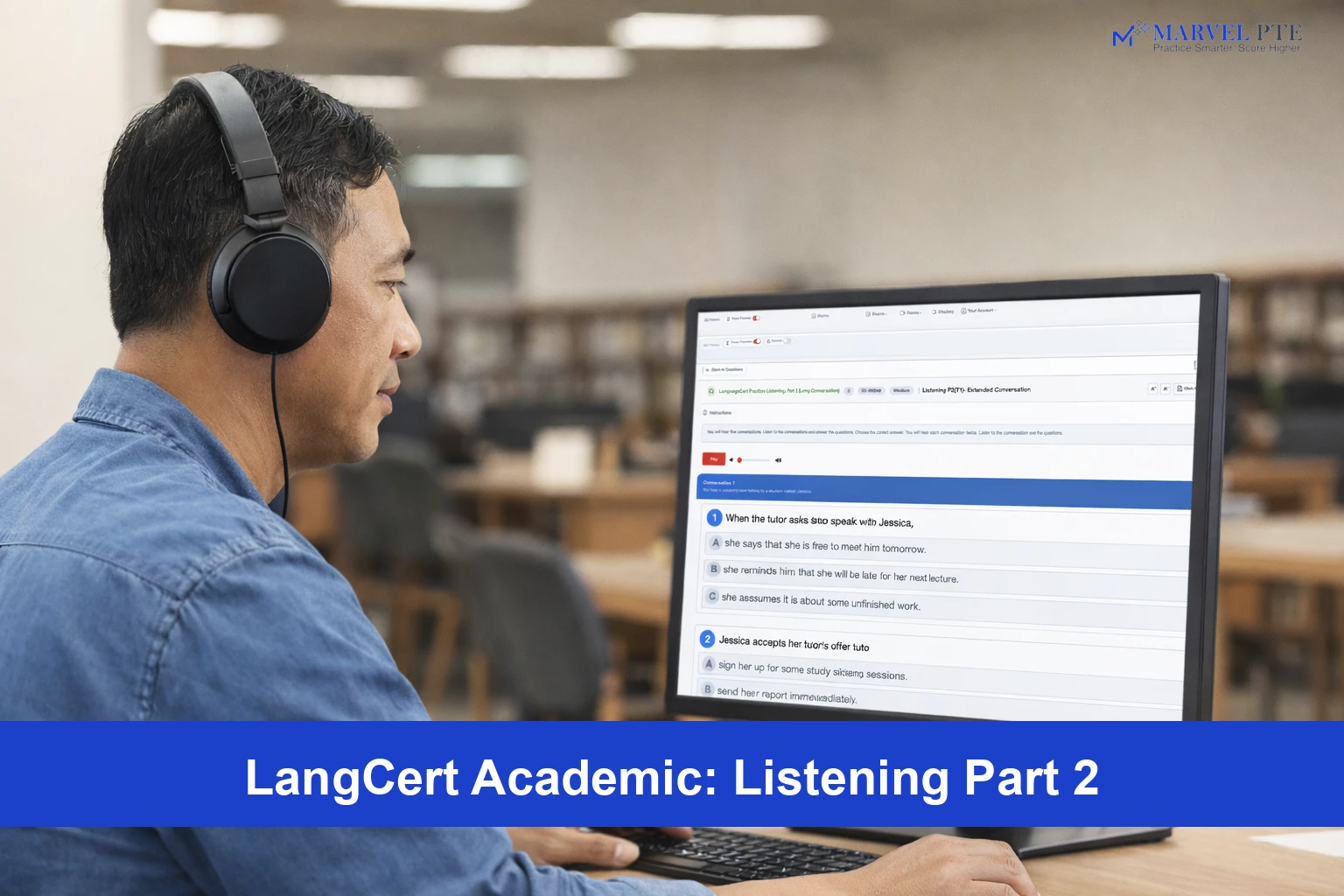
LanguageCert Academic Listening Part 2 is where the test moves from quick exchanges to sustained academic conversations. With 5 conversations and 2 questions each, this part requires you to track speaker opinions, understand outcomes, and follow the flow of discussion. The double playback gives you a significant advantage if you use it properly.
I worked with a student who kept failing Part 2 because she was hunting for exact words from the audio in the answer options. Once we shifted her focus to understanding what speakers meant rather than what they said verbatim, her accuracy improved dramatically. The questions test comprehension, not transcription.
This guide covers exactly how Part 2 works, what question types you will face, and the strategies that actually help on exam day. Whether you are taking the LanguageCert Academic exam at a test centre or via remote proctoring, the format remains identical.
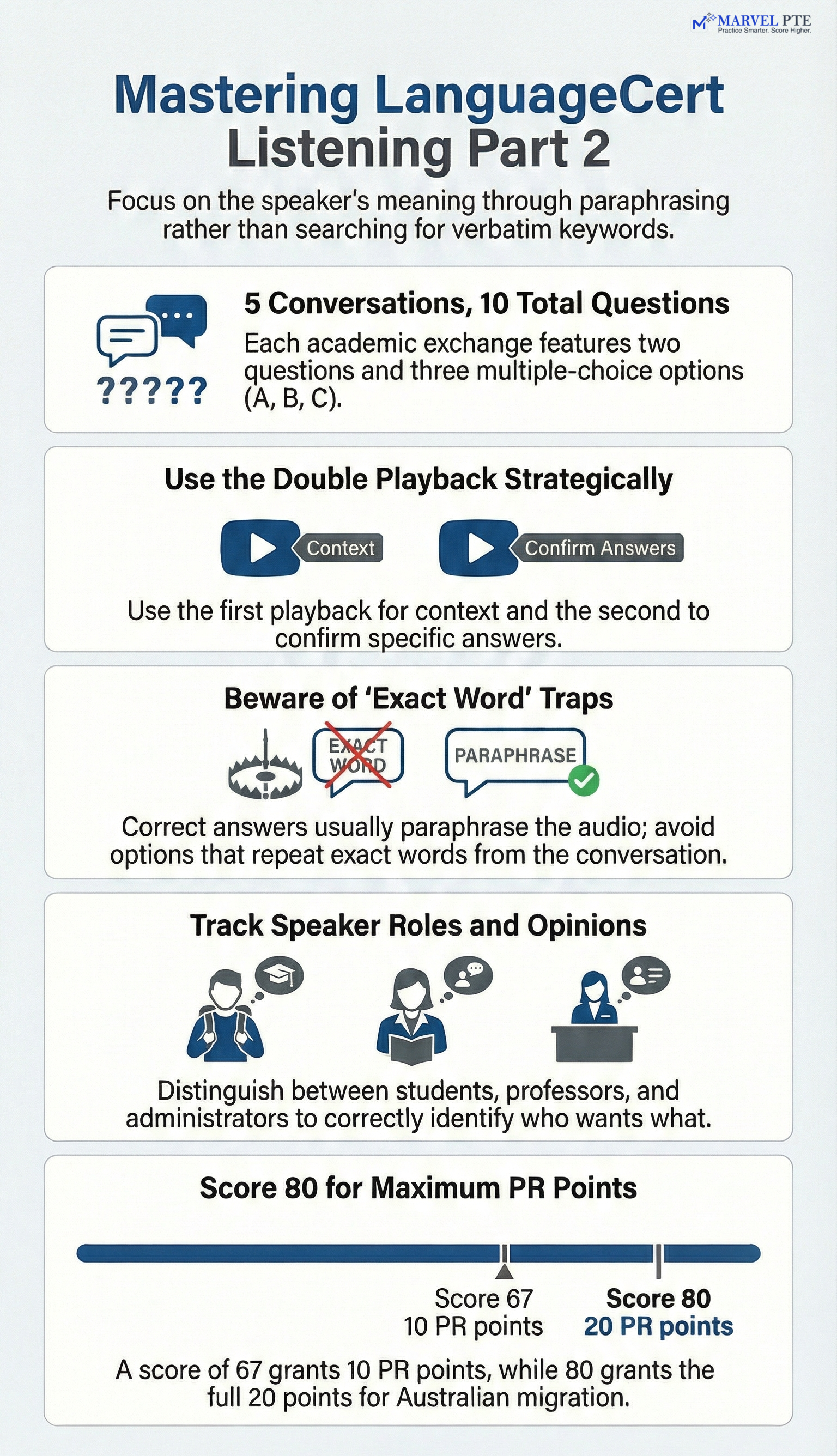
Part 2 is the second of four parts in the LanguageCert Academic Listening section. You will hear five conversations set in academic contexts, and you must answer two multiple choice questions about each conversation.
| Aspect | Details |
|---|---|
| Conversations | 5 |
| Questions per Conversation | 2 |
| Total Questions | 10 |
| Options per Question | 3 (A, B, C) |
| Audio Playback | Twice |
| Marks per Question | 1 |
The conversations simulate real academic situations. You might hear a student discussing a project deadline with a classmate, asking a professor for feedback on an essay draft, or clarifying registration details with an administrator. The language is natural and the exchanges last longer than the brief dialogues in Part 1.
Part 2 matters because it tests your ability to follow extended speech and track multiple viewpoints. These are skills you need in any English language academic environment, whether attending lectures, participating in discussions, or understanding instructions. The LanguageCert Academic test is designed to assess your English language proficiency in realistic academic contexts.
Listen to exam-style academic dialogues and test your comprehension.
Each Part 2 item follows a consistent pattern. You hear a complete conversation, then answer two questions about it. The questions appear on screen, and you select one answer from three options.
Here is the typical sequence:
The conversations usually involve two speakers with distinct roles. One might be seeking help or information, while the other provides guidance or shares an opinion. Understanding who wants what is essential for answering correctly.
| Speaker Pair | Typical Topic |
|---|---|
| Student to student | Group project, study plans, course choices |
| Student to professor | Assignment feedback, research questions, deadline extensions |
| Student to administrator | Registration, accommodation, campus services |
The audio quality is clear and the speech is at a natural pace. Unlike PTE Academic, where you hear the audio once and must capture everything immediately, the LanguageCert Academic test gives you that crucial second playback. This makes LanguageCert one of the more accessible English language tests for test takers who need extra time to process spoken information.
Take a mock listening section with real exam conditions.
Part 2 questions focus on understanding rather than recall. You will encounter several question types:
These ask what a speaker thinks or feels about something. The challenge is distinguishing between what they say and what they believe.
Example: “What does the student think about the professor’s suggestion?”
These ask about decisions, plans, or conclusions. You need to identify what speakers agree to do or what they decide by the end of the conversation.
Example: “What does the student decide to do about the deadline?”
These require you to understand what is implied rather than stated directly. Speakers might hint at preferences or concerns without saying them explicitly.
Example: “What can be inferred about the professor’s view on group work?”
These ask about the overall purpose or topic of the conversation. They test whether you understood why the speakers were talking in the first place.
Example: “What are the speakers mainly discussing?”
Important: The correct answer often paraphrases what was said. If you see an option that uses the exact words from the audio, be cautious. It might be a trap.
Scoring in Part 2 is straightforward:
| Scoring Rule | Details |
|---|---|
| Correct Answer | 1 mark |
| Wrong Answer | 0 marks |
| No Answer | 0 marks |
| Partial Credit | Not available |
| Negative Marking | None |
With 10 questions worth 1 mark each, Part 2 contributes 10 marks to your total Listening score. This is a significant portion of the 30 question Listening section.
There is no penalty for guessing. If you are stuck between two options, eliminate the least likely one and commit to your choice. Leaving questions blank never helps.
Part 2 contributes to your overall Listening score, which is reported separately from Reading, Writing, and Speaking. LanguageCert does not use integrated scoring, so your Listening performance does not affect your other section scores.
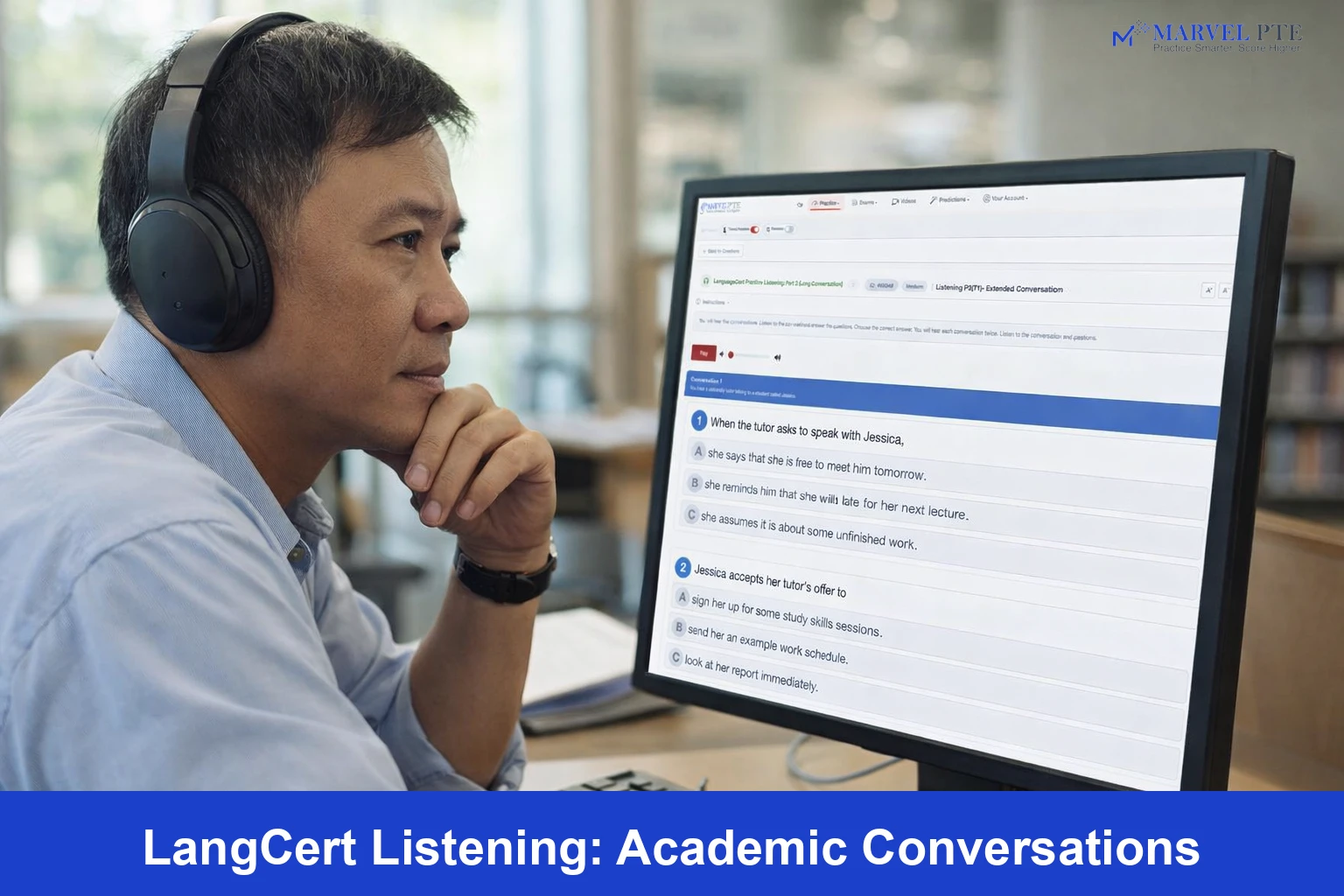
Access our full listening library with transcripts and answers.
Consider this simplified example:
Conversation: A student visits a professor during office hours. The student mentions that their group project partner has not contributed much. The professor suggests they could either speak to the partner directly or request a different partner through the course coordinator. The student says they would prefer to try talking to their partner first before involving anyone else.
Question 1: What is the student’s problem?
Question 2: What does the student decide to do?
The correct answers are B and C. Notice how the options do not repeat exact phrases from the conversation. You need to understand the meaning, not match words.
Test writers design wrong answers to be plausible. Common traps include:
Use the brief preparation time to read both questions. Note what type of question each one is. If Question 1 asks about a problem and Question 2 asks about a decision, you know to listen for the issue first and the resolution second.
Identify keywords in the questions that signal what to listen for. Words like “think,” “feel,” or “believe” indicate opinion questions. Words like “decide,” “agree,” or “plan” indicate outcome questions.
Focus on understanding the overall situation. Who is speaking? What do they want? What is the main topic? Do not try to answer both questions immediately. Let the conversation flow and absorb the context.
Note the relationship between speakers and their roles. This helps you track whose opinion or decision the question is asking about.
Now you know what to listen for. Pay attention to specific phrases that answer each question. Verify your initial impressions and fill in any gaps.
If you were uncertain after the first playback, use the second to confirm or change your answer. The double playback is your advantage. Use it.
When stuck, eliminate options that:
Pro Tip: Pay attention to how speakers respond to each other. Agreement, hesitation, or enthusiasm in their tone often reveals their true opinion.
Part 2 is embedded within the 40 minute Listening section. You do not control the pace since the audio plays automatically. However, you can manage your attention and decision making.
| Strategy | Why It Matters |
|---|---|
| Read questions during prep time | Know what to listen for |
| Use first playback for understanding | Do not rush to answer |
| Use second playback for confirmation | Verify before committing |
| Decide promptly after second play | Do not dwell on uncertainty |
The conversations are longer than Part 1 dialogues, so you need sustained attention. If you find your focus drifting, remind yourself that you will hear the audio again. This reduces pressure and helps you listen more effectively.
Do not spend excessive time on difficult questions. If you are unsure after both playbacks, make your best guess and move forward. Dwelling on one conversation will only create anxiety for the next.
Unlike PTE, LanguageCert allows you to navigate within the Listening section. You can go back to earlier questions and change your answers if needed.
Here is how navigation works:
| Action | Allowed |
|---|---|
| Return to earlier Part 2 questions | Yes |
| Return to Part 1 questions | Yes |
| Change answers within Listening | Yes |
| Return after moving to Writing | No |
A 15 minute warning appears before the Listening section ends. Once you click to proceed to Writing, you cannot go back to Listening or Reading.
Change your answer only if you have a clear reason. Random second guessing often turns correct answers into wrong ones. Trust your initial understanding unless the second playback revealed something you genuinely missed.
If you flagged a question as uncertain, return to it after completing the other conversations. Sometimes later context helps clarify earlier questions.
Students lose marks in Part 2 through predictable errors:
If an option repeats a phrase you heard verbatim, be suspicious. Test writers often use this as bait. The correct answer typically paraphrases the meaning.
Questions often ask about a specific speaker’s opinion or decision. Mixing up who said what leads to wrong answers.
Some students lock onto the first speaker’s opinion and ignore the second. Both speakers contribute to the conversation, and questions may focus on either one.
The conversations are academic but not complex. If a student says they want to extend a deadline, the answer about their goal is probably the straightforward one.
Struggling to track academic conversations? Marvel Edu provides:
| Feature | Benefit |
|---|---|
| Part 2 style conversations | Practice with realistic academic dialogues |
| Double playback audio | Matches exact exam rules |
| Speaker tracking exercises | Train your ear to follow multiple voices |
| Mistake analysis | See which question types need more work |
Our platform includes conversations covering the full range of academic scenarios: student consultations, group discussions, and administrative exchanges. Each practice item plays twice, just like the real exam, so you build the right habits.
Review mode shows not just which answers were wrong, but why. You can see whether you misidentified the speaker, missed a key detail, or fell for a keyword trap.
If you are taking LanguageCert for Australian immigration, here are the Listening scores you need:
| Level | Listening Score | PR Points |
|---|---|---|
| Competent | 57 | 0 |
| Proficient | 67 | 10 |
| Superior | 80 | 20 |
Competent level meets the minimum English language requirement but does not add points. Proficient adds 10 points, and Superior adds 20 points to your Expression of Interest. These scores measure your language proficiency across all four sections of the LanguageCert Academic exam.
The best way to prepare for Part 2 is to complete practice tests under exam conditions. Working through practice paper questions helps you recognise the patterns in academic conversations. Download official practice materials from the LanguageCert website or use platform-based practice tests that simulate the real exam format.
Focus your practice on:
Before sitting Part 2, confirm you have covered these areas:
How many questions accompany each academic conversation in Part 2?
What is a common trap used by test writers when designing incorrect answer options for Part 2?
According to the source material, what is the best strategy for using the first audio playback?
A student taking the test for Australian immigration needs a Superior score. What is the minimum mark required in Listening?
Why is it important to pay attention to the Speaker Roles in Part 2?
In the LanguageCert Academic Listening exam, which part consists of five conversations with two questions each?
Part 2.
How many total multiple-choice questions are found in Part 2 of the Listening section?
10 questions.
How many answer options are provided for each multiple-choice question in Part 2?
Three (A, B, and C).
How many times is each academic conversation played during the Part 2 listening test?
Twice.
What is the specific mark value awarded for each correct answer in Part 2?
1 mark.
What is the penalty for selecting an incorrect answer in the LanguageCert Listening section?
There is no penalty (zero marks are awarded).
In what specific context are the conversations in Part 2 set?
Academic contexts.
Which primary skill is being tested by the extended exchanges in Part 2?
The ability to follow extended speech and track multiple viewpoints.
Which question type focuses on what a speaker believes or feels rather than their literal statement?
Opinion questions.
What do Outcome Questions specifically ask the test-taker to identify?
Decisions, plans, or conclusions agreed upon by the speakers.
Watch expert strategies for following multi-speaker conversations.

LanguageCert Academic Speaking Part 2 tests your ability to handle real conversations in academic settings. …
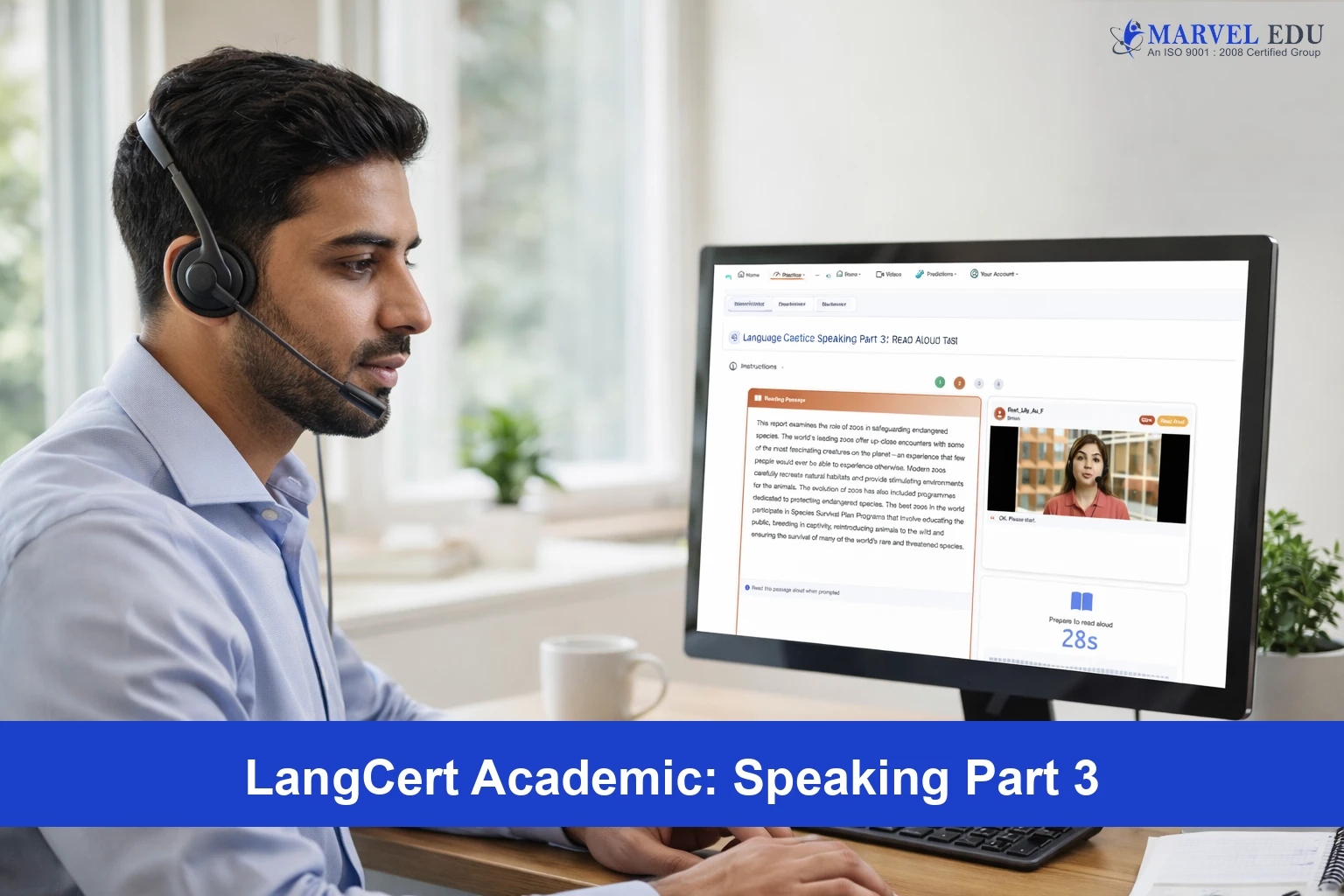
LanguageCert Academic Speaking Part 3 tests two skills in one task: reading aloud and expressing an opinion. …

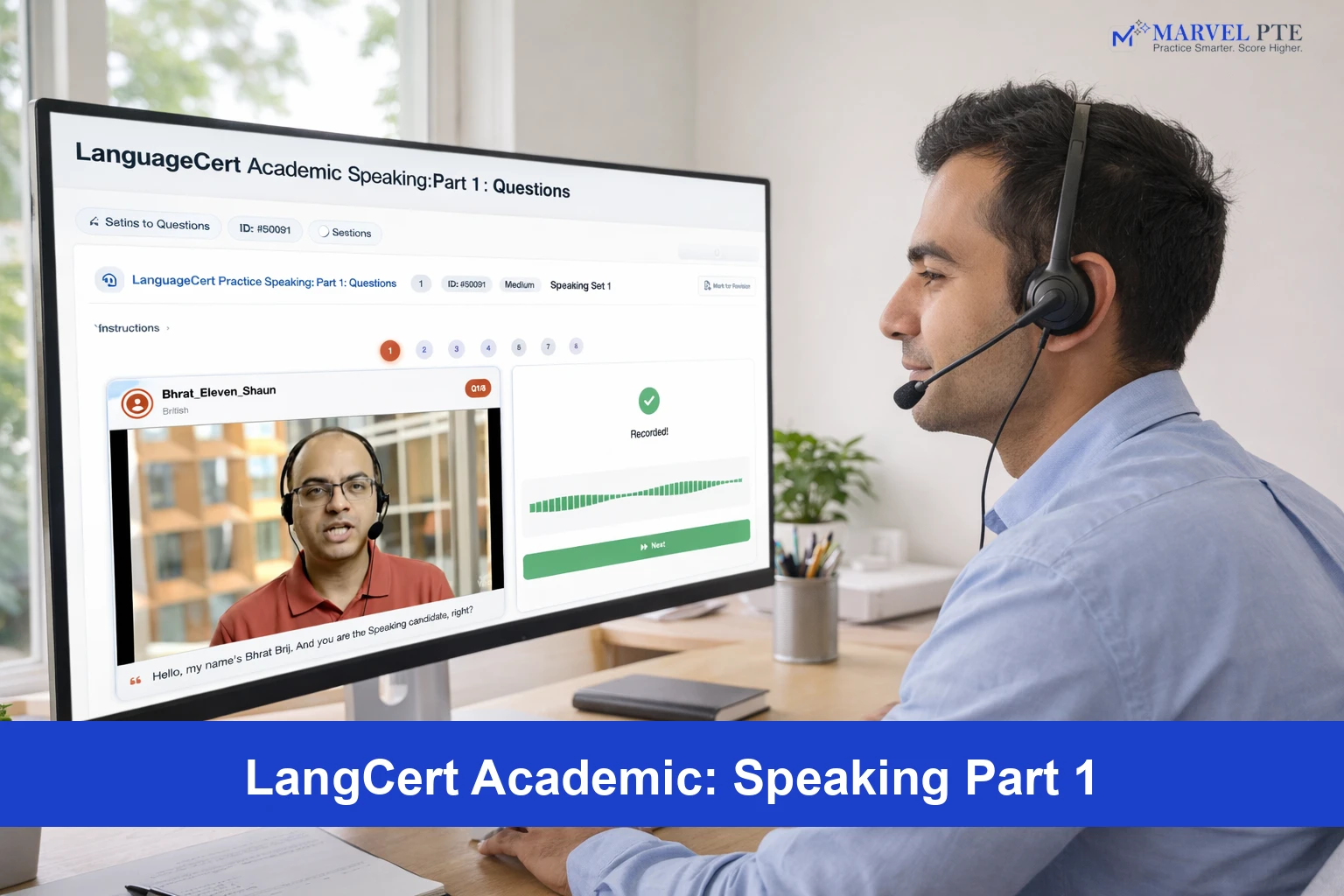
LanguageCert Academic Speaking Part 1 is the opening section of the speaking test, where the examiner asks you …
