New
  • **AI Mock Test Analyzer** just launched — deeper skills breakdown now live. Try it now

  • Live Webinar Friday: Crack PTE Speaking (limited seats). Register

  • October coaching enrollment window opens soon — early spots fill fast. View coaching

Marvel Edu logo Marvel Edu logo
  • PTE
    Overview
    • About Exam
    • Fees & Registration
    Structure
    • Exam Pattern
    • Result & Score
    Student Resources
    • Read Aloud
    • Repeat Sentence
    • Describe Image
    • Retell Lecture
    • Answer Short Question
    • Summarize Group Discussion
    • Respond to A Situation
    All Speaking Guides →
    • Summarize Written Text
    • Write Essay
    All Writing Guides →
    • Fill in the Blanks (Dropdown)
    • Multiple Choice, Multiple Answers
    • Re-order Paragraphs
    • Fill in The Blanks (Drag & Drop)
    • Multiple Choice, Single Answer
    All Reading Guides →
    • Summarize Spoken Text
    • Multiple Choice, Multiple Answers
    • Fill in the Blanks (Type In)
    • Highlight Correct Summary
    • Multiple Choice, Single Answer
    • Select Missing Word
    • Highlight Incorrect Words
    • Write From Dictation
    All Listening Guides →
    AI Practice Software Real exam interface • AI scoring • Instant feedback
    Explore Features
    Overview
    • About Exam
    • Fees & Registration
    Structure
    • Exam Pattern
    • Result & Score
    Student Resources
    • Read Aloud
    • Repeat Sentence
    • Describe Image
    • Respond to A Situation
    • Answer Short Question
    All Speaking Guides →
    • Summarize Written Text
    • Write Email
    All Writing Guides →
    • Reading and Writing Fill in the Blanks
    • Multiple Choice, Multiple Answers
    • Re-order Paragraphs
    • Reading Fill in the Blanks
    • Multiple Choice, Single Answer
    All Reading Guides →
    • Summarize Spoken Text
    • Multiple Choice, Multiple Answers
    • Listening Fill in Blanks
    • Multiple Choice, Single Answer
    • Select Missing Word
    • Highlight Incorrect Words
    • Write from Dictation
    All Listening Guides →
    AI Practice Software CLB scoring • Canada PR ready • Real exam feel
    Explore Features
  • LanguageCert
    Why LanguageCert?
    vs PTE Academic
    • Listening plays twice
    • Review questions anytime
    • No integrated scoring
    • Templates work effectively
    Full Comparison
    Overview
    • About Exam
    • Fees & Registration
    Structure
    • Exam Pattern
    • Result & Score
    Student Resources
    • Part 1: Questions
    • Part 2: Role Play
    • Part 3: Read Aloud
    • Part 4: Presentation
    All Speaking Guides →
    • Part 1: Report on Visual
    • Part 2: Essay
    All Writing Guides →
    • Part 1A: Word Replace
    • Part 1B: Gap Fill
    • Part 2: Sentence Matching
    • Part 3: Multi-Text Attribution
    • Part 4: Long Text MCQ
    All Reading Guides →
    • Part 1: Short Dialogues
    • Part 2: Long Conversation
    • Part 3: Monologue
    • Part 4: Extended Listening
    All Listening Guides →
    AI Practice Software Interlocutor prep • Live interview simulation • AI feedback
    Explore Features
  • Pricing
  • Coaching
    🇦🇺Australia
    • Parramatta One-to-One PTE coaching in Parramatta, Sydney
    • Narellan Expert PTE coaching in Narellan, Campbelltown area
    • Online Australia One-to-One & Group classes from anywhere in Australia
    🇮🇳India
    • Zirakpur PTE coaching classes in Zirakpur, Chandigarh
    🇦🇺Australia
    • Parramatta LanguageCert coaching in Parramatta, Sydney
    • Narellan LanguageCert coaching in Narellan area
    • Online Australia Online LanguageCert classes across Australia
    🇮🇳India
    • Zirakpur LanguageCert coaching in Zirakpur, Chandigarh
  • Support
    Resources
    • Helpdesk FAQs, guides & tutorials for MarvelPTE platform
    • Blog Insider tips, tricks, exam hacks & guides
    Company
    • About Learn how MarvelPTE helps improve English proficiency education
    Contact
    • Contact Us Reach out for assistance, inquiries, or to provide feedback
  • Institute Software
Log In Signup

Menu

  • Pricing
  • Institute Software
Log In Signup
Overview
  • About Exam
  • Fees & Registration
Structure
  • Exam Pattern
  • Result & Score
Student Resources
Why LanguageCert?
vs PTE Academic
  • Listening plays twice
  • Review questions anytime
  • No integrated scoring
  • Templates work effectively
Full Comparison
Overview
  • About Exam
  • Fees & Registration
Structure
  • Exam Pattern
  • Result & Score
Student Resources
  • Mock Tests
  • All Blog Posts
Overview
  • About Exam
  • Fees & Registration
Structure
  • Exam Pattern
  • Result & Score
Student Resources
  • Mock Tests
  • All Blog Posts
  • Read Aloud
  • Repeat Sentence
  • Describe Image
  • Retell Lecture
  • Answer Short Question
  • Summarize Group Discussion
  • Respond to A Situation
  • Summarize Written Text
  • Write Essay
  • Fill in the Blanks (Dropdown)
  • Multiple Choice, Multiple Answers
  • Re-order Paragraphs
  • Fill in The Blanks (Drag & Drop)
  • Multiple Choice, Single Answer
  • Summarize Spoken Text
  • Multiple Choice, Multiple Answers
  • Fill in the Blanks (Type In)
  • Highlight Correct Summary
  • Multiple Choice, Single Answer
  • Select Missing Word
  • Highlight Incorrect Words
  • Write From Dictation
  • Read Aloud
  • Repeat Sentence
  • Describe Image
  • Respond to A Situation
  • Answer Short Question
  • Summarize Written Text
  • Write Email
  • Reading and Writing Fill in the Blanks
  • Multiple Choice, Multiple Answers
  • Re-order Paragraphs
  • Reading Fill in the Blanks
  • Multiple Choice, Single Answer
  • Summarize Spoken Text
  • Multiple Choice, Multiple Answers
  • Listening Fill in Blanks
  • Multiple Choice, Single Answer
  • Select Missing Word
  • Highlight Incorrect Words
  • Write from Dictation
  • Part 1: Questions
  • Part 2: Role Play
  • Part 3: Read Aloud
  • Part 4: Presentation
  • Part 1: Report on Visual
  • Part 2: Essay
  • Part 1A: Word Replace
  • Part 1B: Gap Fill
  • Part 2: Sentence Matching
  • Part 3: Multi-Text Attribution
  • Part 4: Long Text MCQ
  • Part 1: Short Dialogues
  • Part 2: Long Conversation
  • Part 3: Monologue
  • Part 4: Extended Listening
  • PTE Coaching
  • LanguageCert Coaching
Resources
  • Helpdesk FAQs, guides & tutorials for MarvelPTE platform
  • Blog Insider tips, tricks, exam hacks & guides
Company
  • About Learn how MarvelPTE helps improve English proficiency education
Contact
  • Contact Us Reach out for assistance, inquiries, or to provide feedback
LanguageCert Academic Listening

LanguageCert Academic Listening Part 3: Note Completion Strategies and Scoring Guide

26 January, 2026 15 Min ReadBy Ashok
Summarise with AI ChatGPT Grok Perplexity
blog-post
Listening Guide
  • Overview
  • Part 1
  • Part 2
  • Part 3
  • Part 4
On this page DEBUG
  • What Is LanguageCert Academic Listening Part 3?
  • Question Format and Task Description
    • Why Prediction Matters
  • Scoring Rules for Listening Part 3
  • Sample Question and Explanation
    • Acceptable vs Unacceptable Answers
  • Core Skills Tested in Part 3
  • How It All Connects
  • Proven Strategies for High Scores
    • Before the Audio Plays
    • During the First Playback
    • During the Second Playback
  • Common Traps and How to Avoid Them
    • Writing More Than 3 Words
    • Copying Unnecessary Articles
    • Missing Plural Forms
    • Spelling Academic Terms Incorrectly
  • Time Management Tips
  • Can You Revisit or Change Answers?
    • Strategy for Answer Review
  • How Part 3 Differs from PTE Listening
    • Why PTE Habits Can Hurt You
    • Adjustments for PTE Students
  • How Marvel Edu Helps with Part 3 Preparation
  • Final Checklist Before the Exam
  • Score Requirements for Australian PR
  • Key Takeaway
  • Quick Reference
  • Test Your Knowledge
  • Quick Review

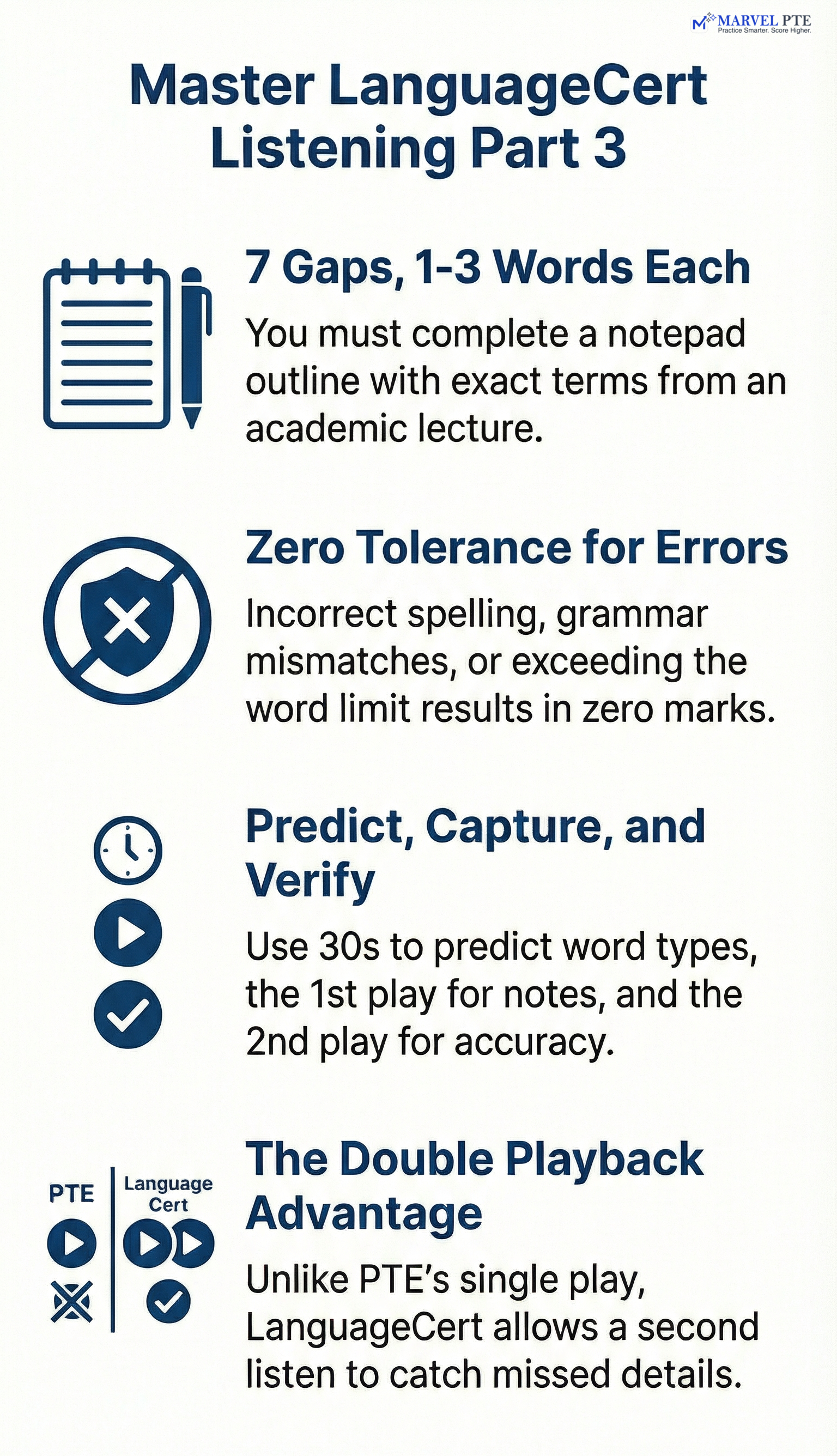
LanguageCert Academic Listening Part 3 tests your ability to follow an academic lecture and complete notes with precise written answers. With 7 gaps to fill and a strict 1 to 3 word limit per answer, this part rewards careful listening and accurate spelling. The good news? The audio plays twice, giving you a genuine second chance to catch details you missed.

I once worked with a student who had strong listening comprehension but kept losing marks in Part 3. Her problem? She wrote full sentences instead of short phrases, exceeding the word limit on nearly every answer. Once she trained herself to write concise notes, her scores improved dramatically. Part 3 is not about how much you understand. It is about how precisely you can capture key information.

This guide covers exactly how Part 3 works, the scoring rules you need to know, proven strategies for gap-fill questions, and how this differs from PTE Listening. Whether you are preparing for Australian immigration or university admission, mastering Part 3 is essential for a strong Listening score.

What Is LanguageCert Academic Listening Part 3?

Part 3 is the third of four parts in the LanguageCert Academic Listening section. You will hear an academic lecture or presentation on a topic such as science, history, or business. Your task is to complete a notepad by filling in 7 gaps with the correct information from the audio.

AspectDetails
Question Count7 gaps (questions 18 to 24)
Audio TypeAcademic lecture or presentation
Answer Type1 to 3 words per gap
Preparation Time30 seconds before audio starts
Audio PlaybackTwice
Marks per Question1

Unlike Parts 1 and 2 which use multiple choice, Part 3 requires you to type your answers. This means spelling accuracy matters. You must listen carefully, identify the relevant information, and write it down correctly within the word limit.

The notepad layout follows the structure of the lecture. Gaps appear in the same order as the information is presented in the audio. There are no tricks where answer 24 appears before answer 18 in the recording.

Try a Sample Lecture

Listen to exam-style academic audio and practise note completion.

Try Free

Question Format and Task Description

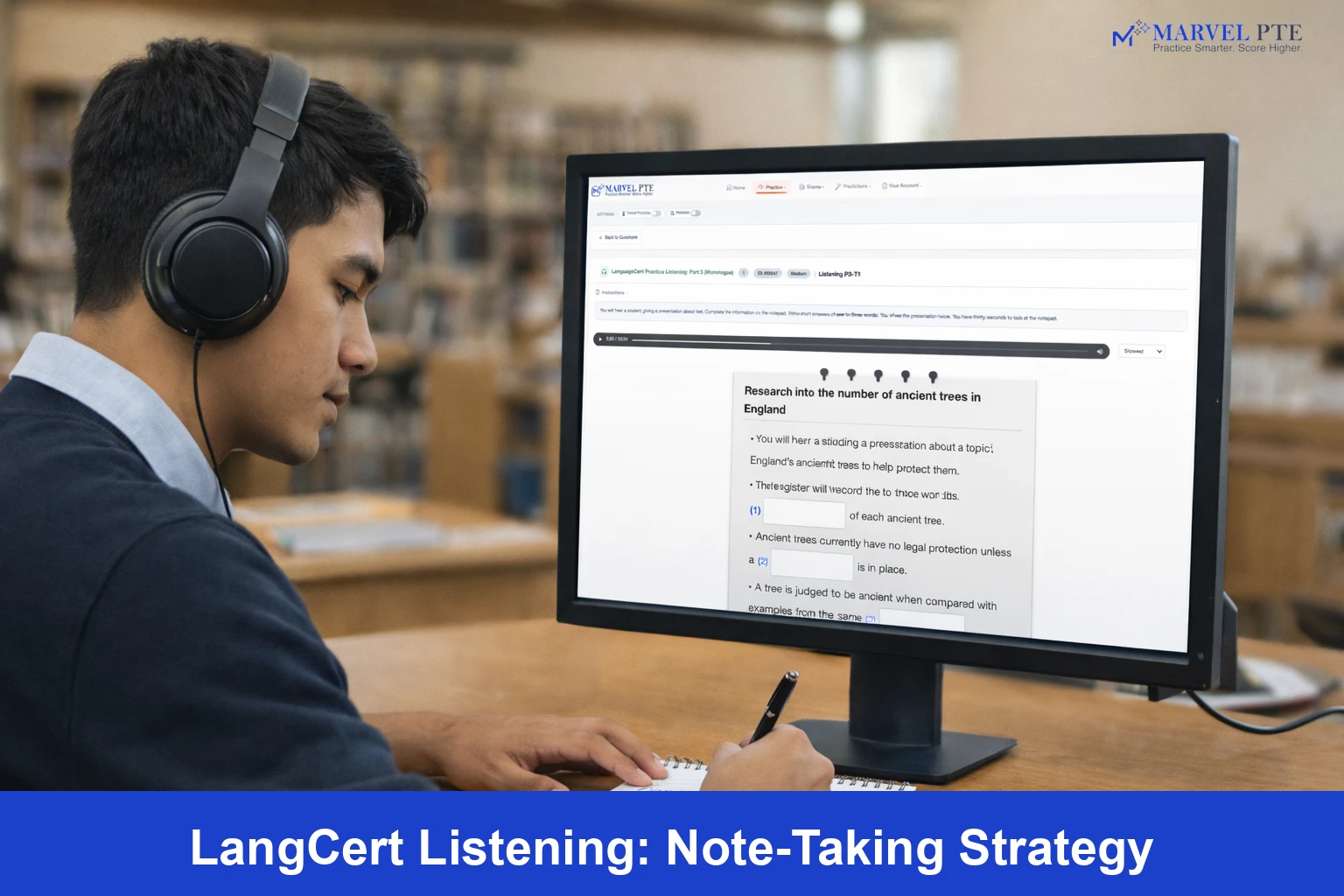
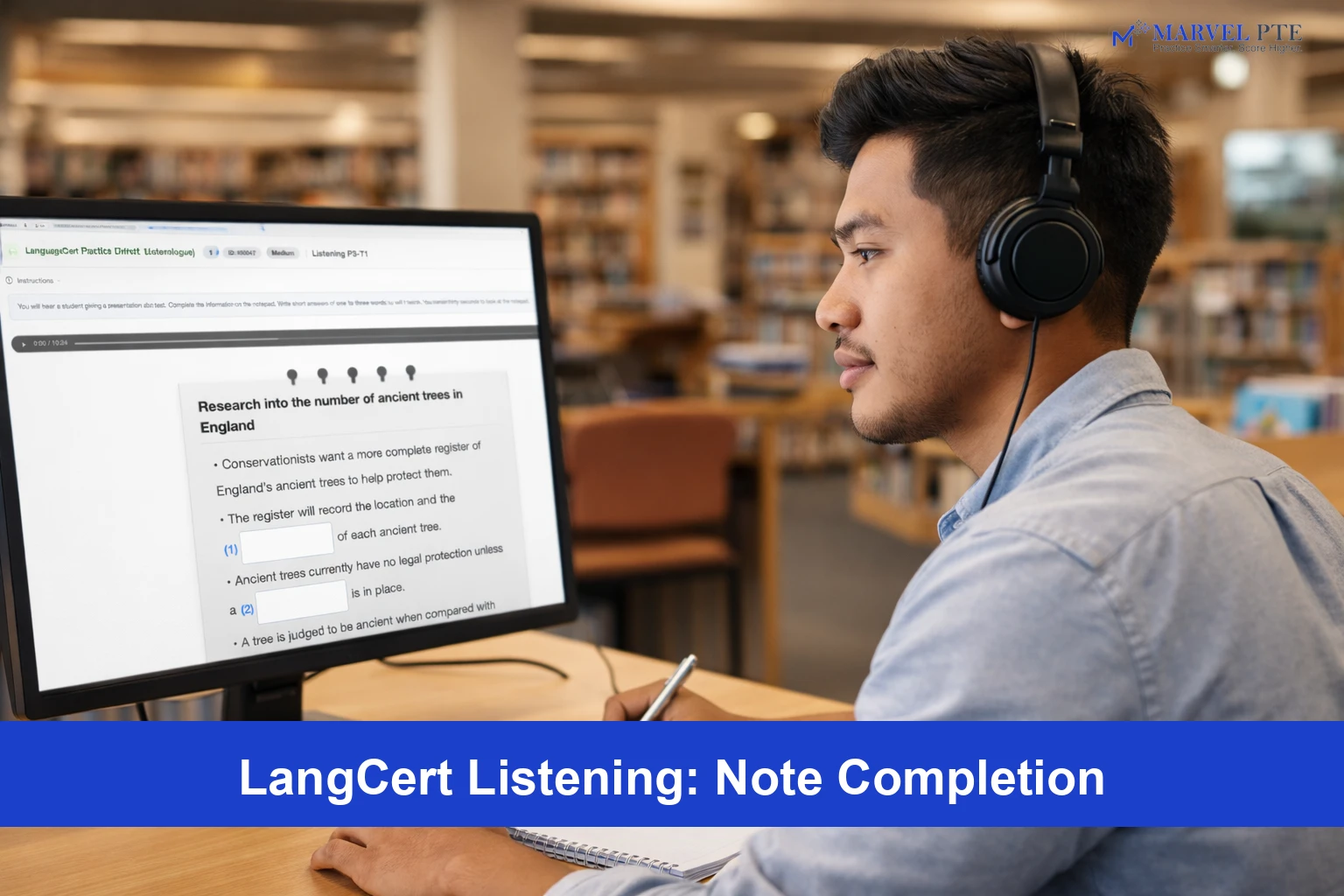
When Part 3 begins, you see a notepad on screen with the lecture title and a structured outline containing 7 gaps. Each gap represents a missing piece of information from the lecture.

The official instruction reads: “You will hear a presentation about [topic]. Complete the information on the notepad. Write short answers of one to three words. You will hear the presentation twice. You have thirty seconds to look at the notepad.”

Here is how the task unfolds:

  • You have 30 seconds to read the notepad and predict what information is missing
  • The audio plays for the first time
  • You have time to write and review your answers
  • The audio plays a second time
  • You finalise your answers before moving to Part 4

The key skill being tested is your ability to identify and accurately record specific academic content. You need to filter out filler words, examples, and tangential comments to focus on the exact terms that complete each gap.

Why Prediction Matters

Use your 30 second preparation time wisely. Read each gap and predict what type of word is missing. Is it a noun? A number? An adjective? Looking at the surrounding words gives you clues about what to listen for.

For example, if the gap reads “Solar energy is most effective in regions with high levels of ______”, you know you need a noun describing what solar panels need. When the audio mentions “sunlight” or “solar radiation”, you are ready to capture it.

Test Your Note-Taking

Take a mock Part 3 section under real exam conditions.

Start Test

Scoring Rules for Listening Part 3

Scoring in Part 3 is strict but fair:

Scoring RuleDetails
Correct Answer1 mark
Wrong Answer0 marks
Spelling Error0 marks
Exceeds Word Limit0 marks
Grammar Mismatch0 marks
No Answer0 marks

There is no partial credit. An answer is either completely correct or it scores zero. This means:

  • “Sunlight” earns a mark if that is the correct answer
  • “Sun light” (two words instead of one) might be marked wrong depending on accepted spellings
  • “The sunlight” uses 2 words when 1 would suffice, which might put you over limit for longer answers
  • “Sunliht” (spelling error) earns zero marks

Part 3 contributes to your overall Listening score, which is reported separately from Reading, Writing, and Speaking. LanguageCert uses standalone scoring, so your Listening performance does not affect your other skill scores.

Reality Check: Good listening with poor spelling still loses marks. This part rewards precision. If you struggle with academic vocabulary spelling, build a study list of common lecture terms.

Sample Question and Explanation

Consider this simplified example from a lecture on renewable energy:

Notepad gap: “Solar panels convert sunlight into ______ using photovoltaic cells.”

Audio excerpt: “The technology behind solar panels is fascinating. These devices convert sunlight into electricity using what we call photovoltaic cells. The process involves semiconductors that absorb photons from the sun…”

The correct answer is “electricity”. Note that:

  • The answer appears directly in the audio
  • It fits grammatically into the sentence
  • It is exactly 1 word, well within the 3 word limit
  • The spelling must be exact

Acceptable vs Unacceptable Answers

Sometimes synonyms are accepted, but only if they fit the meaning and grammar exactly. Here is how different answers would be judged:

AnswerResultReason
electricityCorrectMatches audio and grammar
electrical energyCorrectSynonym that fits context (2 words)
powerPossibly correctDepends on examiner acceptance
electric powerPossibly correctSynonym (2 words)
the electricityRiskyUnnecessary article uses extra word

When in doubt, write exactly what you hear. The audio uses specific terms for a reason, and those terms are what the examiners expect.

Practice All Lectures

Access our full Part 3 question bank with transcripts and answers.

See Questions

Core Skills Tested in Part 3

Part 3 evaluates several interconnected listening abilities:

Identifying key academic terms: You must recognise when the speaker states important vocabulary that completes a gap, even when surrounded by explanatory content.

Listening for definitions and explanations: Lecturers often define terms before using them. Recognising this pattern helps you anticipate answers.

Filtering out filler words: Academic speakers use phrases like “as I mentioned earlier”, “you might be wondering”, and “let me give you an example”. These do not contain answer material.

Writing while listening without losing focus: You need to note answers quickly enough that you do not miss the next piece of information.

How It All Connects

LanguageCert Academic Listening Part 3
Click the colored dots to expand/collapse branches

Proven Strategies for High Scores

Before the Audio Plays

Use your 30 seconds of preparation time effectively:

  1. Read all gaps quickly to understand the lecture structure
  2. Predict word types for each gap (noun, number, adjective, verb)
  3. Underline keywords around each gap that will help you locate the answer in the audio
  4. Note any obvious academic terminology that might appear

Do not spend too long predicting specific vocabulary. Your goal is to be ready to recognise the right information, not to guess it in advance.

During the First Playback

The first playback is for understanding the overall structure:

  • Focus on how the lecture is organised
  • Write short, rough notes next to each gap
  • Do not panic if you miss one answer
  • Keep following the lecture rather than dwelling on what you missed

Many students try to write perfect answers during the first playback. This approach usually backfires. While you are perfecting one answer, the lecture moves on and you miss the next three.

During the Second Playback

Now you know the lecture structure. Use the second playback to:

  • Confirm or correct your answers from the first playback
  • Fill in any gaps you missed
  • Check that your answers fit the word limit
  • Verify spelling of technical terms

The second playback is your recovery opportunity. Answers you missed the first time are often easy to catch the second time because you know exactly when to listen for them.

Blunt Truth: Candidates who try to write perfect answers in the first playback usually miss later gaps. Use the first play for understanding and the second for precision.

LanguageCert Listening Part 3 note-taking strategy

Common Traps and How to Avoid Them

Part 3 has several pitfalls that cost students marks:

Writing More Than 3 Words

This is an automatic zero for that question. Even if your 4 word answer contains the correct information, it will not score. Before submitting, count the words in each answer.

Copying Unnecessary Articles

Adding “a”, “an”, or “the” when they are not needed wastes words. If the sentence already has an article before the gap, do not add another one in your answer.

Missing Plural Forms

If the lecture says “experiments” and you write “experiment”, you lose the mark. Listen carefully for plural endings, which can be subtle in connected speech.

Spelling Academic Terms Incorrectly

Technical vocabulary has specific spellings. “Photosynthesis” cannot be written as “fotosynthesis”. Build a spelling list of common academic terms before your exam.

Fix: Always read the sentence around the gap after writing your answer. Does it make grammatical sense? Does it fit the context? If something feels wrong, it probably is.

Time Management Tips

Part 3 requires careful time allocation across the two playbacks and answer review:

PhaseTimePriority
Preparation30 secondsRead all gaps, predict word types
First Playback~5 minutesUnderstand structure, write rough answers
Between PlaybacksBrief pauseQuick review of what you captured
Second Playback~5 minutesConfirm and correct answers
Final Review20 to 30 secondsCheck spelling and word limits

Do not spend too long predicting vocabulary during preparation. Your 30 seconds should be spent reading the notepad structure, not trying to guess what the lecturer will say.

If you are unsure about an answer after the first playback, leave it blank and note the gap number. The second playback is specifically designed to help you catch what you missed.

Important: You cannot return to Listening after moving to Writing, so finalise your answers carefully before proceeding.

Can You Revisit or Change Answers?

Yes, within the Listening section you can go back and change your answers. This is a significant advantage over PTE, where once you move to the next question, you cannot return.

You can edit answers:

  • During the pause between playbacks
  • After the second playback
  • Anytime before clicking to proceed to Part 4 or Writing

Once you move to the Writing section, Listening and Reading are locked. A 15 minute warning appears to remind you to review any flagged answers.

Strategy for Answer Review

Use any remaining time after the second playback to re-read all your completed notes once. Check for:

  • Spelling errors in academic terms
  • Missing plural forms
  • Answers that exceed the word limit
  • Gaps you accidentally left blank

How Part 3 Differs from PTE Listening

If you have prepared for PTE, you need to adjust your approach for LanguageCert. The differences affect your strategy significantly:

FeatureLanguageCert Part 3PTE Fill in the Blanks
Audio PlaybackTwiceOnce only
Word Limit1 to 3 wordsVaries by question
Answer ReviewCan go back within sectionCannot go back
Negative MarkingNoneNone
Integrated ScoringNoYes (contributes to other skills)
FocusAccuracy with second chanceMemory under pressure

Why PTE Habits Can Hurt You

PTE trains you to capture everything on the first and only playback. This creates a habit of frantic note-taking and immediate answer commitment. In LanguageCert, this urgency is unnecessary and often counterproductive.

Students transferring from PTE often:

  • Make rushed decisions on the first playback
  • Ignore the strategic value of the second playback
  • Feel unnecessary pressure that affects concentration

Adjustments for PTE Students

  • Slow down on the first playback
  • Focus on understanding the lecture structure, not capturing every word
  • Use the second playback to verify and correct
  • Trust that you will hear the information twice

The double playback is your advantage. Do not waste it by treating the first play like it is your only chance.

How Marvel Edu Helps with Part 3 Preparation

Preparing for note completion requires specific practice. Marvel Edu provides:

FeatureBenefit
Real exam-style lecture simulationsPractice with authentic academic presentations
Double playback functionalityMatches exact exam rules
Built-in spelling and word limit checksImmediate feedback on common errors
Progress tracking for gap-fill accuracyIdentify patterns in your mistakes
Academic vocabulary builderImprove spelling of technical terms

Our platform replicates the actual test experience. You hear each audio twice, face the same time pressure, and receive detailed analysis of your answer patterns. The AI feedback shows you exactly why answers are marked correct or incorrect, helping you understand the precision required for Part 3.

Final Checklist Before the Exam

Before test day, confirm you can answer yes to these questions:

  • Do you use your 30 seconds to read all gaps and predict word types?
  • Do you focus on structure during the first playback rather than perfect answers?
  • Do you use the second playback to confirm and correct?
  • Can you write answers within the 1 to 3 word limit?
  • Have you practised spelling common academic vocabulary?
  • Do you check grammar fit after writing each answer?

Score Requirements for Australian PR

If you are taking LanguageCert for Australian immigration, here are the Listening scores you need:

LevelListening ScorePR Points
Competent570
Proficient6710
Superior8020

Competent level meets the minimum English requirement but does not add points. Proficient adds 10 points, and Superior adds 20 points to your Expression of Interest.

Key Takeaway

Listening Part 3 is not about fast writing. It is about structured listening, smart note-taking, and clean answers. The double playback gives you room to understand first and confirm second. The strict word limit and spelling requirements mean precision matters more than volume.

With the right strategy and targeted practice using Marvel Edu, this section becomes one of the easiest places to score consistently. Focus on accuracy, trust the double playback, and verify your spelling before moving on.

Quick Reference

LanguageCert Listening Part 3 infographic

Test Your Knowledge

Quick Quiz
1 / 5

What is the maximum number of words allowed for each answer in LanguageCert Academic Listening Part 3?

Which of the following will result in a score of zero for a question in Part 3?

What is the recommended use of the 30-second preparation time?

How does LanguageCert Listening Part 3 differ from PTE Academic Listening Fill in the Blanks?

What should a candidate focus on during the first playback of the audio?

Quiz Complete!

You scored 0 out of 5

Quick Review

Practice Cards
1 / 10
Press Space to flip, ← → to navigate
Question

What specific ability does LanguageCert Academic Listening Part 3 test?

Answer

The ability to follow an academic lecture and complete notes with precise written answers.

Question

How many gaps are included in LanguageCert Academic Listening Part 3?

Answer

7 gaps.

Question

What is the word limit for each gap in LanguageCert Listening Part 3?

Answer

1 to 3 words.

Question

How many times is the audio played in LanguageCert Listening Part 3?

Answer

Twice.

Question

Which question numbers in the Listening section comprise Part 3?

Answer

Questions 18 to 24.

Question

What are the common academic topics used for the lecture in Part 3?

Answer

Science, history, or business.

Question

How much preparation time is given before the Part 3 audio starts?

Answer

30 seconds.

Question

What is the mark value for each correct answer in Part 3?

Answer

1 mark.

Question

How does the notepad layout in Part 3 relate to the audio recording?

Answer

It follows the structure and order of information presented in the audio.

Question

What is the consequence of a spelling error in LanguageCert Listening Part 3?

Answer

The answer scores 0 marks.

Cards studied: 0 / 10

Frequently Asked Questions

Part 3 contains 7 gap-fill questions. You listen to an academic lecture or presentation and complete notes by typing 1 to 3 words in each gap.

The audio plays twice. You have 30 seconds to read through the notepad before the lecture begins. Use the first playback for understanding structure and the second to confirm your answers.

Each answer must be 1 to 3 words. Writing more than 3 words results in zero marks for that question, even if your answer contains the correct information.

Yes, spelling must be accurate. Good listening with poor spelling still loses marks. If you spell a word incorrectly, you receive zero marks for that gap.

Yes, you can review and change your answers within the Listening section. However, once you move to the Writing section, you cannot return to Listening or Reading.

For Competent English: 57. For Proficient (10 points): 67. For Superior (20 points): 80.

Improve Your Spelling

Watch expert strategies for accurate academic vocabulary.

See Course
Overview
Part 1
Part 2
Part 3
5 Part 4
  • Overview: All Listening Parts
  • Part 1: Short Dialogues 7Q · 7 marks
  • Part 2: Long Conversation 10Q · 10 marks
  • Part 3: Monologue 7Q · 7 marks
  • Part 4: Extended Listening 6Q · 6 marks
30 questions 40 minutes
Previous Part 2
Next Part 4
author image

Ashok

Ashok is a PTE expert at Marvel Edu, specializing in helping students develop effective strategies for achieving their target scores. With extensive experience in PTE coaching, he provides valuable insights and guidance to test takers preparing for their exams.

View all posts by Ashok

Related posts

Show more
blog-post
LanguageCert Academic
Speaking

LanguageCert Academic Speaking Part 2: Role Play Task Format, Scoring, and Strategies

LanguageCert Academic Speaking Part 2 tests your ability to handle real conversations in academic settings. …

author image

by Reet

Jan 28, 2026
blog-post
LanguageCert Academic
Speaking

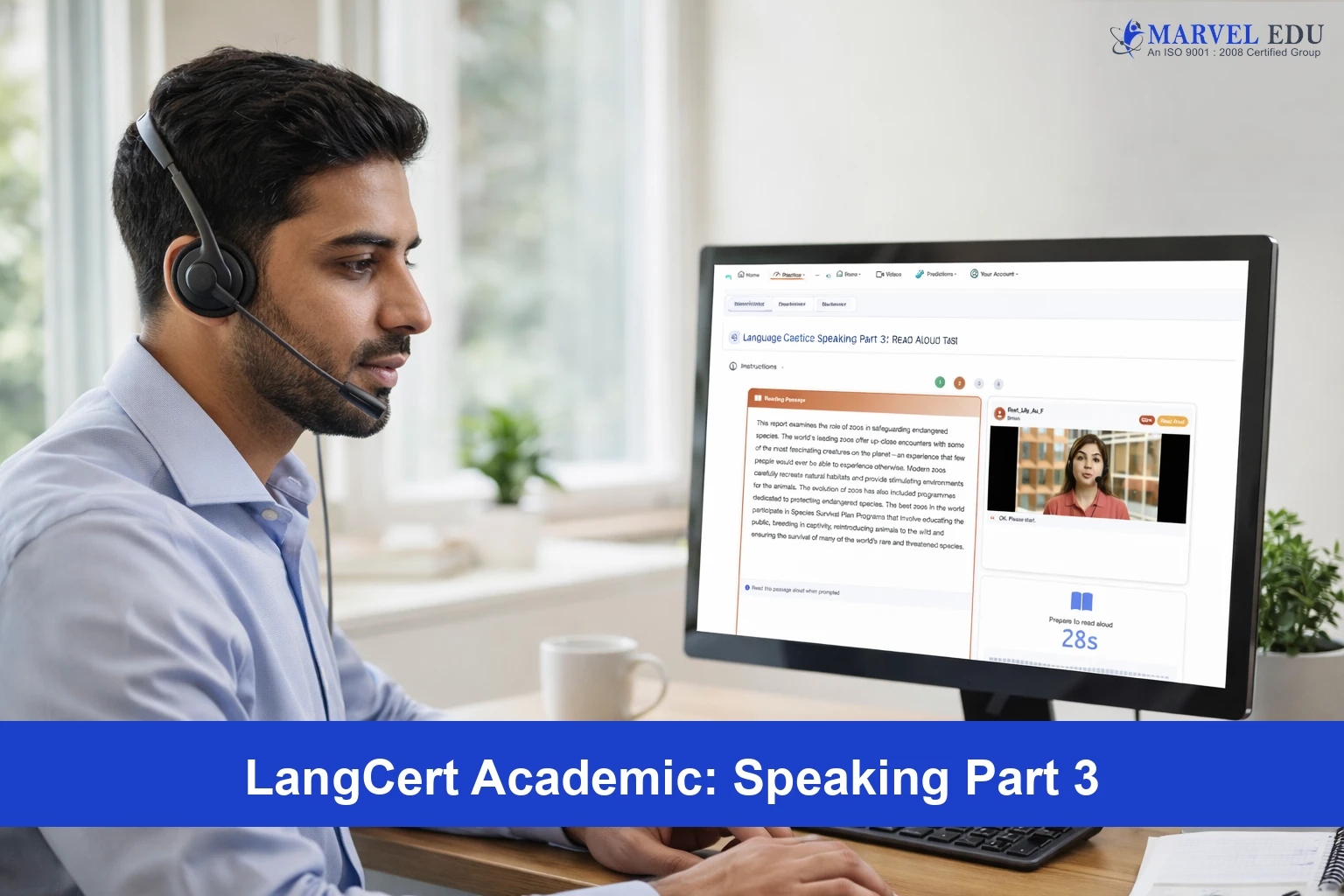
LanguageCert Academic Speaking Part 3: Read Aloud and Opinion Task Guide

LanguageCert Academic Speaking Part 3 tests two skills in one task: reading aloud and expressing an opinion. …

author image

by Vanita Handa

Jan 28, 2026
blog-post
LanguageCert Academic
Speaking

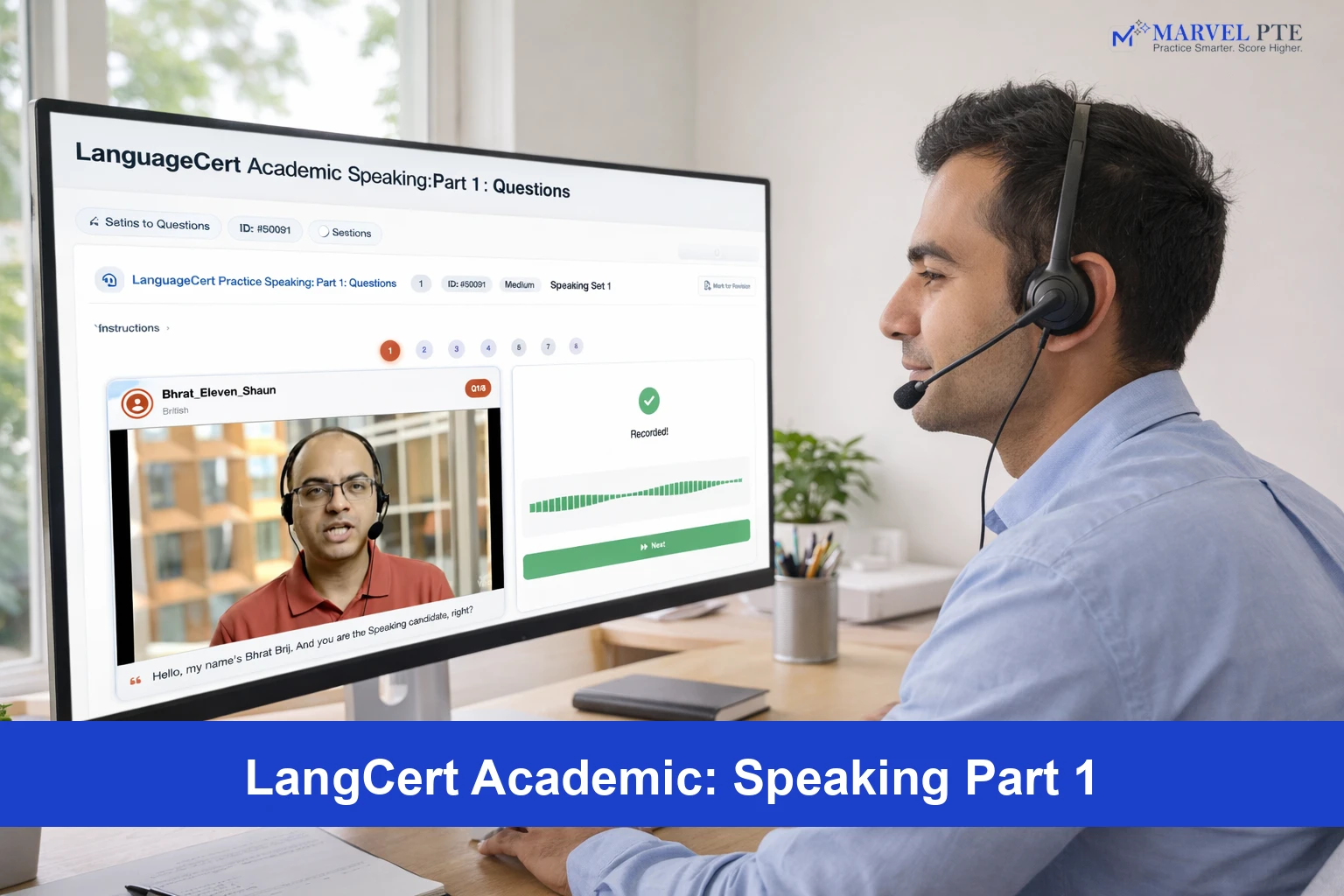
LanguageCert Academic Speaking Part 1: Personal Questions Format, Tips, and Strategies

LanguageCert Academic Speaking Part 1 is the opening section of the speaking test, where the examiner asks you …

author image

by Gaurav Chhikara

Jan 27, 2026
Marvel PTE Marvel PTE
Our Locations
Sydney Campbelltown Address Smart Work Hub, Level 2, 351 Oran Park Drive Oran Park , NSW Australia
India Address 2nd Floor, SCO 12-13, Ambala - Chandigarh Rd Above Super Mart, Near S S Multispeciality Hospital Zirakpur , Punjab 140603 India
Coaching
  • PTE Coaching in Zirakpur|
  • PTE Coaching in Parramatta|
  • PTE Coaching in Narellan|
  • PTE Coaching in Campbelltown|
  • PTE Coaching in Kingsford
  • PTE Coaching in Randwick
  • PTE Coaching in Chatswood
  • PTE Coaching in Epping
  • PTE Coaching in Ryde
  • PTE Coaching in Strathfield
  • PTE Coaching in Hurstville
  • PTE Coaching in Auburn
  • PTE Coaching in Cabramatta
  • PTE Coaching in Bankstown
  • PTE Coaching in Penrith
  • PTE Coaching in Liverpool
  • PTE Coaching in Fairfield
  • PTE Coaching in Sydney
  • PTE Coaching in Blacktown
Explore
  • Pricing
  • Institute Software
Contact
  • +91-8699-121-121
  • [email protected]
  • Contact Us
  • Pay Now
Policies
  • Terms & Services|
  • Privacy Policy|
  • Cookie Policy|
  • Refund Policy
© 2026 Marvel PTE. All Rights Reserved.