
LanguageCert Academic
LanguageCert Academic Speaking Part 2: Role Play Task Format, Scoring, and Strategies
LanguageCert Academic Speaking Part 2 tests your ability to handle real conversations in academic settings. …

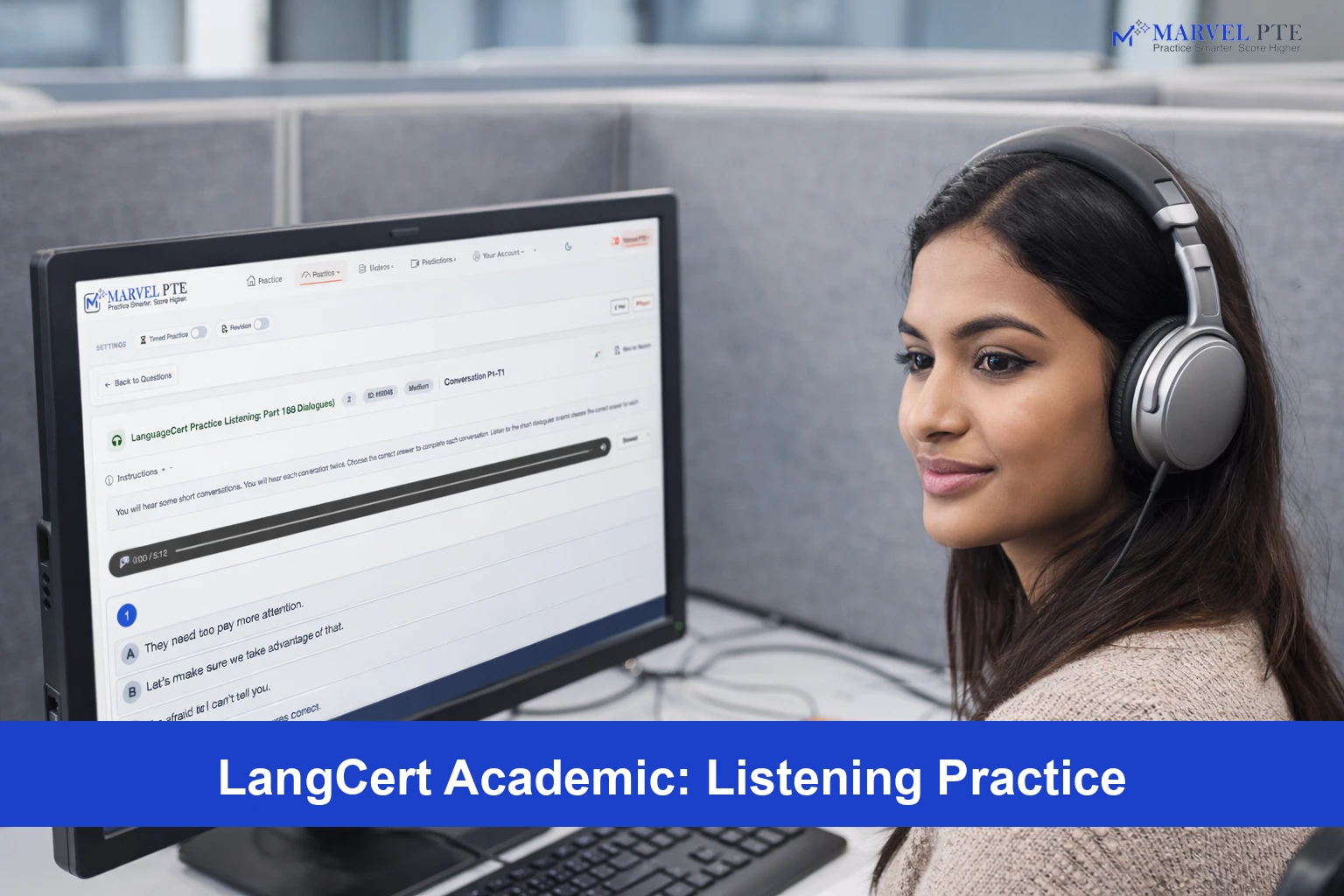
The LanguageCert Academic Listening section tests your ability to understand spoken English in academic contexts. With 40 minutes to answer 30 questions across four distinct parts, this section requires both comprehension skills and smart time management. The good news? Every audio clip plays twice, giving you a genuine second chance to catch details you missed the first time.
I remember coaching a student who had failed PTE Listening twice because he could not keep up with the single playback. When he switched to LanguageCert, the double playback changed everything. He went from anxious to confident, knowing he would hear each recording again.
This guide breaks down exactly what each part tests, how the questions work, and which strategies actually help on test day.
Before diving into individual parts, here is the structure you will encounter:
| Aspect | Details |
|---|---|
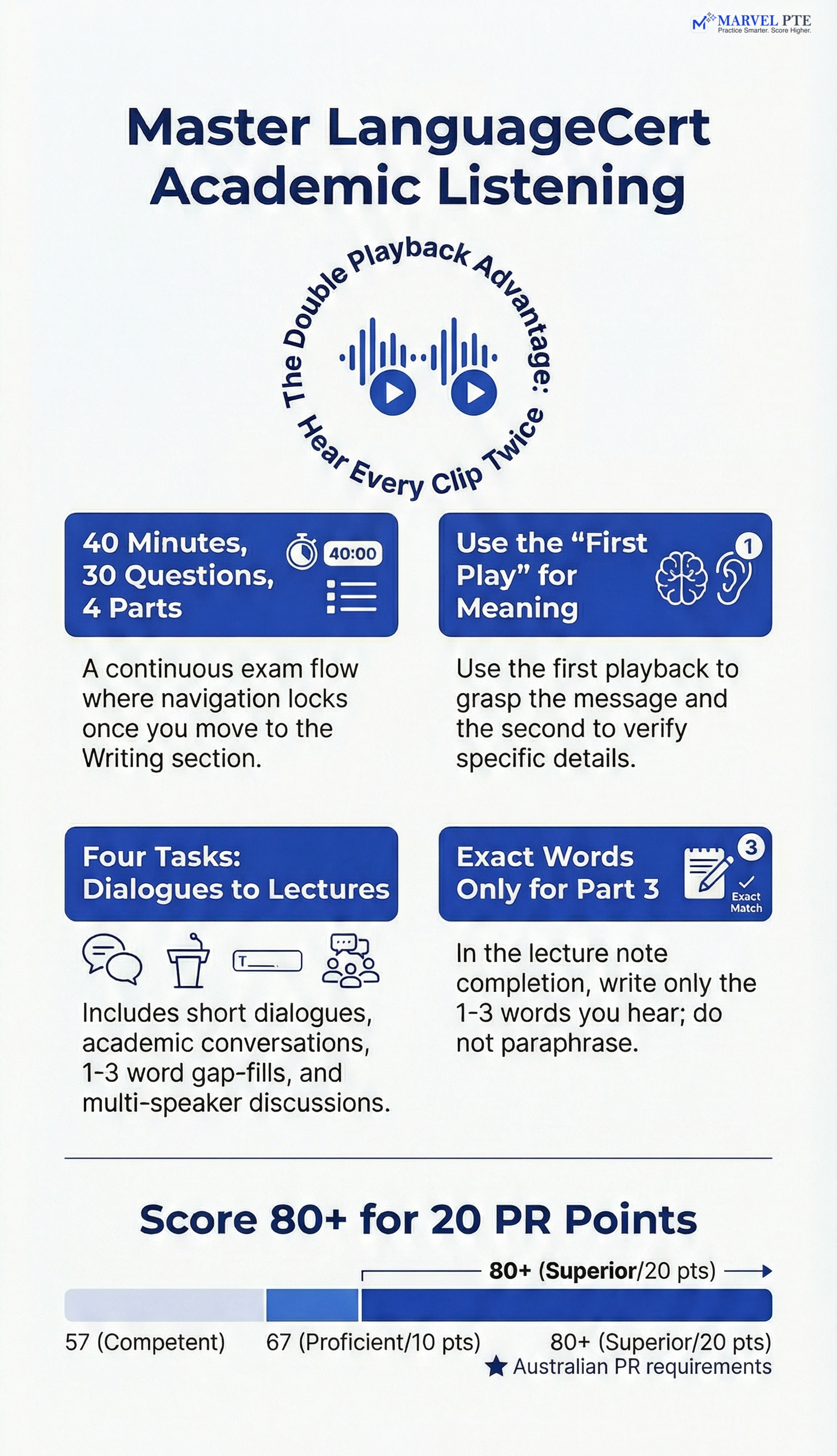
| Total Duration | 40 minutes |
| Total Questions | 30 |
| Number of Parts | 4 |
| Audio Playback | Twice for all parts |
| Navigation | Cannot return after moving to Writing |
The Listening section runs continuously. You will move through Parts 1 to 4 in sequence. A 15 minute warning appears before time runs out, and once you proceed to the Writing section, you cannot go back to Listening or Reading.
This structure matters for your preparation. Unlike exams where audio plays once and you must capture everything immediately, LanguageCert gives you breathing room. Use the first playback to understand the overall message. Use the second to verify your answers and fill any gaps.
Key Advantage: The double playback means you should not panic if you miss something. Stay calm, note what you caught, and wait for the repeat.
Listen to exam-style audio and test your comprehension.
Part 1 presents seven short, unfinished conversations. Your task is to choose the correct completion from three options.
| Format Detail | Value |
|---|---|
| Questions | 7 |
| Options per Question | 3 |
| Type | Unfinished dialogues |
| Audio Playback | Twice |
These are not vocabulary tests. Part 1 checks whether you understand speaker intention and conversational context. The dialogues are short and the language is straightforward, but you need to grasp what the speaker actually means, not just what words they use.
Before the audio starts, read through the three options. Try to predict what kind of response would make sense. When the dialogue plays, focus on the tone and purpose. Is the speaker agreeing, disagreeing, asking for clarification, or making a suggestion?
On the first playback, get the general meaning. On the second, confirm your choice. If you are still unsure after both plays, make your best guess and move on. These are short questions, and spending too long on one will hurt you later.
Students often pick answers that sound correct in isolation but do not fit the conversation flow. Always ask: does this response actually answer what the first speaker said?
Take a mock listening section with real exam conditions.
Part 2 contains five longer conversations set in academic contexts, such as a student talking to a professor or an administrator explaining a process. Each conversation has two questions, giving you 10 questions total.
| Format Detail | Value |
|---|---|
| Questions | 10 |
| Conversations | 5 |
| Questions per Conversation | 2 |
| Options per Question | 3 |
| Audio Playback | Twice |
You need to track the flow of a discussion. The questions often ask about opinions, reasons, and outcomes. Unlike Part 1, where dialogues are brief, Part 2 requires sustained attention across longer exchanges.
Read both questions before the audio starts. Knowing what you are listening for helps you focus. Identify who is speaking (student, lecturer, administrator) and what role each person plays in the conversation.
On the first playback, follow the structure. Who wants what? What is the problem or topic? On the second playback, verify the specific details the questions ask about.
Many test takers lose focus between Question 1 and Question 2 of the same conversation. They answer the first question, relax, and miss key information for the second. Stay engaged throughout.
Another mistake is chasing exact wording. The correct answer often paraphrases what the speaker said rather than repeating it word for word.
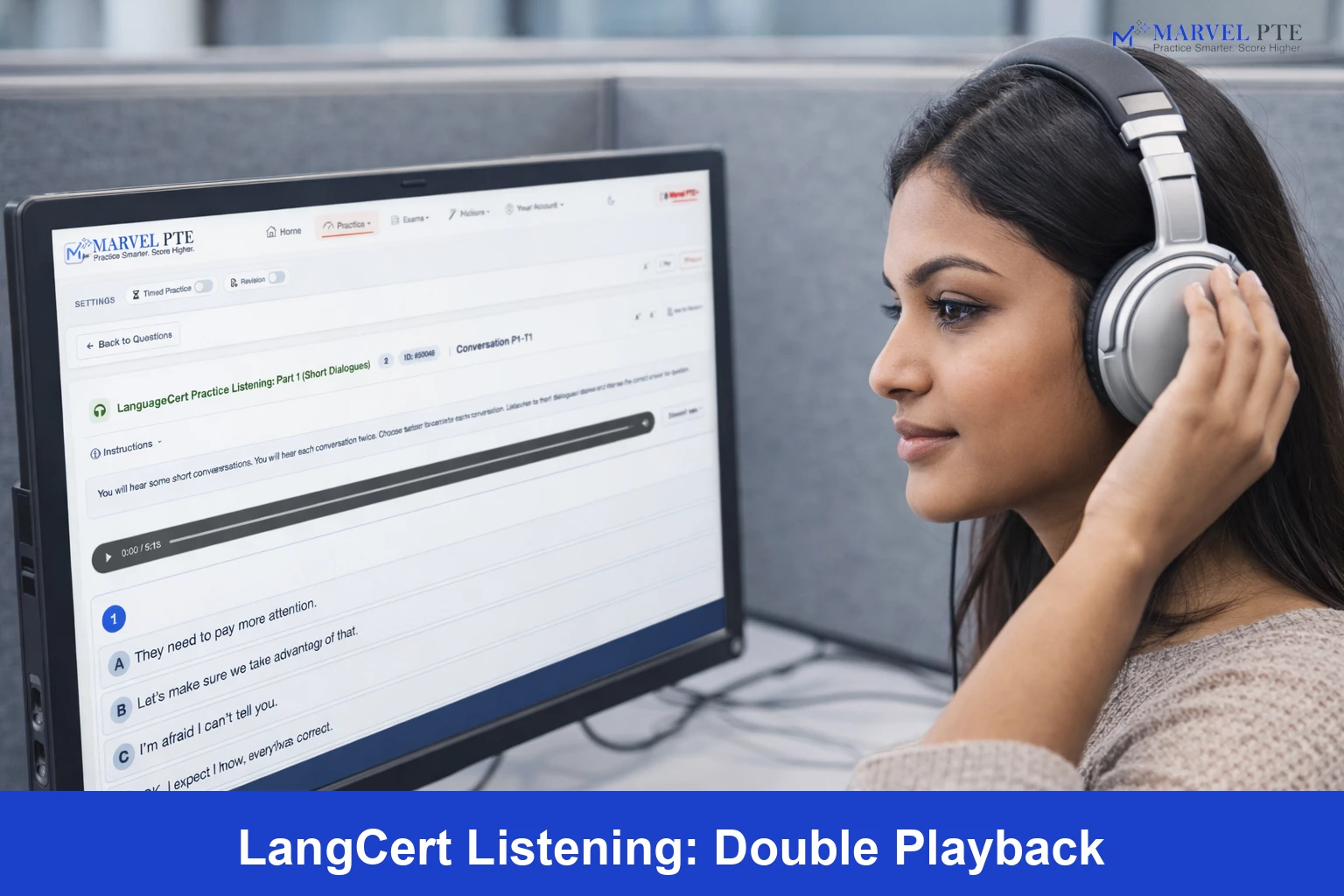
Part 3 is different from the multiple choice format of Parts 1 and 2. You will hear an academic presentation or lecture and complete a notepad by filling in seven gaps. Each gap requires one to three words.
| Format Detail | Value |
|---|---|
| Questions | 7 gaps |
| Word Limit | 1 to 3 words per gap |
| Preparation Time | 30 seconds |
| Audio Playback | Twice |
Part 3 tests your ability to extract key information from structured academic speech. You are not summarising or paraphrasing. You are writing exactly what you hear, in the correct place.
You get 30 seconds to look at the notepad before the audio starts. Use this time to scan the gaps and predict what type of word might fit. Is it a noun, a number, a date, a name?
During the first playback, focus on understanding the lecture structure. Where does the speaker discuss topic A versus topic B? Note what you can, but do not stress if you miss some gaps.
The second playback is your chance to fill in missing answers and check spelling. Write only what you hear. Do not paraphrase or add words.
Writing too much is a frequent error. If the gap needs one to three words and you write a full sentence, you will lose marks. Another mistake is changing what you heard to make it sound better. Write the exact words from the audio.
Access our full listening library with transcripts and answers.
Part 4 features a longer audio, typically a podcast discussion or group conversation on an academic topic. You will answer six multiple choice questions, each with three options.
| Format Detail | Value |
|---|---|
| Questions | 6 |
| Options per Question | 3 |
| Preparation Time | 1 minute |
| Audio Playback | Twice |
With multiple speakers, Part 4 checks whether you can track different viewpoints. Questions often focus on attitudes, agreements, and contrasts between speakers. You need to identify who said what and what position each person holds.
You get a full minute to read the questions before the audio starts. Use every second. Underline keywords in the questions. Note what you are listening for: does the question ask about Speaker A’s opinion, Speaker B’s reason, or a point of agreement?
On the first playback, track speaker opinions rather than every detail. On the second, use elimination. Cross out options you know are wrong and confirm your final choice.
The extended length can cause mental fatigue. Students sometimes tune out after the first few questions, missing key information for the final ones. Pace yourself. Stay focused through the entire recording.
You have 40 minutes for 30 questions. Here is how to allocate your attention:
| Part | Questions | Suggested Focus |
|---|---|---|
| Part 1 | 7 | Quick responses, do not overthink |
| Part 2 | 10 | Track conversation flow, read both questions beforehand |
| Part 3 | 7 | Use prep time, write exact words |
| Part 4 | 6 | Use full prep minute, track multiple speakers |
The double playback is your safety net. If you miss something on the first play, you will hear it again. This means you should not freeze or panic. Keep moving.
Parts 3 and 4 are longer and more demanding. If you find yourself getting tired, take a breath between parts. You cannot pause the audio, but you can mentally reset during the brief gaps.
Pro Tip: The 15 minute warning is your signal to wrap up any remaining questions and prepare to transition to Writing.
If you are taking LanguageCert for Australian immigration, here are the Listening scores you need:
| Level | Listening Score | PR Points |
|---|---|---|
| Competent | 57 | 0 |
| Proficient | 67 | 10 |
| Superior | 80 | 20 |
The Competent level meets the minimum English requirement for most skilled visas but does not add points. Proficient adds 10 points, and Superior adds 20 points to your Expression of Interest.
Struggling to simulate real exam conditions? Marvel Edu provides:
| Feature | Benefit |
|---|---|
| Audio plays exactly twice | Matches real exam rules |
| Part-wise practice mode | Focus on Parts 1, 2, 3, or 4 individually |
| Timed full simulations | Navigation locks after Listening, just like the exam |
| Mistake analysis by question type | See which part needs more work |
Our platform replicates the actual test experience. You will hear each audio twice, face the same time pressure, and see your results broken down by part.
Before your test, confirm you have covered these areas:
What is the primary benefit of the audio playback policy in the LanguageCert Academic Listening section?
What is the specific requirement for the notepad completion task in Listening Part 3?
Which score is required for the 'Superior' level to gain 20 points for Australian PR?
How should a candidate use the preparation time provided before Listening Part 4?
In Part 1, what is the candidate required to evaluate to choose the best response?
What is the total duration of the LanguageCert Academic Listening section?
40 minutes.
How many total questions are in the LanguageCert Academic Listening exam?
30 questions.
How many distinct parts make up the Listening section?
4 parts.
What is the navigational restriction once a candidate moves to the Writing section?
You cannot return to Listening or Reading once you move to Writing.
How many multiple-choice options are provided for each question in Part 1?
3 options per question.
What is the format of Listening Part 2?
5 academic conversations with 2 questions each.
What is the relationship between correct answers and audio wording in Part 2?
Correct answers often paraphrase what was said rather than repeating word-for-word.
How should candidates use the 30-second preparation time in Part 3?
Scan the gaps and predict what type of word might fit (noun, number, date, name).
What does Part 4 specifically check regarding multiple speakers?
Whether you can track different viewpoints and identify who said what.
How can you manage mental fatigue between listening parts?
Take a breath and mentally reset during the brief gaps between recordings.
Watch expert strategies for catching key details.

LanguageCert Academic Speaking Part 2 tests your ability to handle real conversations in academic settings. …
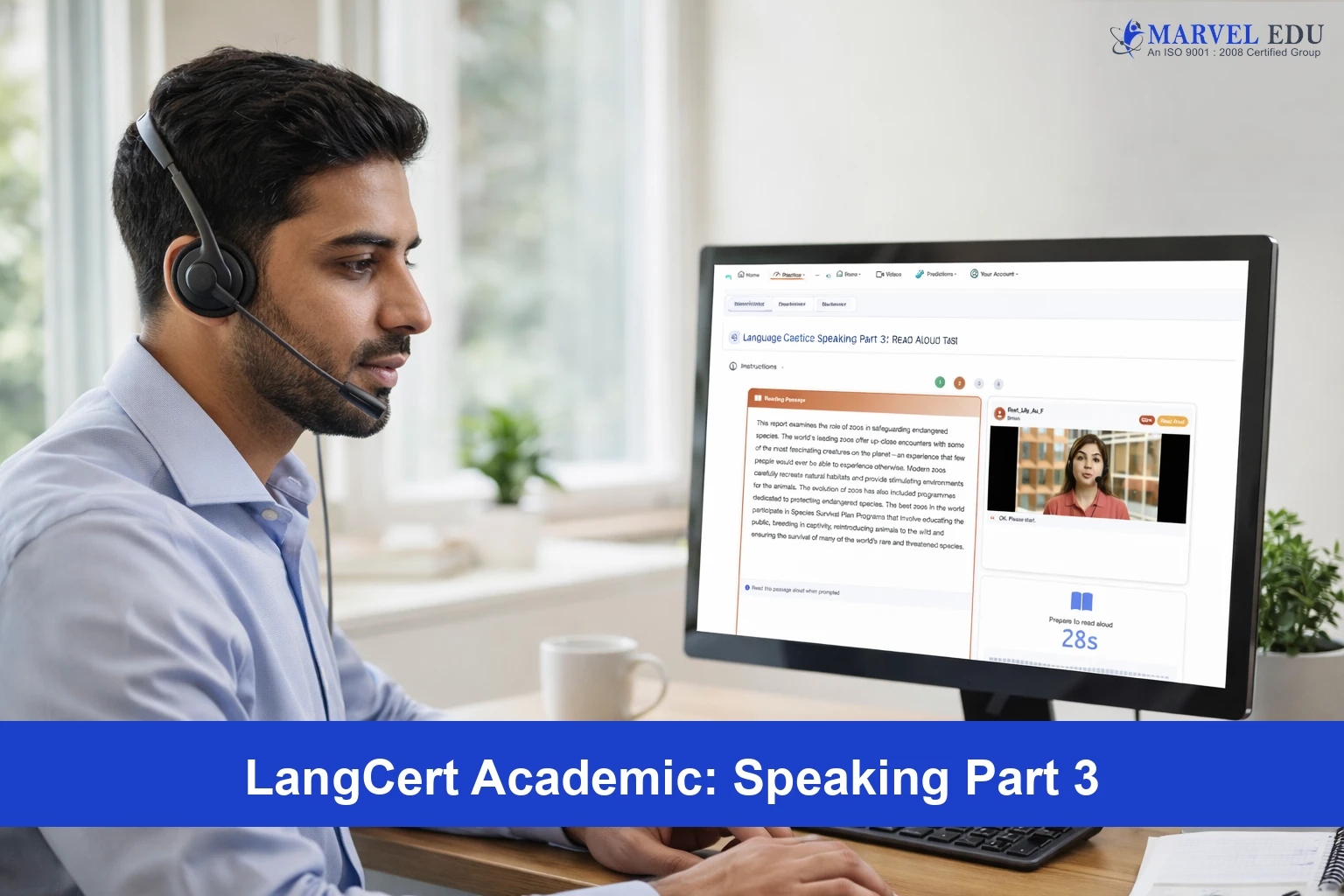
LanguageCert Academic Speaking Part 3 tests two skills in one task: reading aloud and expressing an opinion. …

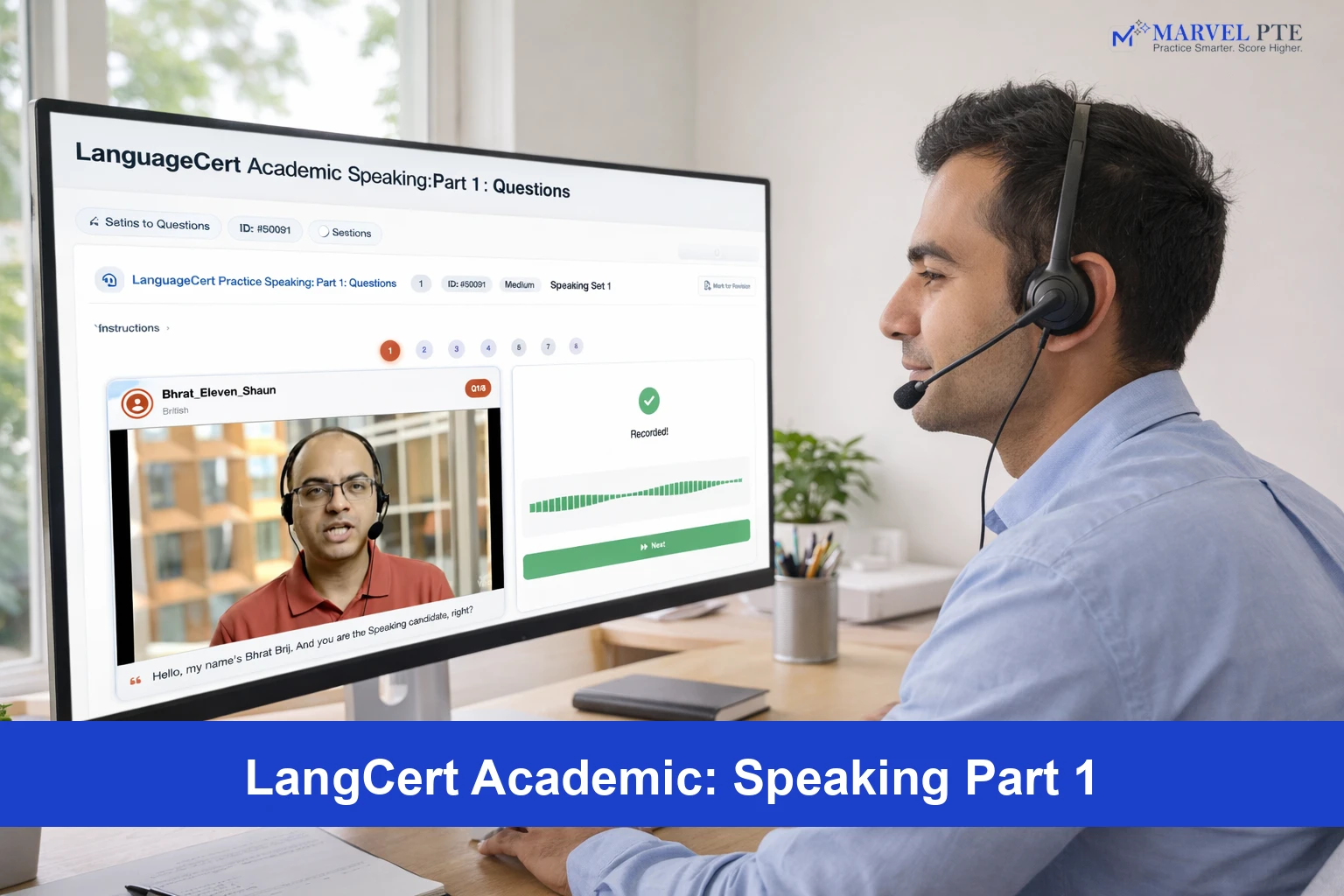
LanguageCert Academic Speaking Part 1 is the opening section of the speaking test, where the examiner asks you …
