
LanguageCert Academic
LanguageCert Academic Speaking Part 2: Role Play Task Format, Scoring, and Strategies
LanguageCert Academic Speaking Part 2 tests your ability to handle real conversations in academic settings. …

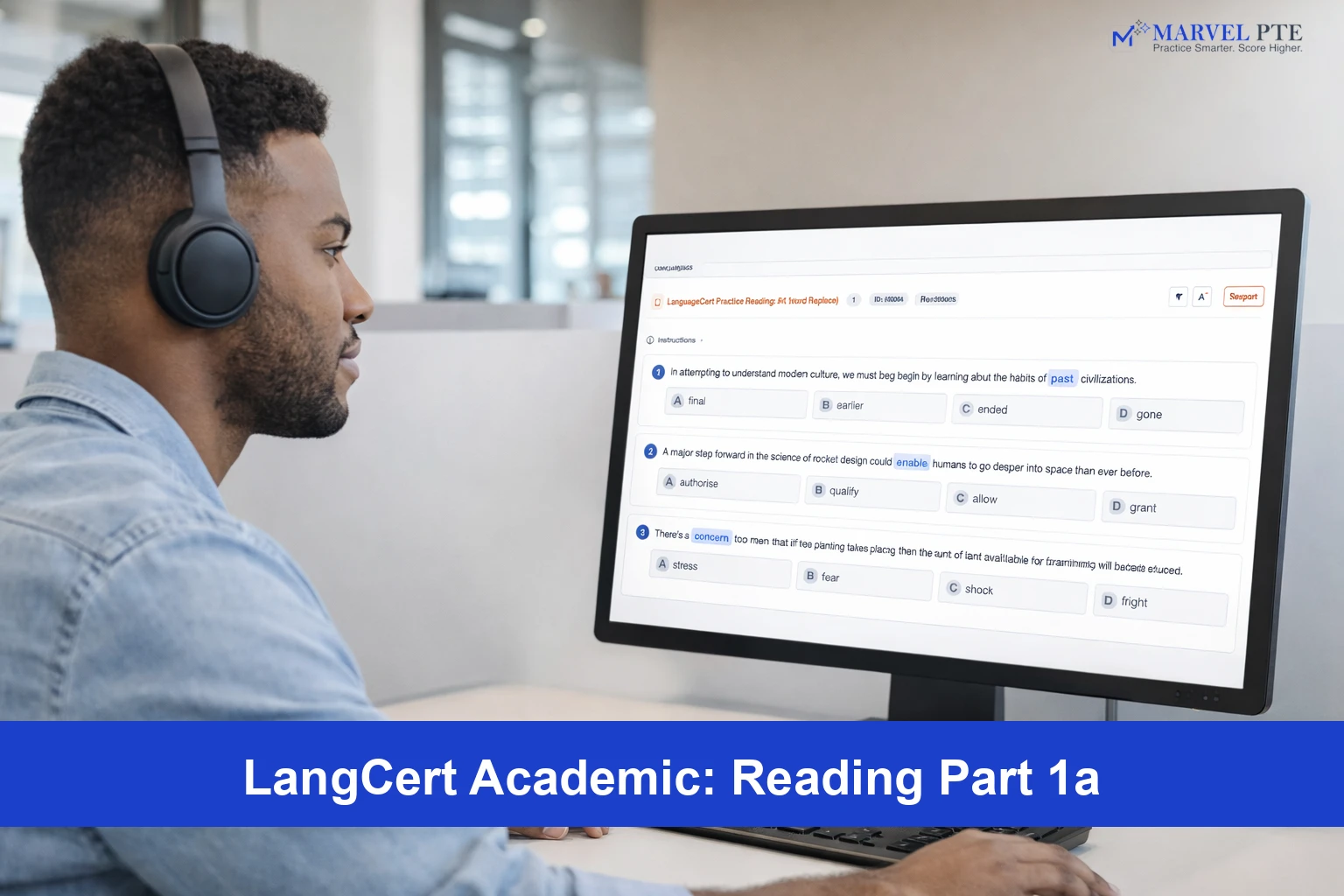
Reading Part 1a is where your LanguageCert Academic Reading section begins. It tests vocabulary in context through 6 independent sentences, each with a bolded word. The task sounds simple: identify what the bolded word means based on how it’s used. But context changes meaning, and that’s what catches people out.
The Reading section gives you 50 minutes for 30 questions across 5 parts. Part 1a is the first of these. While Part 1b tests grammar through gap-fills in a paragraph, Part 1a focuses purely on vocabulary understanding through independent sentences.
Here’s where Part 1a sits within the full Reading test:
| Part | Questions | What It Tests | Time Suggestion |
|---|---|---|---|
| Part 1a | 6 | Vocabulary in context (4 options) | 6 minutes |
| Part 1b | 5 | Grammar (gap-fill, 3 options) | 5 minutes |
| Part 2 | 6 | Sentence matching | 10 minutes |
| Part 3 | 7 | Multi-text scanning | 11 minutes |
| Part 4 | 6 | Long text comprehension | 18 minutes |
| Total | 30 | 50 minutes |
Part 1a matters for your overall score because it’s where many students either build confidence or start second-guessing themselves. Get these 6 questions right, and you’ve set a positive tone for the rest of the section.
Pro Tip: Part 1a uses independent sentences, not a connected passage. Focus on the context within each individual sentence rather than looking for connections between them.
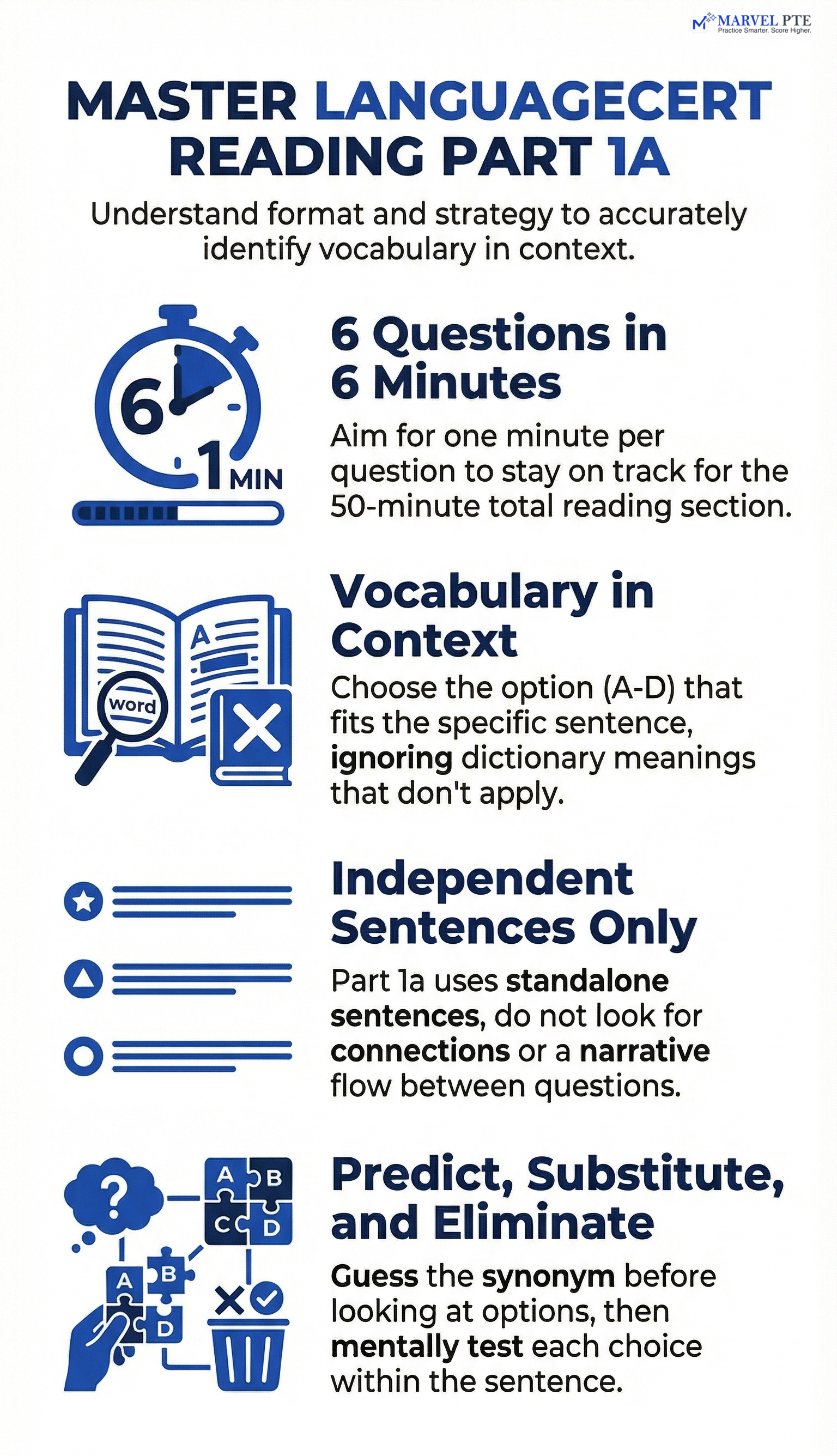
Part 1a presents 6 independent sentences, each containing a word in bold. Your task is straightforward: for each bolded word, choose the option (A, B, C, or D) that best matches its meaning in that specific context.
The skills being tested include:
You have approximately 6 minutes for these 6 questions, though there’s no strict per-question timer. Since you can review answers within the Reading section, spending slightly longer here won’t hurt if it means getting them right.
Part 1a differs from later reading parts because it’s focused entirely on vocabulary precision. Parts 2-4 test broader comprehension skills like identifying main ideas, matching information, and making inferences. Part 1a is narrower: do you understand what this specific word means here?
Practice smarter with AI-powered mock tests and instant feedback.
Every Part 1a question follows the same format. You see a sentence with a bolded word, then four options (A, B, C, D) below it. One option is correct, three are distractors.
Example format:
A sentence might read: “The research findings were preliminary and required further verification.”
Options:
The correct answer is B (initial), because “preliminary” means early-stage or not yet finalised. Options A, C, and D mean the opposite or something different.
Common traps to watch for:
The texts in Part 1a are typically academic in nature. They might cover topics like scientific research, historical events, social issues, or educational matters. You don’t need specialist knowledge of these topics. The vocabulary being tested is general academic vocabulary that appears across disciplines.
Build your vocabulary-in-context skills with targeted practice questions.
Here’s how to approach Part 1a efficiently:
Step 1: Read each sentence carefully
Don’t jump straight to the bolded word. Read the entire sentence first. Understanding the full context helps you interpret the bolded word correctly.
Step 2: Focus on the bolded word in context
Look at how the bolded word fits within the sentence. Read the complete sentence, not just the words immediately before and after the bold text.
Step 3: Predict before you look at options
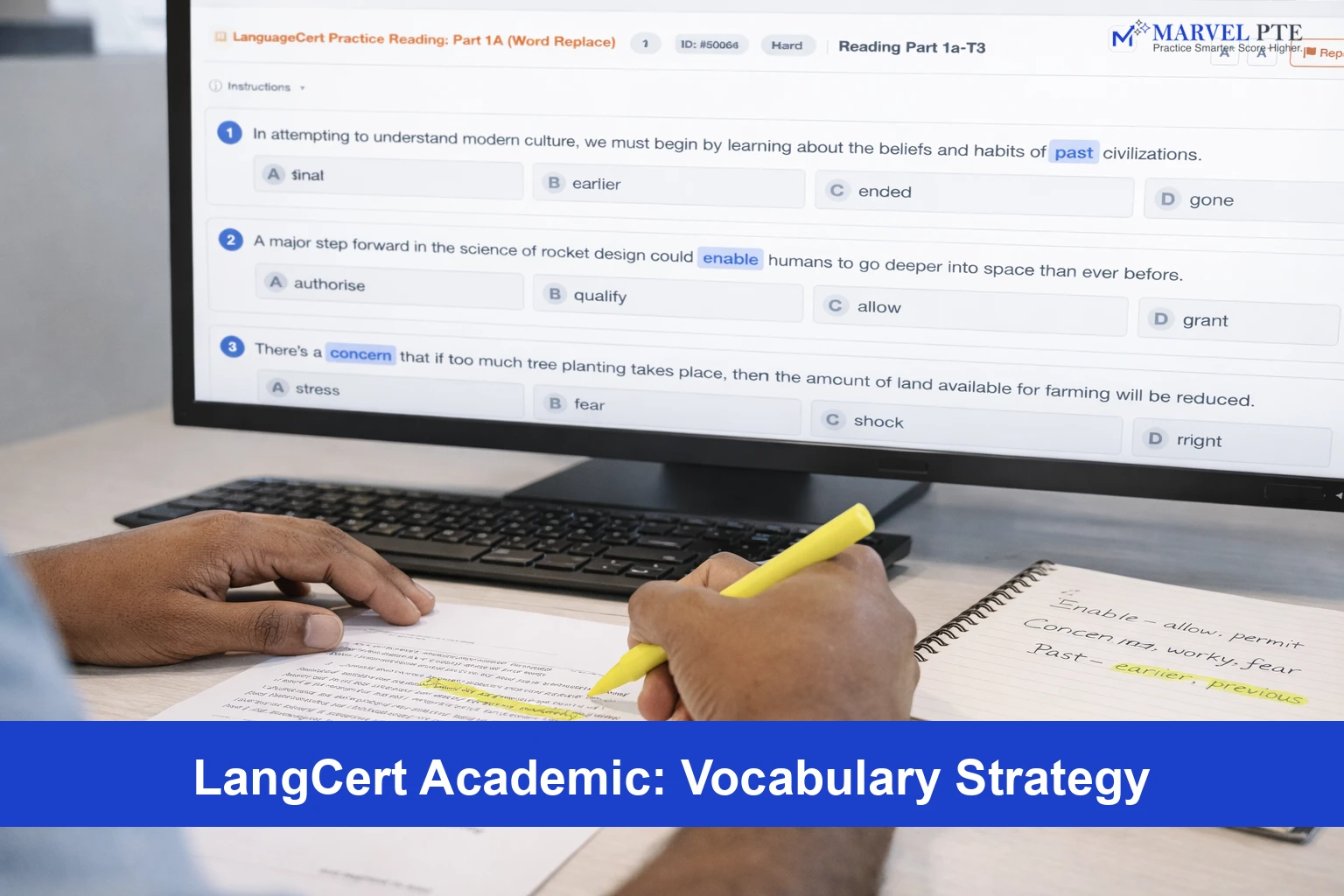
Before checking the four options, ask yourself: what word could replace the bolded word and keep the same meaning? If you can think of a synonym yourself, you’re more likely to spot the correct answer.
Step 4: Test each option by substitution
Put each option into the sentence mentally. Does it make sense grammatically? Does it preserve the meaning? Does it fit with what comes before and after?
Step 5: Eliminate confidently wrong options
If one option clearly doesn’t work, cross it off mentally. This improves your odds if you need to make an educated guess between the remaining two.
Step 6: Don’t overthink
Part 1a questions test vocabulary, not trick questions. If an option sounds right and makes sense in context, it probably is right. Trust your first instinct unless you have a strong reason to change.
Key Point: Matching ideas matters more than matching exact words. The correct option won’t always be a perfect synonym. It will be the option that preserves the sentence’s meaning.
Choosing based on isolated word meaning
The word “bank” means different things in “river bank” versus “savings bank.” Students who rely on dictionary definitions without considering context often pick the wrong answer.
Ignoring paraphrases
The correct answer might not be a direct synonym. It might be a phrase or word that expresses the same idea differently. If you’re looking only for exact synonyms, you might miss the right choice.
Spending too long on one question
You have about 6 minutes for 6 questions. If one question is genuinely puzzling, mark your best guess and move on. You can return to it after completing the other parts if time allows.
Second-guessing correct answers
Changing answers without good reason often leads to mistakes. If you had a clear reason for your first choice, stick with it unless new evidence (like re-reading the context) genuinely changes your understanding.
Not reading all four options
Some students pick the first option that seems reasonable without checking whether another option is better. Always read all four before deciding.
Preparing for Part 1a requires building vocabulary-in-context skills, not just memorising word lists. Marvel Edu offers targeted practice that develops these skills.
| Feature | What You Get |
|---|---|
| Part 1a Practice Sets | Questions mirror the exact LanguageCert format with 4-option MCQs |
| AI Explanations | Understand why each answer is correct or incorrect |
| Vocabulary Builder | Targeted drills for synonym recognition and context clues |
| Timed Practice | Build exam-day speed with realistic 6-minute Part 1a sessions |
| Progress Tracking | See your vocabulary accuracy improve over time |
| All 5 Parts | Complete coverage from Part 1a through Part 4 |
The same AI technology trusted by 85,000+ PTE test takers is now available for LanguageCert. Practice with confidence knowing you’re building the exact skills Part 1a demands.
Why Marvel Edu? Our LanguageCert Reading practice includes 100+ Part 1a questions with detailed explanations, covering B2, C1, and C2 vocabulary levels.
When you book your LanguageCert Academic test, you’ll take the exam at an approved test centre. The LanguageCert test experience differs from home-based options because test centre exams provide a controlled environment with proper invigilation.
On exam day, arrive at the test centre early. The LanguageCert exam requires identification documents, and test centre staff will verify your details before you begin. The reading section, including Part 1a, is completed on a computer at the test centre.
Unlike some other English language tests such as PTE Academic or Cambridge English exams, the LanguageCert Academic exam allows you to review and change answers within each section. This means you can flag tricky Part 1a vocabulary questions and return to them before moving to Part 1b.
What to expect at the test centre:
Building vocabulary-in-context skills requires consistent practice. Here are resources that help prepare for the LanguageCert Academic reading part 1a exam format:
Official practice papers
LanguageCert provides official practice papers that mirror the actual exam format. These practice papers include sample Part 1a questions with the same vocabulary-in-context structure you’ll encounter on test day. Working through official practice papers helps you understand what the LanguageCert exams expect.
Practice tests online
Online practice tests simulate the computer-based LanguageCert test environment. Timed practice tests build both accuracy and speed, helping you manage the 50 minutes allocated for all reading questions.
Qualification handbook
The LanguageCert qualification handbook outlines exactly what the exam tests. Reading this qualification handbook helps you understand the assessment criteria for Part 1a vocabulary questions.
How does the LanguageCert Academic reading part 1a compare to vocabulary testing in other English proficiency exams?
| Test | Vocabulary Format | Time Pressure | Review Allowed |
|---|---|---|---|
| LanguageCert Academic | Direct synonym matching | Moderate | Yes |
| PTE Academic | Integrated in fill-in-blanks | High | No |
| Cambridge English | Multiple choice in context | Moderate | Yes |
| IELTS | No direct vocabulary section | N/A | Yes |
The LanguageCert test format for Part 1a is more straightforward than vocabulary testing in PTE Academic, where vocabulary appears within fill-in-the-blank questions. This makes the LanguageCert exam particularly suitable for candidates who prefer clear, direct question formats.
On test day, remember:
Habits to apply immediately:
Final reminders for accuracy and pacing:
How are the sentences structured in Reading Part 1a?
What is the recommended time allocation for Part 1a's six questions?
What is the primary difference between Part 1a and Part 1b?
How does LanguageCert differ from PTE Academic in answer navigation?
What Reading score is needed for Proficient English (10 PR points)?
What is the primary focus of Reading Part 1a?
Vocabulary in context - matching bolded words to their synonyms
How many independent sentences are in Part 1a?
6 independent sentences, each with one bolded word
How many answer options (A, B, C, D) per question?
4 options per question
Are Part 1a sentences connected to each other?
No, they are 6 completely independent sentences with no connection between them
Why should you predict a synonym before looking at options?
It helps identify the correct answer based on context rather than being misled by distractors
What is more important than finding an exact synonym?
Matching the overall idea and preserving the sentence's meaning
What is a common trap involving multiple word meanings?
Choosing an option that matches a dictionary definition but doesn't fit the specific sentence context
How much time is recommended for Part 1a?
6 minutes (50 minutes total for all 30 Reading questions)
Can you go back and change Part 1a answers?
Yes, unlike PTE, LanguageCert allows reviewing and changing answers within the Reading section
What is the key difference between Part 1a and Part 1b?
Part 1a: vocabulary in context (6 questions, 4 options). Part 1b: grammar gap-fill (5 questions, 3 options)
Access mock tests covering all 5 Reading parts with detailed explanations.

LanguageCert Academic Speaking Part 2 tests your ability to handle real conversations in academic settings. …
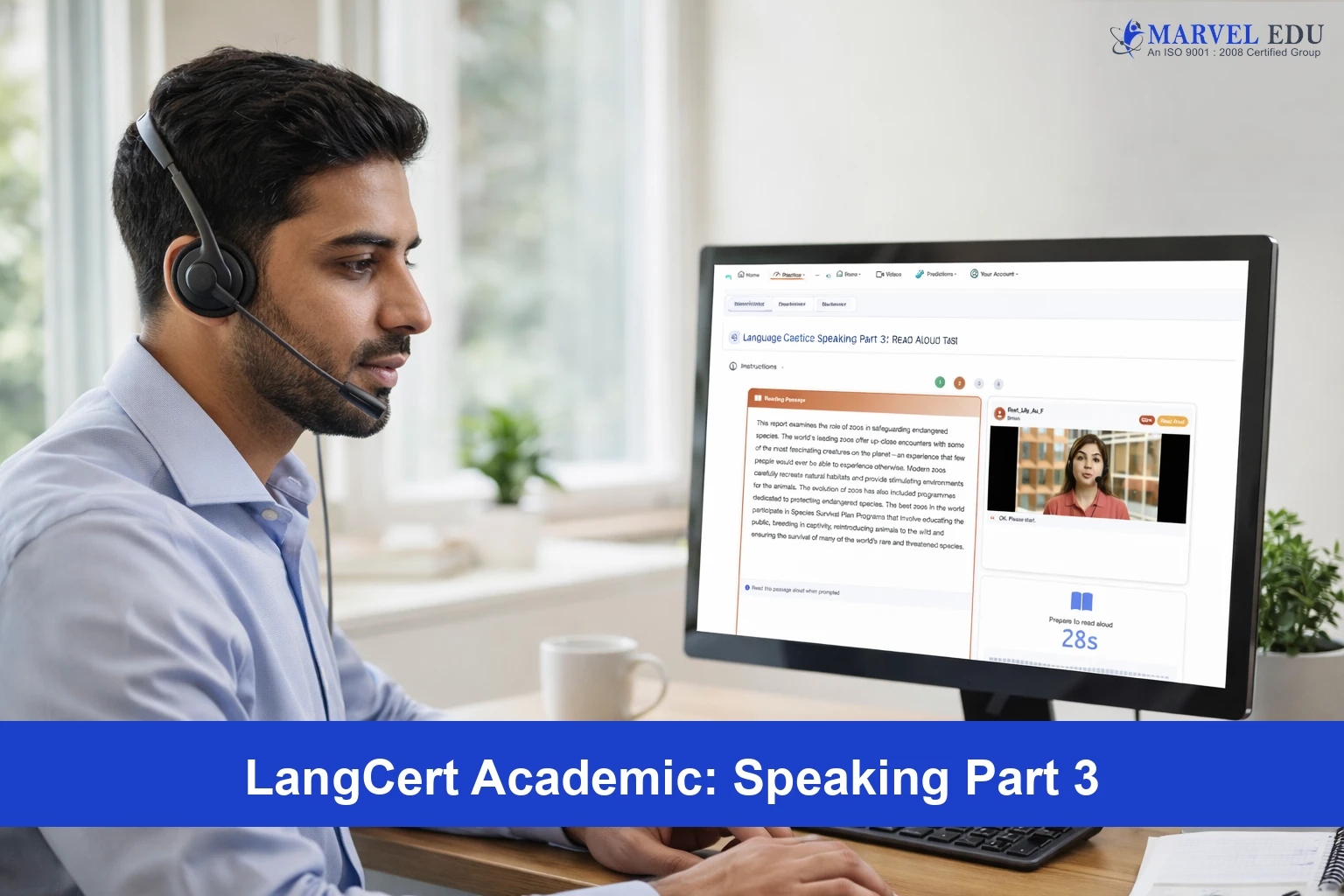
LanguageCert Academic Speaking Part 3 tests two skills in one task: reading aloud and expressing an opinion. …

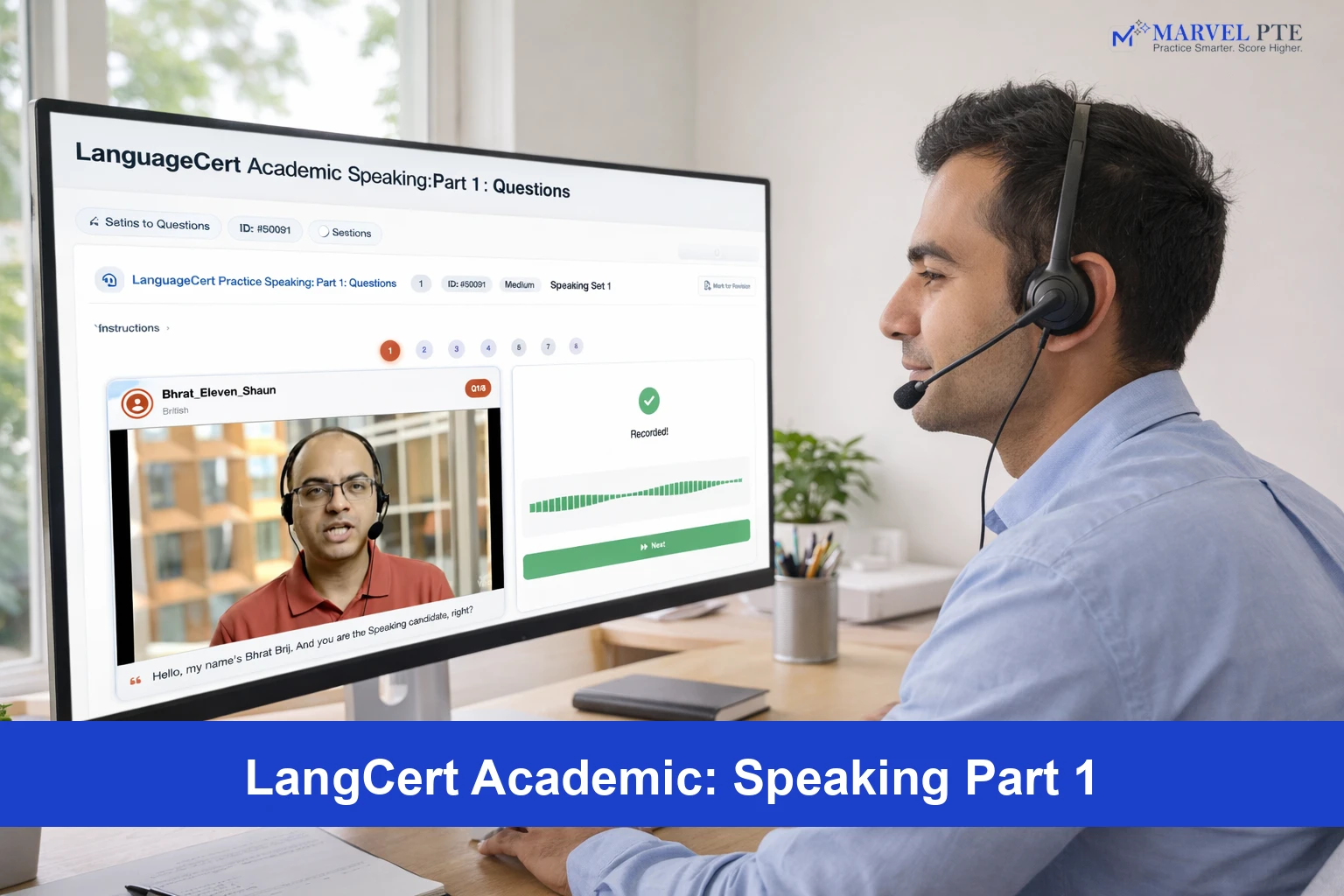
LanguageCert Academic Speaking Part 1 is the opening section of the speaking test, where the examiner asks you …
