
LanguageCert Academic
LanguageCert Academic Speaking Part 2: Role Play Task Format, Scoring, and Strategies
LanguageCert Academic Speaking Part 2 tests your ability to handle real conversations in academic settings. …

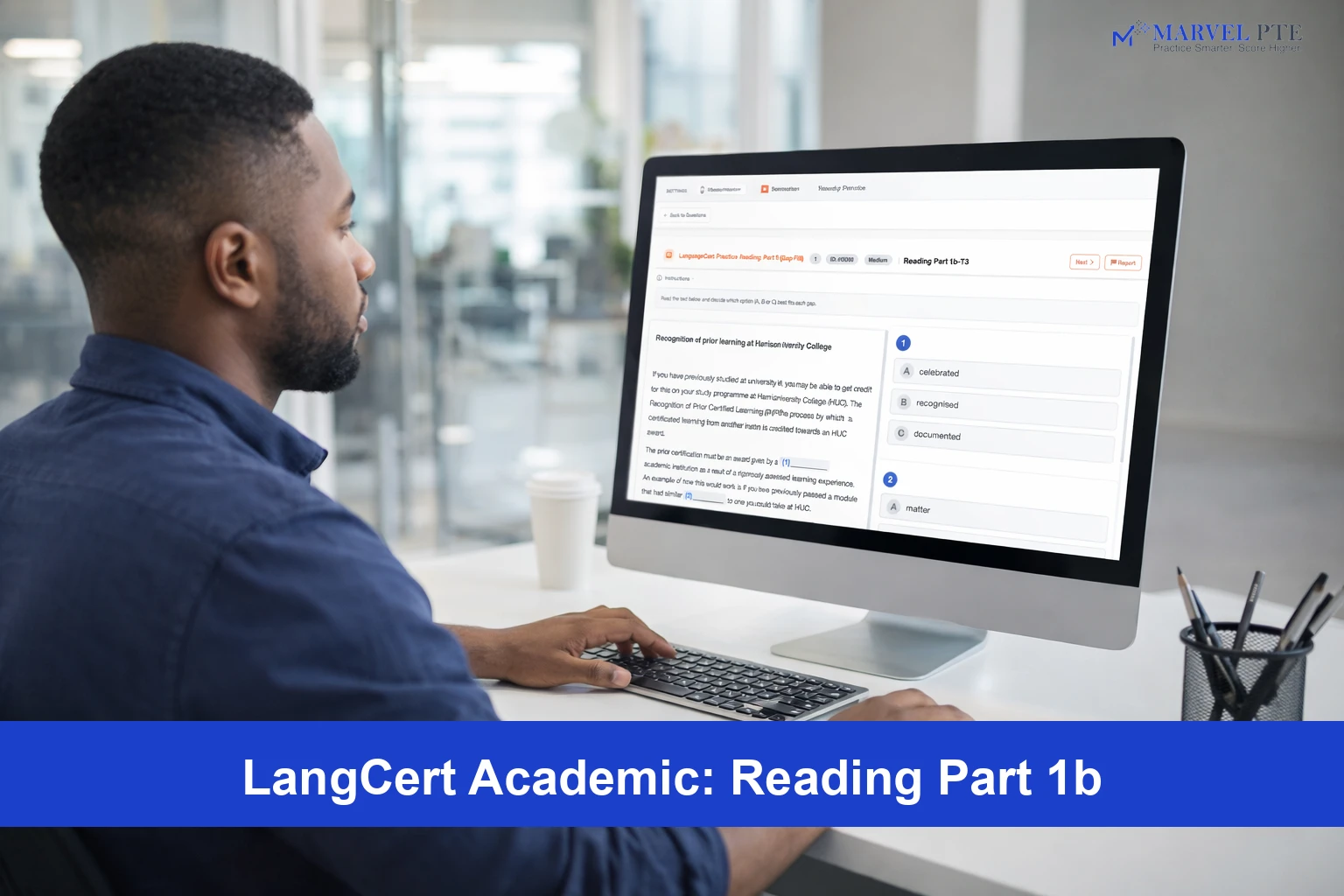
Reading Part 1b follows immediately after Part 1a in your LanguageCert Academic Reading section. While Part 1a tests vocabulary through independent sentences, Part 1b shifts focus to grammar. You’ll see a single paragraph with 5 gaps, and your task is to select the grammatically correct option for each gap from 3 choices.
Part 1b sits within the 50-minute Reading section that contains 30 questions across 5 parts. After completing the vocabulary questions in Part 1a, you move directly to the grammar-focused Part 1b.
Here’s where Part 1b fits in the Reading test structure:
| Part | Questions | What It Tests | Time Suggestion |
|---|---|---|---|
| Part 1a | 6 | Vocabulary in context (4 options) | 6 minutes |
| Part 1b | 5 | Grammar gap-fill (3 options) | 5 minutes |
| Part 2 | 6 | Sentence matching | 10 minutes |
| Part 3 | 7 | Multi-text scanning | 11 minutes |
| Part 4 | 6 | Long text comprehension | 18 minutes |
| Total | 30 | 50 minutes |
Part 1b matters because grammar accuracy affects comprehension throughout the entire Reading section. Getting these 5 questions right demonstrates you understand how English sentences connect and flow, which helps with the more complex reading tasks in Parts 2-4.
Key Point: Part 1b uses a connected paragraph, not independent sentences like Part 1a. Read the entire paragraph first to understand the context before attempting individual gaps.
Part 1b presents one academic-style paragraph containing exactly 5 numbered gaps. Below the paragraph, you’ll find three options (A, B, C) for each gap. Your task is to select the option that makes the sentence grammatically correct and fits the paragraph’s meaning.
The structure typically looks like this:
Example format:
The research team discovered that participants who exercised regularly (1) better cognitive performance. This improvement was (2) evident in tasks requiring sustained attention. However, the benefits (3) only after several weeks of consistent activity…
Gap 1:
The correct answer depends on the tense established by the paragraph and the grammatical structure of each sentence.
Grammar points commonly tested:
The paragraph topics are academic but accessible. You might read about scientific research, historical events, educational trends, or social observations. No specialist knowledge is required.
Practice smarter with AI-powered mock tests and instant feedback.
Each correct answer in Part 1b earns you marks toward your overall Reading score. LanguageCert Academic scores each skill separately (Listening, Reading, Writing, Speaking), and your Reading score depends on getting as many of the 30 questions correct as possible.
How scoring works:
Why accuracy matters here:
Part 1b questions test foundational grammar skills. If you struggle with basic tense selection or preposition use, it may affect your comprehension in later parts where you need to understand complex sentences quickly.
For Australian immigration purposes:
| Level | Reading Score | PR Points |
|---|---|---|
| Competent | 60 | 0 |
| Proficient | 71 | 10 |
| Superior | 83 | 20 |
Every question counts. Five correct answers in Part 1b contribute directly to reaching these thresholds.
Here’s what a Part 1b paragraph might look like:
Climate scientists have been studying ocean temperatures (1) the past three decades. Their findings suggest that warming trends are accelerating, (2) has significant implications for coastal communities. The data indicates that sea levels (3) by approximately 3mm per year, though this rate varies (4) different regions. Researchers believe that (5) immediate action is taken, the consequences could be severe.
Gap 1:
Correct answer: B) for
Explanation: “For” is used with a duration of time (three decades). “Since” would require a specific starting point (since 1994). “During” doesn’t fit with “the past three decades” structure.
Gap 2:
Correct answer: C) which
Explanation: “Which” introduces a non-defining relative clause referring to the entire previous statement. “That” cannot follow a comma in non-defining clauses. “What” doesn’t function as a relative pronoun here.
This pattern continues for all 5 gaps. The key is understanding both the grammar rule and how it applies within the specific context.
Build your grammar gap-fill skills with targeted practice questions.
Read the full paragraph first
Unlike Part 1a where each sentence stands alone, Part 1b uses a connected text. Reading the entire paragraph before looking at options helps you understand the overall tense, tone, and topic.

Identify the grammar being tested
For each gap, ask yourself: Is this testing tense? Preposition? Article? Connector? Knowing what grammar point is being tested helps you eliminate wrong options faster.
Look at what comes before and after
Grammar depends on surrounding words. A gap after “have been” needs a past participle. A gap before a noun might need an article or adjective. Use context clues from immediately adjacent words.
Eliminate obviously wrong options
With only 3 options, eliminating even one wrong answer dramatically improves your odds. If you can identify why one option doesn’t fit grammatically, you’re left choosing between just two.
Trust the flow of the paragraph
Academic paragraphs follow logical patterns. Connectors like “however” signal contrast. “Therefore” signals cause and effect. “Moreover” signals additional information. These patterns help you predict what type of word fits each gap.
Pro Tip: Read the completed paragraph in your head after selecting answers. If it sounds awkward or illogical, reconsider your choices.
You have approximately 5 minutes for Part 1b’s 5 questions. Here’s how to use that time effectively:
Recommended approach:
Using the navigation features:
LanguageCert Academic allows you to:
This flexibility means you shouldn’t panic if one gap seems difficult. Mark your best guess, flag it, and move on. You can return after completing other parts if time permits.
Avoiding common time traps:
Overthinking simple grammar
Sometimes the answer is straightforward. If “in” sounds right before a location, it probably is. Don’t assume every question has a trick.
Choosing based on one word only
The correct answer must fit the entire sentence structure, not just pair well with the word immediately before or after the gap. Read the complete sentence each time.
Ignoring paragraph context
A gap at the end of the paragraph might relate to information from the beginning. If the opening sentence uses past tense, a closing gap might need past tense too for consistency.
Rushing because Part 1a was easy
Part 1a’s vocabulary questions feel different from Part 1b’s grammar questions. Don’t let confidence from Part 1a lead you to rush through Part 1b carelessly.
Not reading all three options
With only 3 choices, you might see the first option and think it fits. Always check all three. The second or third might be more precisely correct.
The LanguageCert Academic exam is delivered at approved test centres across Australia and internationally. When preparing for Part 1b, candidates benefit from using practice papers and practice tests that simulate the real exam experience. Official LanguageCert practice papers follow the same format as the actual test, featuring grammar gap-fill paragraphs with three options per gap.
Many test centres provide information about local practice test sessions. Your test report will show separate scores for each Reading part, helping you identify whether grammar-based questions like Part 1b need more attention.
For English language proficiency purposes, Part 1b demonstrates your ability to understand grammatical relationships within academic texts. This section of the LanguageCert Academic test helps assessors determine your readiness for higher education or professional contexts where precise English language use matters.
Unlike PTE Academic or Cambridge English tests that integrate grammar into other question types, LanguageCert Academic tests grammar explicitly in Part 1b. This direct approach means you can target your preparation more precisely.
The secure English language test structure of LanguageCert Academic makes it suitable for UK visa and Australian immigration applications. The qualification handbook provides detailed information about what each part tests and how scores are calculated.
Preparing for Part 1b requires developing grammar-in-context skills beyond memorising rules. Marvel Edu offers targeted practice that builds these skills efficiently.
| Feature | What You Get |
|---|---|
| Part 1b Practice Sets | Questions mirror the exact LanguageCert format with 3-option gaps |
| AI Explanations | Understand why each grammar choice is correct or incorrect |
| Grammar Focus Drills | Targeted practice for prepositions, tenses, and connectors |
| Timed Practice | Build exam-day speed with realistic 5-minute Part 1b sessions |
| Progress Tracking | See your grammar accuracy improve over time |
| Full Reading Mock Tests | Complete coverage from Part 1a through Part 4 |
The LanguageCert practice on Marvel Edu includes authentic paragraph-style questions that test the same grammar points you’ll encounter on exam day.
How many options are provided for each gap in Reading Part 1b, and how does this differ from Part 1a?
What is the primary focus of the questions in Reading Part 1b?
Which strategy is highly recommended before attempting to fill the gaps in Part 1b?
According to the test navigation rules, which statement about Part 1b is true?
What is the recommended time allocation for completing the 5 questions in Part 1b?
What is the specific format of Reading Part 1b?
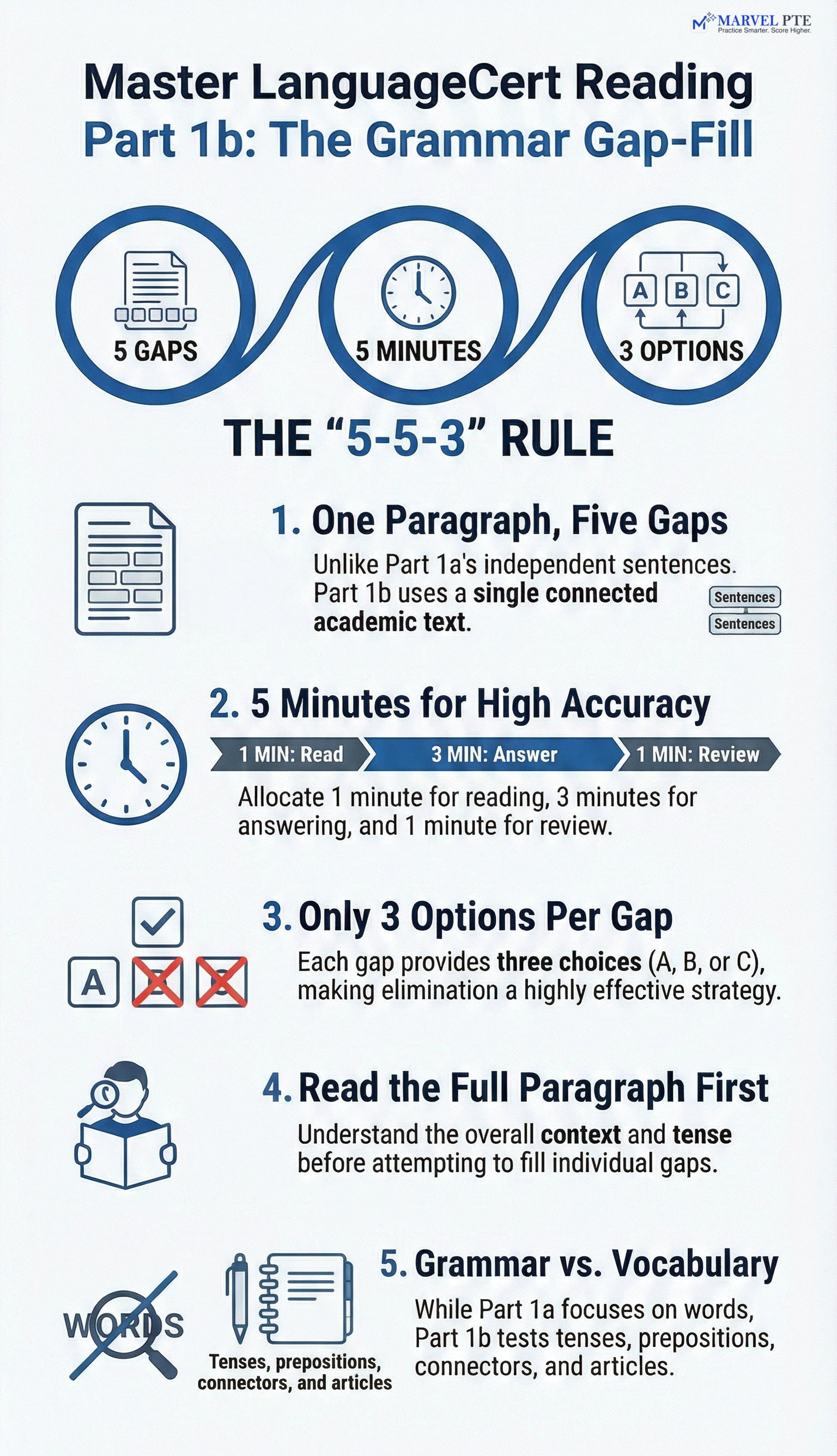
A single connected academic paragraph with 5 gaps. For each gap, you choose from 3 options (A, B, or C).
How does Part 1b differ from Part 1a?
Part 1a tests vocabulary using independent sentences with 4 options. Part 1b tests grammar within a connected text using only 3 options per gap.
What is the recommended time allocation for Part 1b?
Approximately 5 minutes: 1 minute to read, 3 minutes to answer, 1 minute to review.
What grammar points are commonly tested in Part 1b?
Verb tenses, prepositions, articles, connectors (however, therefore), relative pronouns (which, who), and word forms.
What strategy should you use before looking at the gap options?
Read the entire paragraph first to understand the overall tense, tone, and topic context.
Can you return to Part 1b questions later if you skip them?
Yes. You can skip, flag for review, and move freely within the Reading section to change answers.
How is Part 1b scored?
Each of the 5 questions carries equal weight. There is no negative marking, so never leave a question blank.
What context clues should you look for when analysing a gap?
Words immediately before and after the gap, logical flow indicated by connectors, and tense established in previous sentences.
What is a common mistake with Part 1b options?
Not reading all three options. Candidates often pick the first reasonable option without checking if another is more precise.
What Reading score is needed for Superior English (20 PR points)?
A Reading score of 83 out of 100. Every Part 1b question contributes toward this total.
Access mock tests covering all 5 Reading parts with detailed explanations.

LanguageCert Academic Speaking Part 2 tests your ability to handle real conversations in academic settings. …
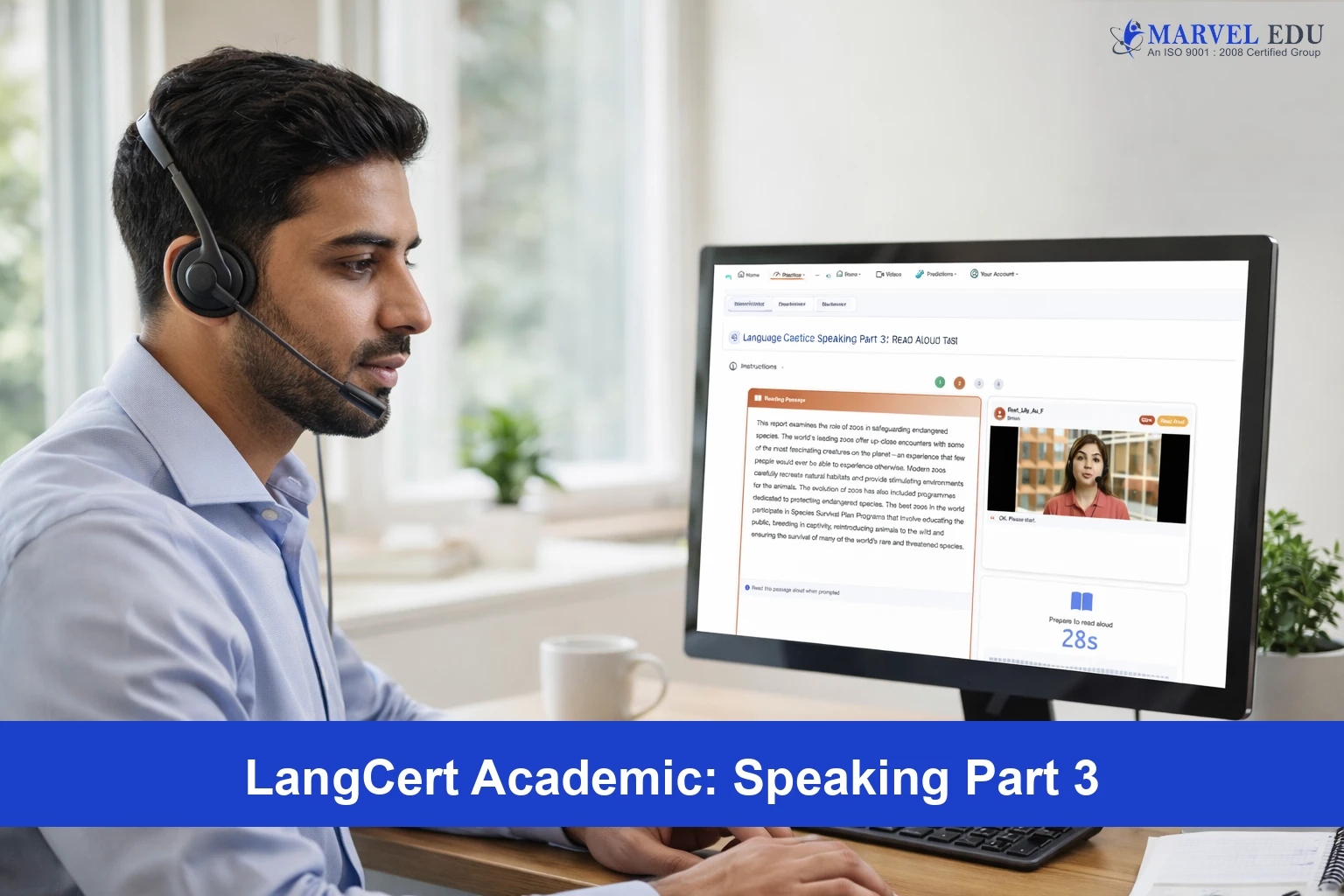
LanguageCert Academic Speaking Part 3 tests two skills in one task: reading aloud and expressing an opinion. …


LanguageCert Academic Speaking Part 1 is the opening section of the speaking test, where the examiner asks you …
