
LanguageCert Academic
LanguageCert Academic Speaking Part 2: Role Play Task Format, Scoring, and Strategies
LanguageCert Academic Speaking Part 2 tests your ability to handle real conversations in academic settings. …

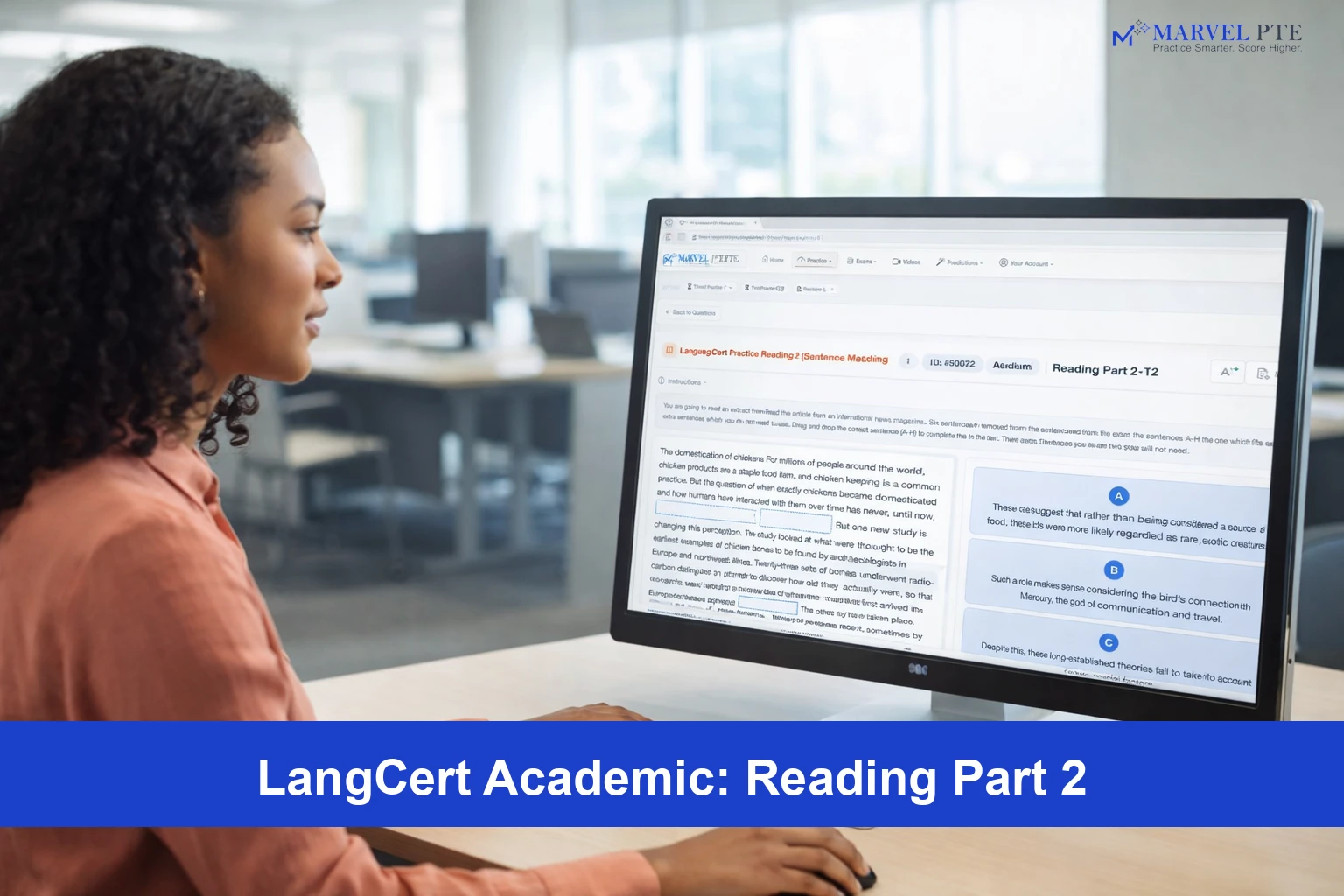
Reading Part 2 tests your ability to understand how a text flows logically. After completing the vocabulary questions in Part 1a and the grammar gap-fill in Part 1b, Part 2 presents a different challenge: matching complete sentences to gaps in an article. You’ll drag and drop sentences from a bank of options, keeping in mind that two sentences won’t be used.
Part 2 sits within the 50-minute Reading section that contains 30 questions across 5 parts. This is where you move beyond individual word choices and start working with complete sentences and paragraph-level understanding.
Here’s where Part 2 fits in the Reading test structure:
| Part | Questions | What It Tests | Time Suggestion |
|---|---|---|---|
| Part 1a | 6 | Vocabulary in context (4 options) | 6 minutes |
| Part 1b | 5 | Grammar gap-fill (3 options) | 5 minutes |
| Part 2 | 6 | Sentence matching (8 options, drag-and-drop) | 10 minutes |
| Part 3 | 7 | Long text comprehension | 11 minutes |
| Part 4 | 6 | Multiple matching | 18 minutes |
| Total | 30 | 50 minutes |
Part 2 matters because it tests cohesion and logical flow. Understanding how sentences connect helps you with the longer reading tasks in Parts 3 and 4, where you need to track ideas across multiple paragraphs.
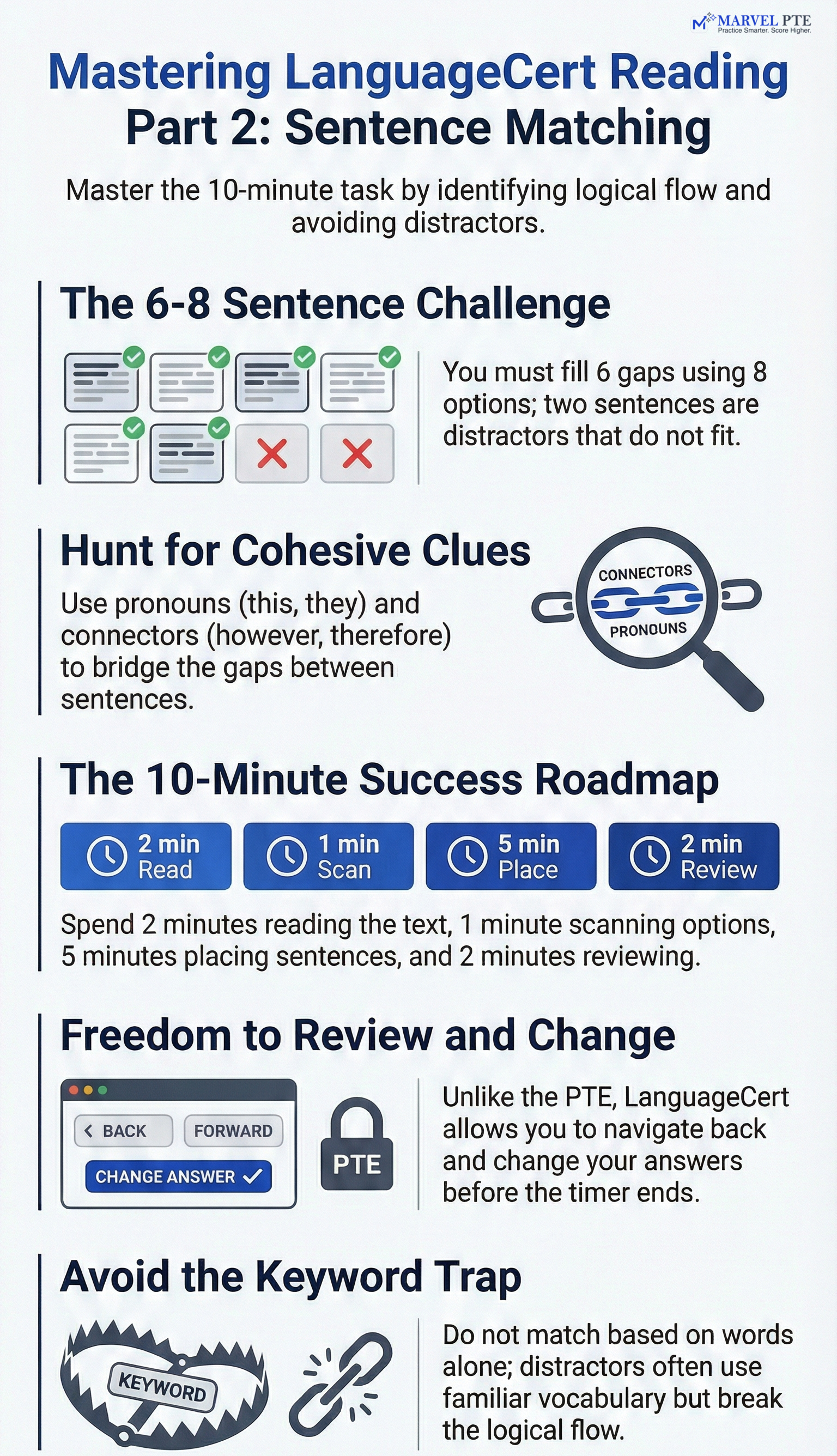
Key Point: Part 2 gives you 8 sentence options but only 6 gaps. Two sentences are distractors designed to confuse you. Learning to identify and eliminate these distractors is essential for accuracy.
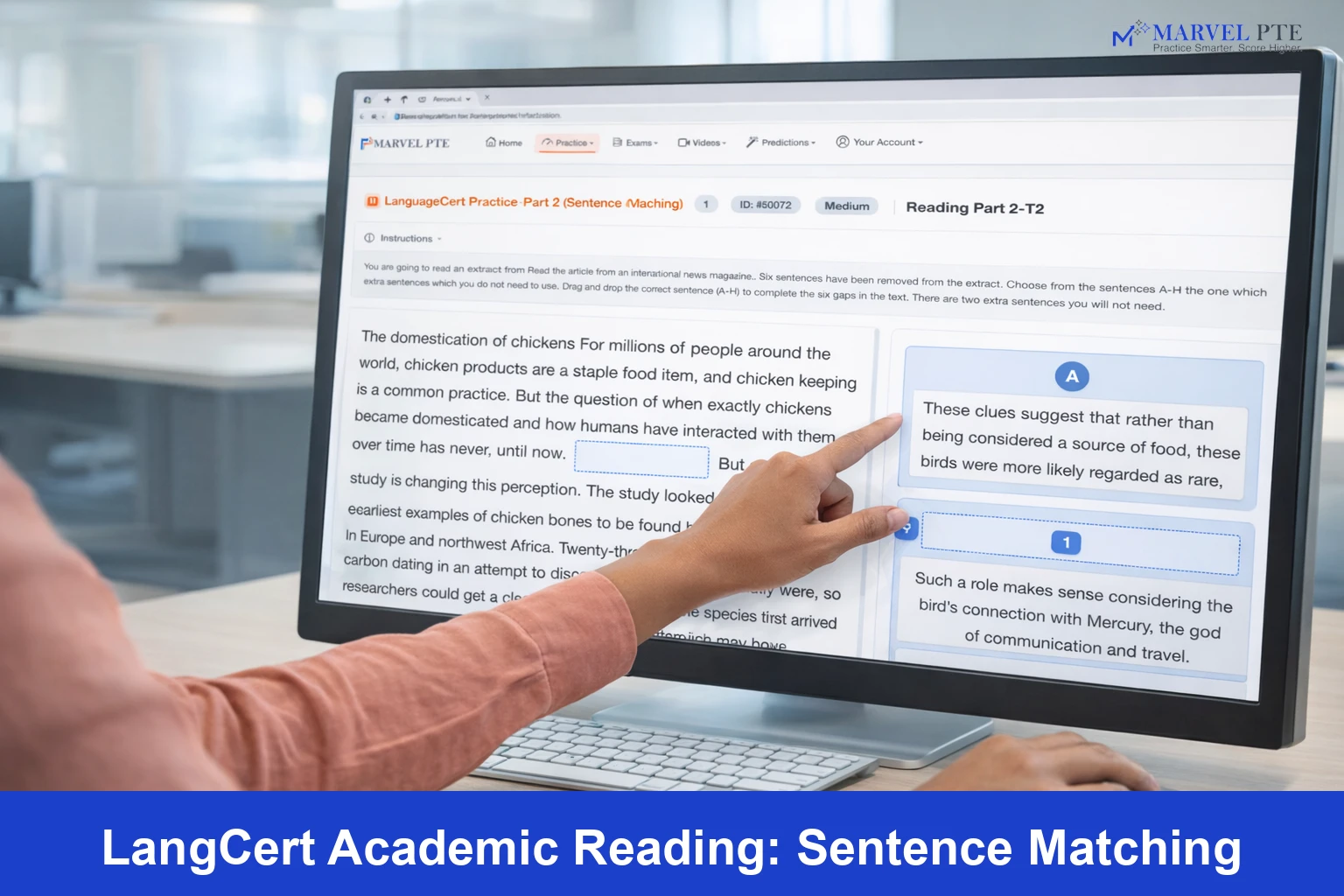
Part 2 presents an article with 6 numbered gaps where sentences have been removed. On the right side of your screen, you’ll see 8 sentence options labelled A through H. Your task is to drag each correct sentence from the right and drop it into the appropriate gap on the left.
The official instruction reads:
“Drag and drop the correct sentence (A-H) to complete the six gaps in the text. There are two extra sentences you will not need.”
What the interface looks like:
The article topics are academic but accessible. You might read about scientific discoveries, historical events, social trends, or technological developments. No specialist knowledge is required, though the writing style is formal.
Understanding the interface helps you work faster. Practising with the actual drag-and-drop layout before exam day means less time figuring out mechanics and more time focusing on the content.
Practice smarter with AI-powered mock tests and instant feedback.
Each correctly placed sentence earns you marks toward your overall Reading score. LanguageCert Academic scores each skill separately, and your Reading score depends on getting as many of the 30 questions correct as possible.
How scoring works:
Why accuracy matters here:
Part 2 questions test your understanding of text structure. If you struggle to see how ideas connect, it may affect your performance in Parts 3 and 4 where you need to track information across longer texts.
For Australian immigration purposes:
| Level | Reading Score | PR Points |
|---|---|---|
| Competent | 60 | 0 |
| Proficient | 71 | 10 |
| Superior | 83 | 20 |
Every question counts. Six correct answers in Part 2 contribute directly to reaching these thresholds.
Part 2 tests skills that go beyond vocabulary and grammar:
Logical progression of ideas
Academic texts follow patterns. An introduction leads to supporting details, examples follow claims, and conclusions tie back to main points. Recognising these patterns helps you predict what type of sentence belongs in each gap.
Cohesive devices
Writers use specific words to connect ideas:
Topic continuity
Each paragraph typically develops one main idea. A sentence that suddenly introduces an unrelated concept probably doesn’t belong, even if its vocabulary seems relevant.
Rejecting “almost correct” options
The two distractor sentences are designed to look plausible. They might contain related vocabulary or discuss the same general topic, but they won’t fit the logical flow. Learning to spot why a sentence doesn’t quite work is as important as recognising why the correct one does.
Build your sentence matching skills with targeted drag-and-drop practice.
Here’s how a Part 2 passage might look:
Environmental scientists have been monitoring coral reef health across the Pacific for two decades. (1) Some species showed remarkable ability to recover from bleaching events, while others declined steadily.
The research team identified several factors affecting reef resilience. Water temperature played the expected role, but (2) Local fishing practices, for example, had a greater impact than initially thought.
These findings have practical implications. (3) Reducing local stressors might give reefs the breathing room they need to adapt to gradually warming waters…
Sample sentence options:
Gap 1: Option A fits because “Their findings” refers back to the scientists’ monitoring, and “coral species responded” connects to the next sentence about species showing different responses.
Gap 2: Option C fits because “Other influences” connects to the previous mention of “water temperature” and leads naturally to the example about fishing practices.
Gap 3: Option D fits because “therefore” signals a conclusion drawn from the findings, and “factors within immediate human control” connects to reducing local stressors.
Option B is a distractor. It contradicts the passage’s point that multiple factors matter, not just climate.
Read the full article first
Before looking at the sentence options, read the entire article with gaps. Get a sense of the topic, the argument being made, and the overall structure. This helps you predict what type of content belongs in each gap.
Identify what comes before and after each gap
The sentences immediately before and after a gap provide crucial clues:
Look for reference clues
Pronouns and reference words must point to something specific:
Match ideas, not just keywords
Distractors often contain vocabulary from the passage. Don’t be fooled by surface-level matches. Ask whether the sentence advances the logical argument of the paragraph.
Leave difficult gaps and return later
If two sentences seem equally suitable for one gap, skip it. Completing easier gaps first often clarifies the difficult ones through elimination.
Use elimination strategically
With 8 options and 6 gaps, you need to identify the 2 sentences that don’t belong anywhere. If you can confidently spot even one distractor early, you’ve simplified all your remaining decisions.
Pro Tip: After placing all sentences, read the completed article in your head. If any sentence sounds awkward or breaks the logical flow, reconsider that placement.
You have approximately 10 minutes for Part 2’s 6 questions. Here’s how to use that time effectively:
Recommended approach:
Why Part 2 shouldn’t take longer:
Parts 3 and 4 have more questions and require careful reading. If you spend too long on Part 2, you’ll rush the later sections where precision matters most.
Drag-and-drop efficiency:
The interface allows you to:
Practise with the actual interface so mechanics don’t slow you down on exam day.
When to move on:
If you’ve spent more than 2 minutes on a single gap, make your best guess and flag it for review. Spending 4 minutes on one question means rushing through three others.
Yes. LanguageCert allows you to navigate freely within the Reading section.
How this reduces pressure compared to PTE:
In PTE Academic, once you move past a question, you cannot return. This creates anxiety about making the “right” choice immediately. LanguageCert’s approach lets you:
Smart review strategy:
Don’t review every question. Focus on:
Why over-editing can be risky:
Research shows that first instincts are often correct. If you change too many answers without clear reasons, you might move from right to wrong. Only change an answer if you can articulate why the new choice is better.
Preparing for Part 2 requires developing pattern-recognition skills beyond what textbooks offer. Marvel Edu provides targeted practice that builds these skills efficiently.
| Feature | What You Get |
|---|---|
| Real Exam-Style Interface | Drag-and-drop practice matching the actual LanguageCert layout |
| Targeted Practice Sets | Questions focused specifically on sentence matching |
| Instant Feedback | Explanations showing why each sentence fits or fails |
| Distractor Analysis | Learn to identify the 2 sentences that don’t belong |
| Timed Practice | Build exam-day speed with realistic 10-minute Part 2 sessions |
| Full Reading Mock Tests | Complete coverage from Part 1a through Part 4 |
The LanguageCert practice on Marvel Edu includes authentic article-style passages with the same cohesion challenges you’ll face on exam day.
Before finalising each gap, ask yourself:
If you can answer yes to all five, move on with confidence.
Matching based only on keywords
A sentence containing “coral reef” might not belong in a gap about coral reefs. The vocabulary match might be superficial while the logical connection is absent.
Ignoring sentence flow and cohesion
Each sentence should feel like a natural continuation of the previous one. If you have to mentally “force” the connection, the sentence probably doesn’t belong there.
Spending too long on one gap
With 6 gaps in 10 minutes, you have under 2 minutes per question including reading time. Getting stuck on one gap jeopardises your entire Part 2 performance.
Forgetting there are two extra options
Some candidates try to place all 8 sentences, leading to confusion. Remember: 2 sentences are designed not to fit anywhere.
Assuming LanguageCert Reading behaves like PTE Reading
The question types, scoring, and navigation differ between tests. Strategies that work for PTE fill-in-the-blanks won’t directly transfer to LanguageCert sentence matching.
The LanguageCert Academic test is available at approved test centres worldwide, including locations across Australia, the UK, and internationally. When booking your exam, you can choose between taking the LanguageCert test at a physical test centre or completing it as an online exam from home with remote proctoring.
Before your exam day, review your test results requirements. For Australian immigration applications, you need specific scores in listening, reading, writing, and speaking. The LanguageCert Academic test meets English language requirements for skilled migration visas and other subclass applications.
LanguageCert Academic is recognised as a secure English language test (SELT) for immigration and university admission purposes. The qualification demonstrates English proficiency at academic level, meeting English language requirements set by institutions for higher education and professional registration.
Your test score reflects your language skills across all four components. Unlike some English tests that combine scores, LanguageCert Academic provides separate results for each skill, giving a clear picture of your English proficiency in different areas.
Effective preparation includes using practice papers and practice tests that mirror the actual exam structure. Many test takers find that working with authentic practice paper materials helps reduce exam stress and builds confidence for exam success.
Focus on understanding the exam structure for each section. For Reading Part 2 specifically, practise identifying cohesive devices and tracking how ideas flow between sentences. This skill transfers across all academic reading tasks and supports your overall language proficiency development.
In LanguageCert Academic Reading Part 2, how many sentence options are provided compared to the number of gaps in the text?
How does the LanguageCert interface differ from the PTE Academic exam in terms of navigation?
What is a primary characteristic of distractor sentences in Part 2?
Which of these is a cohesive device used to signal relationships between ideas in a text?
What strategy is suggested if a candidate finds two sentences that both seem to fit one gap?
What is the primary skill tested in LanguageCert Academic Reading Part 2?
The ability to understand cohesion and the logical flow of a text.
How many numbered gaps are typically found in the Reading Part 2 article?
Six gaps.
In the sentence matching task, how many total sentence options are provided to fill the gaps?
Eight options.
What is the purpose of the two extra sentence options in Part 2?
They act as distractors designed to confuse the candidate.
How many total questions comprise the LanguageCert Academic Reading section?
Thirty questions.
What is the recommended time allocation for completing Part 2?
Ten minutes.
How is the scoring weight distributed across the six questions in Part 2?
Each of the six questions carries equal weight.
What Reading score is required to reach the 'Proficient' level for Australian immigration points?
Seventy-one.
A 'Competent' Reading score of 60 results in how many Australian PR points?
Zero points.
In which Reading part do candidates move from individual word choices to paragraph-level understanding?
Part 2.
Access mock tests covering all 5 Reading parts with detailed explanations.

LanguageCert Academic Speaking Part 2 tests your ability to handle real conversations in academic settings. …
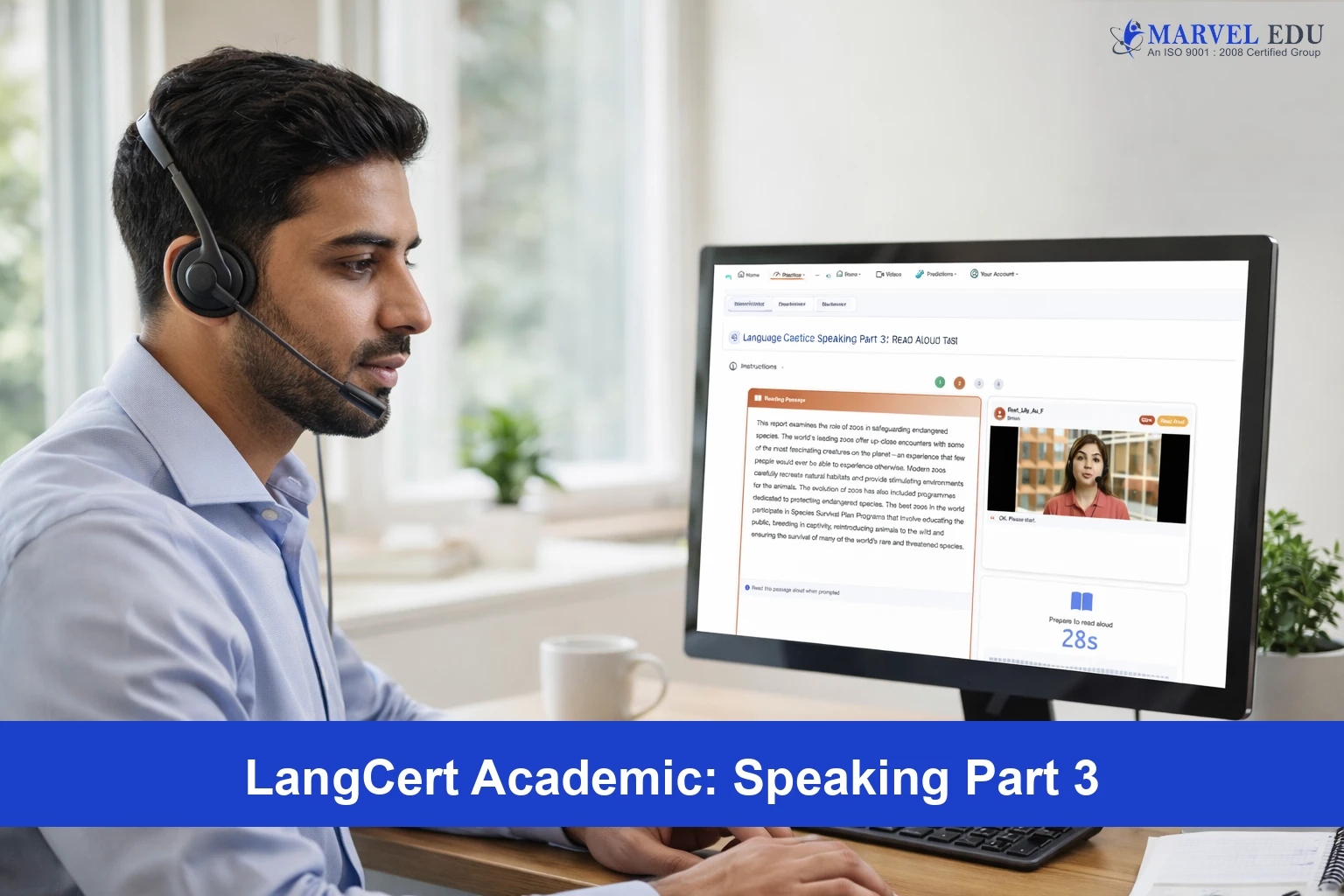
LanguageCert Academic Speaking Part 3 tests two skills in one task: reading aloud and expressing an opinion. …

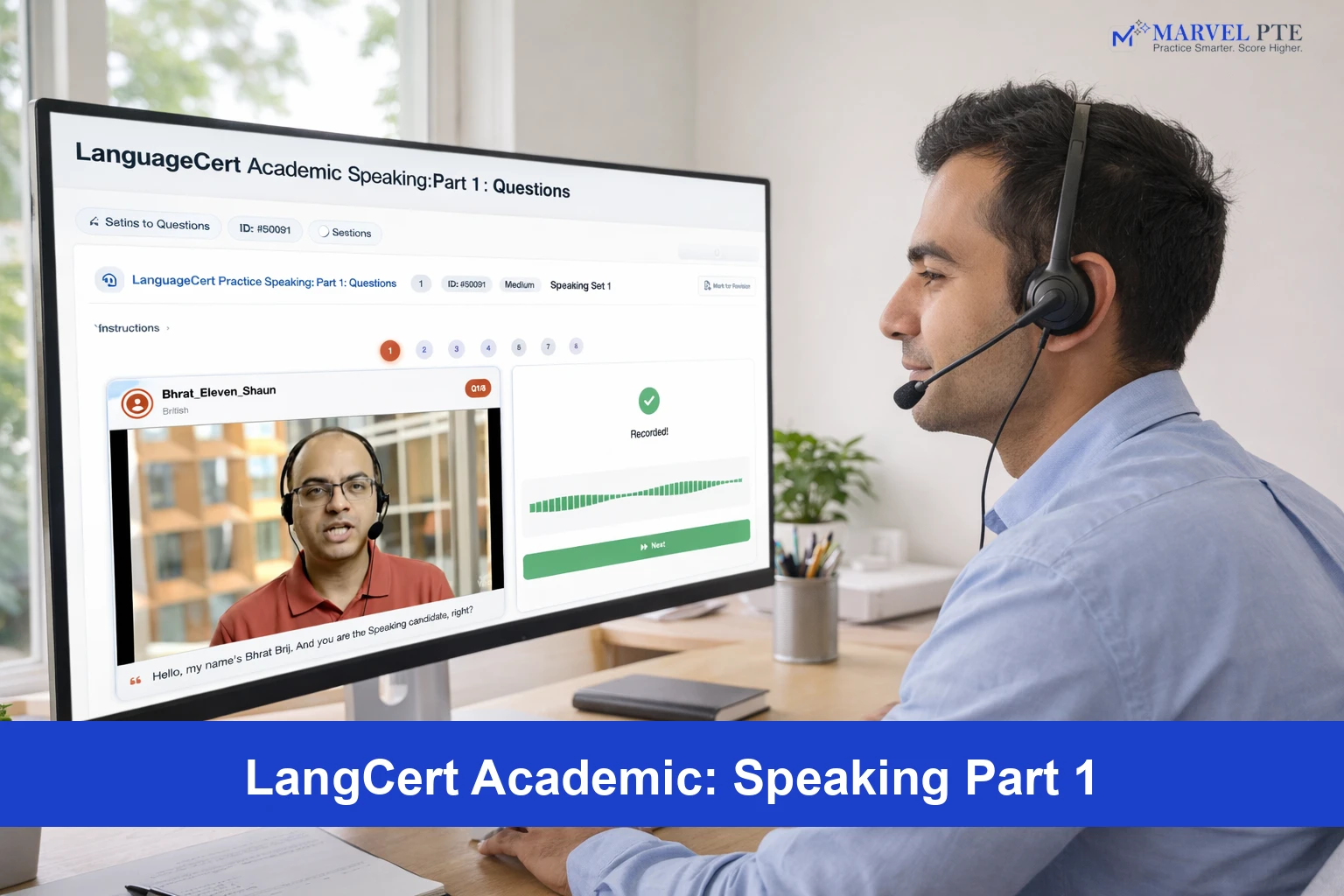
LanguageCert Academic Speaking Part 1 is the opening section of the speaking test, where the examiner asks you …
