
LanguageCert Academic
LanguageCert Academic Speaking Part 2: Role Play Task Format, Scoring, and Strategies
LanguageCert Academic Speaking Part 2 tests your ability to handle real conversations in academic settings. …

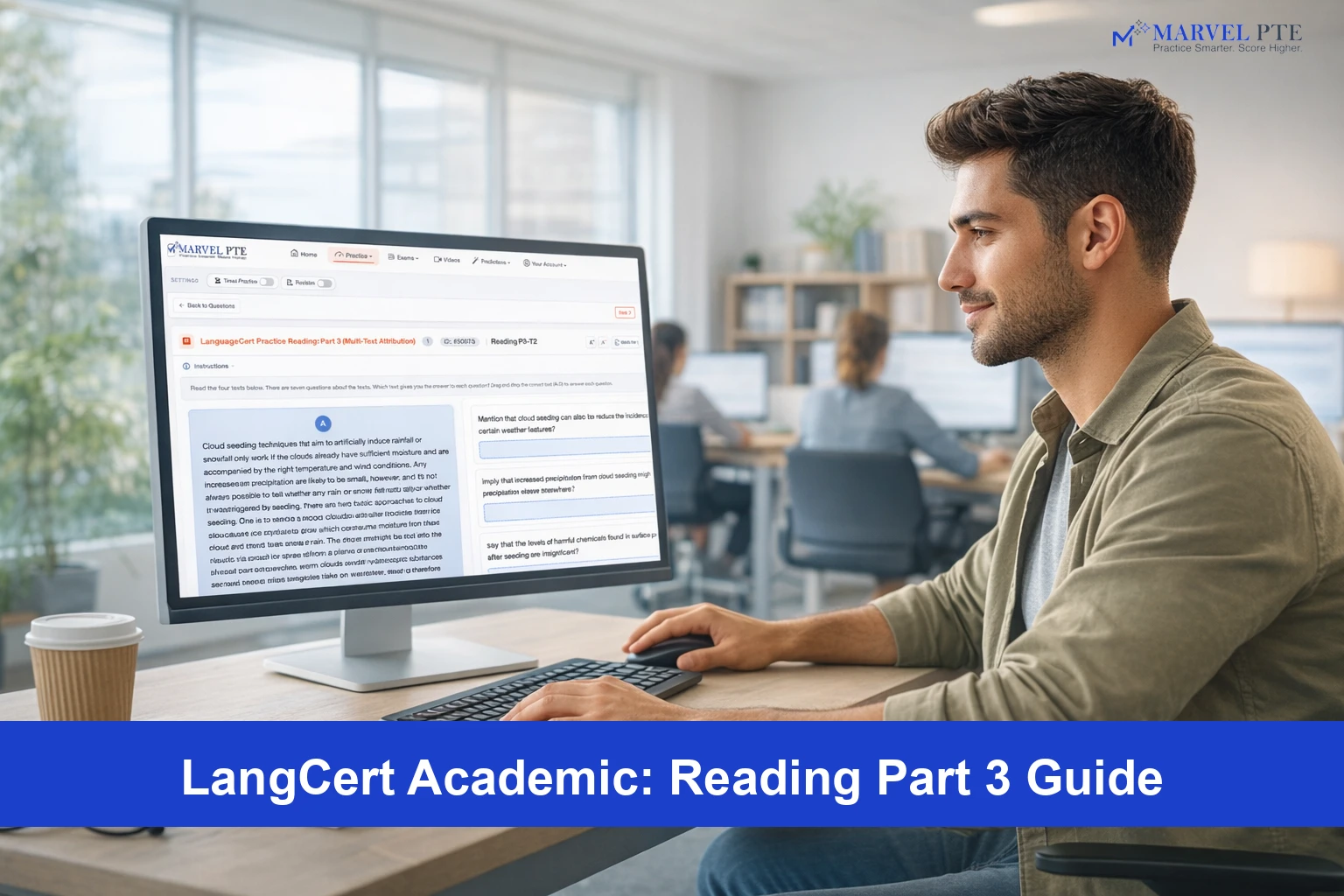
Reading Part 3 introduces a new challenge: working with multiple texts simultaneously. After completing the vocabulary questions in Part 1a, grammar gap-fill in Part 1b, and sentence matching in Part 2, you now face four short texts on a common theme and must identify which text contains specific information.
Part 3 sits within the 50-minute Reading section that contains 30 questions across 5 parts. This part tests your ability to scan, compare, and locate information across multiple sources.
The official instruction reads:
“Read four short texts on a common theme and answer questions to identify information from the texts.”
Here’s where Part 3 fits in the Reading test structure:
| Part | Questions | What It Tests | Time Suggestion |
|---|---|---|---|
| Part 1a | 6 | Vocabulary in context (4 options) | 6 minutes |
| Part 1b | 5 | Grammar gap-fill (3 options) | 5 minutes |
| Part 2 | 6 | Sentence matching (8 options) | 10 minutes |
| Part 3 | 7 | Text matching (4 texts) | 11-12 minutes |
| Part 4 | 6 | Long text MCQ (4 options) | 16-18 minutes |
| Total | 30 | 50 minutes |
Part 3 tests your ability to quickly locate and compare information across different sources. Unlike Part 2 where you work within a single text, Part 3 requires you to track what each of four different writers says about the same topic.
Key Point: The four texts discuss the same theme but from different angles. Each writer may have a different opinion, focus on different aspects, or present different facts. Your job is to identify which text contains specific information.
Part 3 presents four short texts labelled A, B, C, and D, followed by 7 questions. Each question asks you to identify which text contains certain information, and you drag and drop the correct text letter to match.
What the interface looks like:
Types of questions you’ll see:
Important to understand:
Practice smarter with AI-powered mock tests and instant feedback.
Each correctly matched question earns one mark toward your overall Reading score. LanguageCert Academic scores each skill separately, and your Reading score depends on getting as many of the 30 questions correct as possible.
How scoring works:
Why accuracy matters in Part 3:
Part 3 questions require careful scanning and comparison. Rushing through the texts often leads to confusing which writer said what, especially when multiple texts discuss similar points.
For Australian immigration purposes:
| Level | Reading Score | PR Points |
|---|---|---|
| Competent | 60 | 0 |
| Proficient | 71 | 10 |
| Superior | 83 | 20 |
Seven correct answers in Part 3 contribute directly to reaching these thresholds.
Master text matching with authentic multi-text practice sets.
Here’s how Part 3 works in practice:
Sample texts on the topic: “Remote Work”
Text A: “The shift to remote work has fundamentally changed how companies approach office space. Many organisations have downsized their physical premises, recognising that employees can be productive from home. However, this transition has not been without challenges, particularly for new hires who miss the informal learning that happens in person.”
Text B: “Working from home offers undeniable benefits for work-life balance. Parents can manage childcare more flexibly, and the elimination of commuting saves both time and money. Yet critics argue that remote work blurs the boundary between professional and personal life, leading some employees to work longer hours than before.”
Text C: “Research indicates that remote workers often report higher job satisfaction than their office-based counterparts. The autonomy to structure one’s own day appeals to many professionals. Nevertheless, isolation remains a concern, with some studies linking prolonged remote work to increased feelings of loneliness.”
Text D: “The environmental impact of reduced commuting cannot be ignored. Fewer cars on the road means lower carbon emissions, and some environmentalists view the remote work trend as a positive development for climate goals. Companies have also noted reduced energy consumption in their buildings.”
Sample questions:
“Which text mentions the impact of remote work on the environment?”
“In which text does the writer suggest that remote work can negatively affect employee wellbeing?”
“Which writer discusses how remote work affects new employees specifically?”
How to approach these questions:
Skim all four texts first
Before looking at the questions, read through all four texts quickly. Your goal is to understand the main point of each text and note what makes each one unique. This takes 3-4 minutes but saves time when answering questions.
Create mental labels for each text
As you read, mentally tag each text with its focus:
These labels help you quickly identify where to look for specific information.
Use question keywords to scan
When you read a question, identify the key concept and scan the texts for related vocabulary. If the question asks about “environmental impact,” scan for words like “emissions,” “climate,” “carbon,” or “energy.”
Eliminate impossible texts
Often, you can quickly rule out two texts that clearly don’t contain the information. This narrows your search to two texts, making it easier to find the correct match.
Watch for overlapping content
Sometimes multiple texts touch on similar topics. Text B and Text C might both mention work-life balance, but only one directly addresses the specific point in the question. Read carefully to distinguish which text actually makes the claim.
Pro Tip: The question wording often paraphrases what the text says. Don’t look for exact word matches; look for the same idea expressed differently.
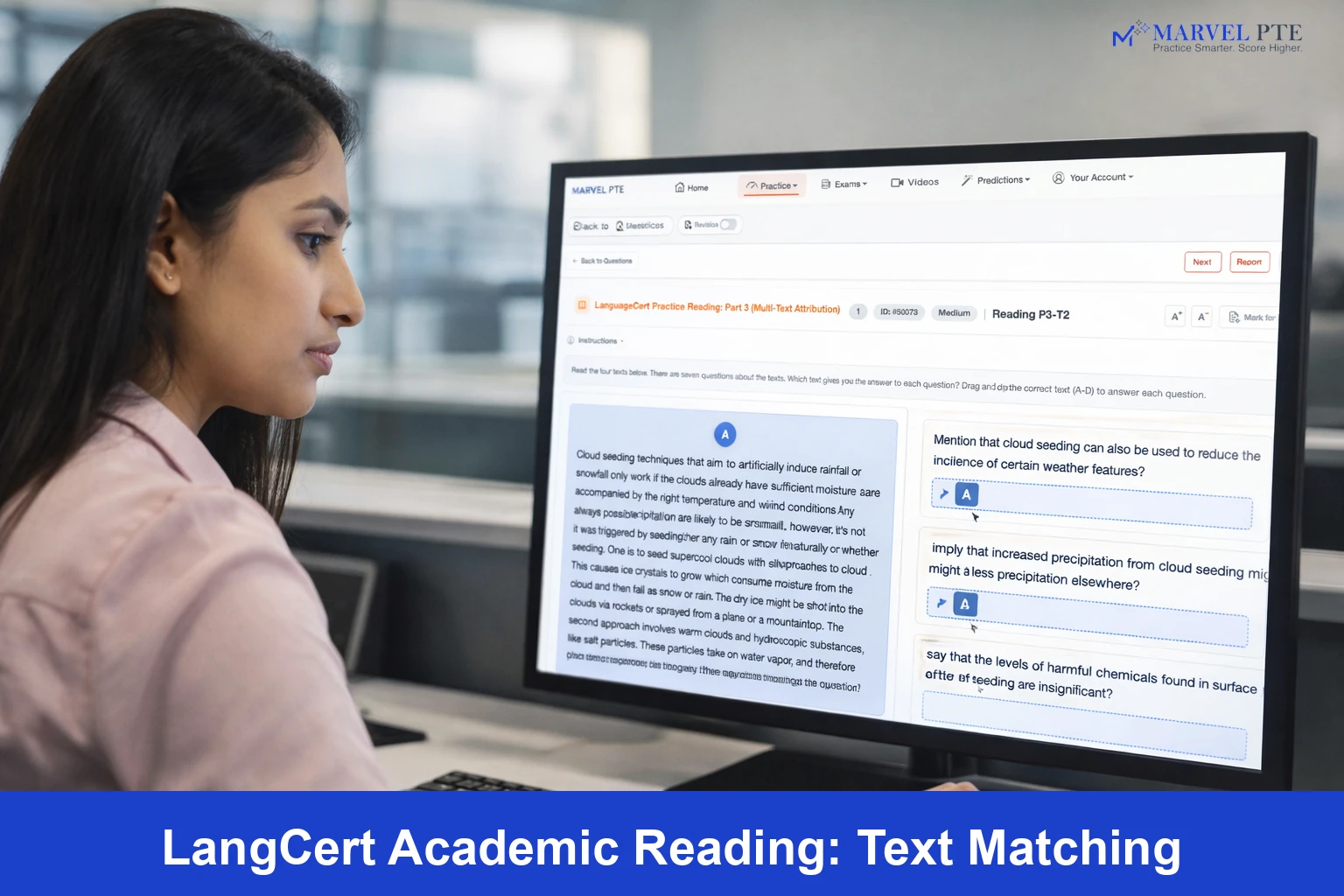
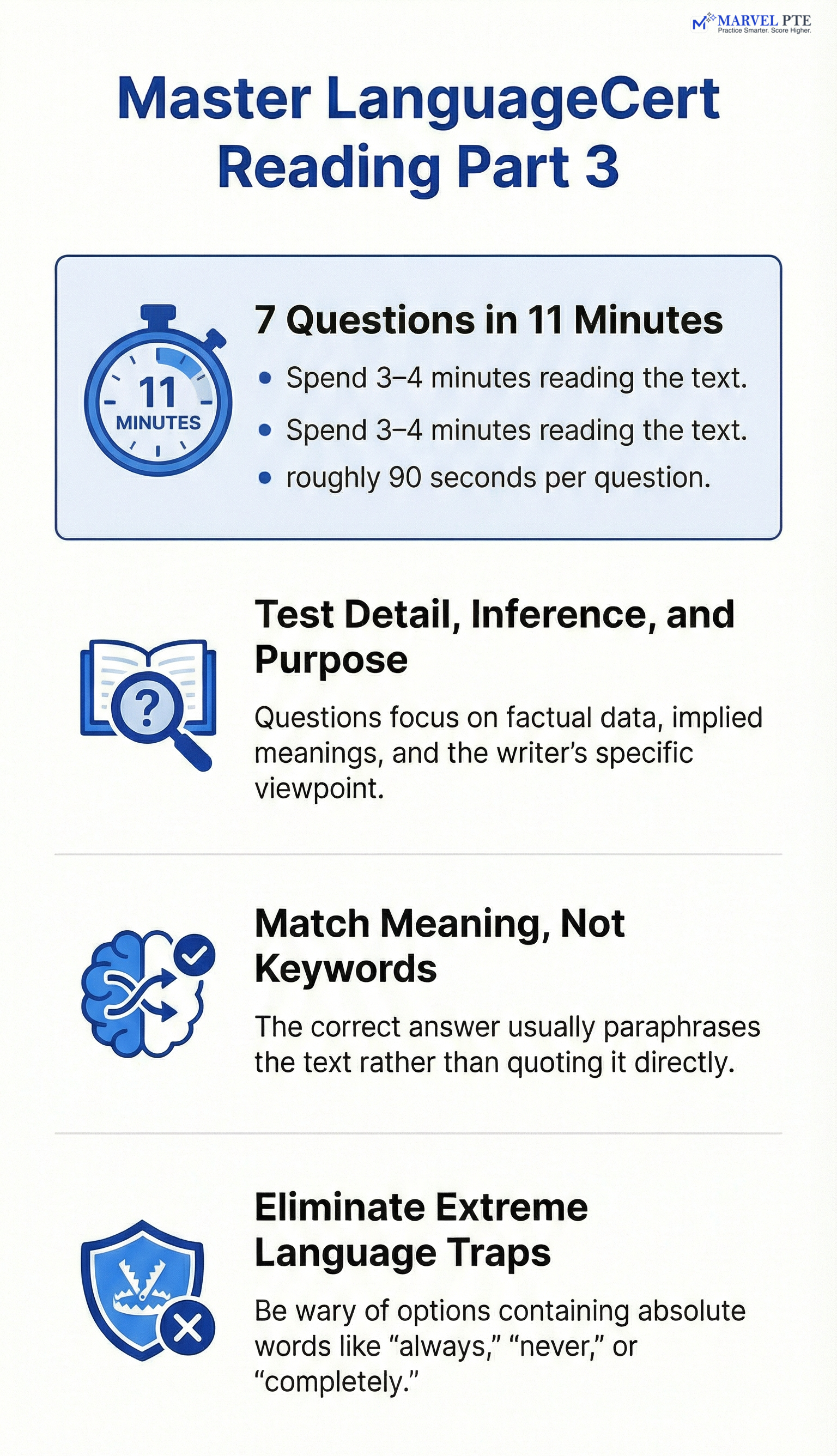
You have approximately 11-12 minutes for Part 3’s 7 questions. Here’s how to use that time effectively:
Recommended approach:
Time allocation breakdown:
| Task | Time | Purpose |
|---|---|---|
| Skim all 4 texts | 3-4 min | Understand main point of each |
| Answer 7 questions | 7 min | ~1 min per question |
| Review | 1-2 min | Check uncertain answers |
| Total | 11-12 min |
When to move on:
If you’ve spent more than 90 seconds on a single question without finding the answer, make your best guess and continue. The information is definitely in one of the four texts, so an educated guess based on elimination is better than spending too long.
Balancing Part 3 with other sections:
Part 4 requires more reading time because it has a longer text. Don’t let Part 3 eat into your Part 4 time. If you’re running behind, use the elimination strategy to make quick decisions.
LanguageCert allows you to revisit any Reading question before time runs out. This flexibility is valuable for Part 3 because you might discover helpful information while answering later questions.
When review helps:
When review wastes time:
Checking your work:
After completing Part 3, quickly verify that your answers make sense. If you’ve matched text A to four questions and haven’t used text D at all, reconsider your answers. While it’s possible for one text to answer multiple questions, all four texts are typically relevant.
Preparing for Part 3 requires developing the ability to quickly compare and contrast information across multiple sources. Marvel Edu provides targeted practice that builds these skills.
| Feature | What You Get |
|---|---|
| Authentic Multi-Text Practice | Four-text sets matching the actual LanguageCert format |
| Targeted Part 3 Sets | Questions focused specifically on information identification and text matching |
| Detailed Explanations | Learn why each text is or isn’t the correct match |
| Timed Practice Mode | Build exam-day speed with realistic 11-minute Part 3 sessions |
| Full Reading Mock Tests | Complete coverage from Part 1a through Part 4 |
| Comparison Skill Training | Exercises that develop your scanning and matching abilities |
The Reading practice on Marvel Edu includes authentic academic topics with the same complexity you’ll encounter on exam day.
Before your test, review these principles for Part 3 success:
Applying these principles consistently leads to better accuracy and confidence on exam day.
Confusing which text said what
With four texts on the same topic, it’s easy to mix up which writer made which point. The mental labelling strategy helps prevent this confusion.
Looking for exact word matches
Questions often paraphrase the text’s content. The question might ask about “negative effects” while the text says “drawbacks” or “challenges.” Focus on meaning, not identical words.
Reading too deeply on first pass
Your initial read should be quick. You’re building a mental map, not memorising details. Save deep reading for when you’re answering specific questions.
Spending too long on difficult questions
Every question is worth one mark. If you can’t find the answer quickly, make an educated guess and move on. Don’t sacrifice Part 4 time for one Part 3 question.
Assuming even distribution
While all four texts are usually used, don’t force an even split. If the correct answer is text B for three questions, that’s fine. Match based on content, not assumptions about distribution.
The LanguageCert Academic test is available at approved test centres worldwide, including locations across Australia, the UK, and internationally. When booking your exam, you can choose between taking the test at a physical test centre or completing it as an online exam from home with remote proctoring.
Before your exam day, review your test results requirements. For Australian immigration applications, you need specific scores in listening, reading, writing, and speaking. The LanguageCert Academic test meets English language requirements for skilled migration visas.
LanguageCert Academic is recognised as a secure English language test (SELT) for immigration and university admission purposes. It sits among approved tests accepted by the Australian Department of Home Affairs, alongside PTE Academic and IELTS.
Your test score reflects your language skills across all four components. LanguageCert Academic provides separate results for each skill, giving a clear picture of your proficiency in different areas. This differs from some tests that provide only an overall score.
For Australian visa purposes, only specific tests meet the English language requirement, and LanguageCert Academic SELT is one of them. The qualification demonstrates English proficiency at academic level, aligned with CEFR levels from B2 to C2.
Effective preparation includes using practice tests that mirror the actual exam structure. The official qualification handbook provides sample questions, though many test takers find that working with additional practice materials builds confidence.
For Reading Part 3 specifically, practise with multi-text sets that require you to compare information across sources. This skill transfers well to academic and professional contexts where you must synthesise information from different documents.
Consistent practice with targeted materials helps develop the specific scanning and matching abilities Part 3 requires. Many candidates benefit from timed practice sessions that simulate exam conditions.
How many texts do you read in Reading Part 3?
What is the main task in Part 3?
How many questions are in Part 3?
What Reading score is required for 'Proficient' status and 10 PR points for Australian immigration?
Which strategy is most effective for Part 3?
How many texts are presented in Reading Part 3?
Four short texts (A, B, C, D)
What is the common feature of the four texts?
They all discuss the same theme from different angles or perspectives.
How many questions must you answer in Part 3?
7 questions
What is the task format in Part 3?
Match each question to the text (A, B, C, or D) that contains the relevant information.
How is Part 3 answered in the test interface?
Drag and drop the text letter to match each question.
Can the same text be the answer to multiple questions?
Yes, a text may answer more than one question.
What makes Part 3 different from Part 4?
Part 3 has four short texts with matching; Part 4 has one long text with MCQ.
How much time is suggested for Part 3?
Approximately 11-12 minutes
What should you note while reading each text?
The main point, unique details, and the writer's perspective.
Why is skimming useful in Part 3?
It helps you quickly locate which text contains the information asked in each question.
Access mock tests covering all 5 Reading parts with detailed explanations.

LanguageCert Academic Speaking Part 2 tests your ability to handle real conversations in academic settings. …
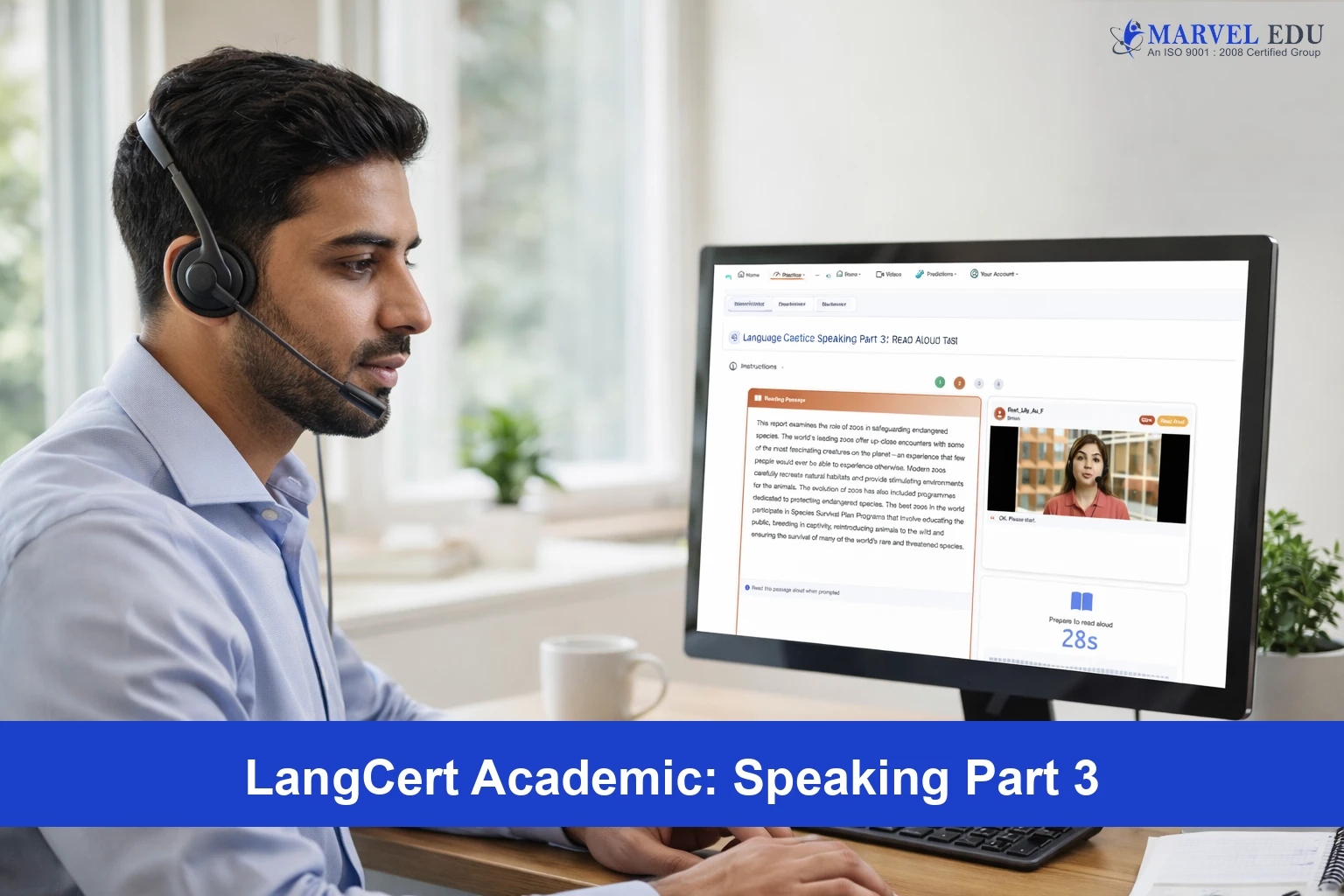
LanguageCert Academic Speaking Part 3 tests two skills in one task: reading aloud and expressing an opinion. …

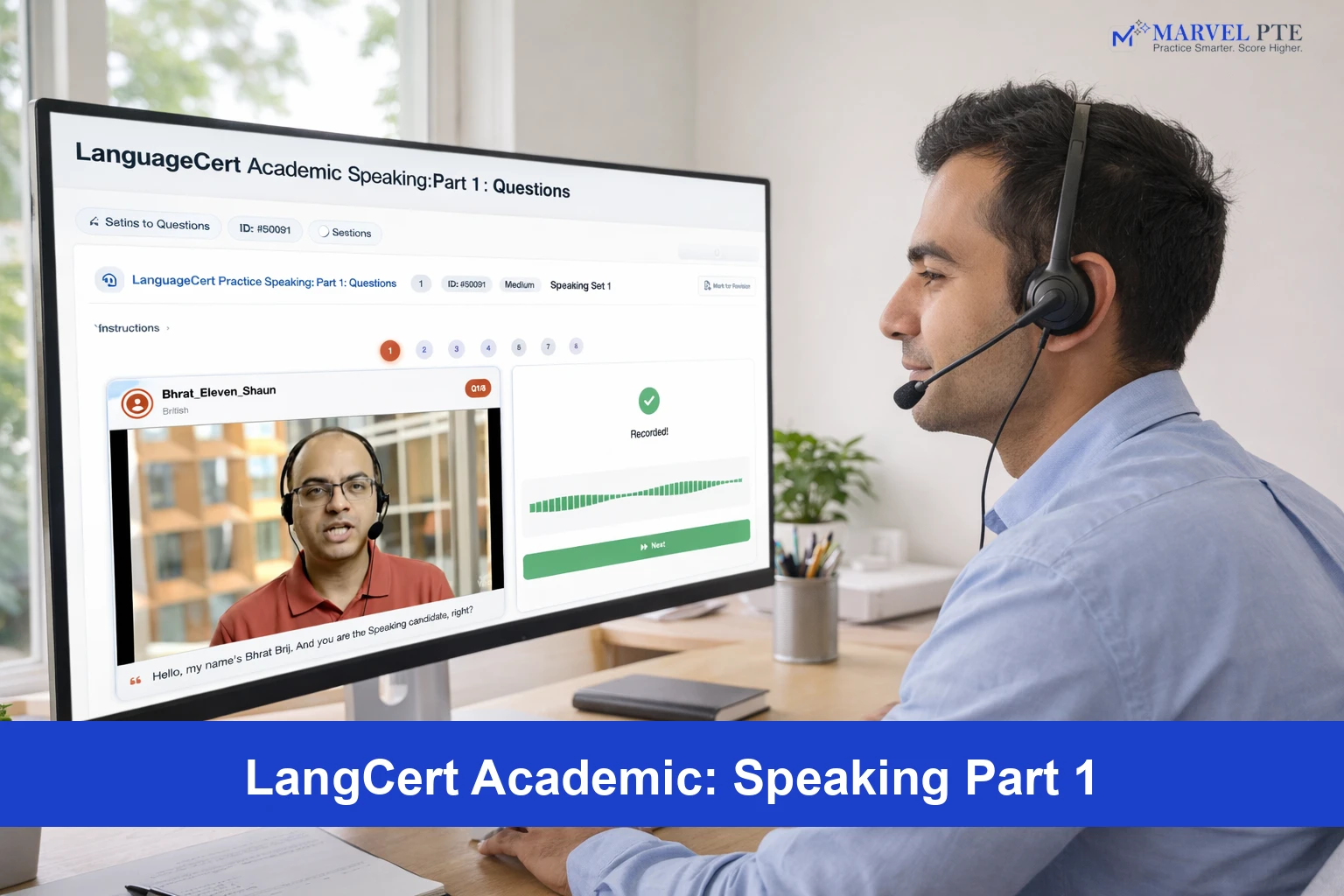
LanguageCert Academic Speaking Part 1 is the opening section of the speaking test, where the examiner asks you …
