
LanguageCert Academic
LanguageCert Academic Speaking Part 2: Role Play Task Format, Scoring, and Strategies
LanguageCert Academic Speaking Part 2 tests your ability to handle real conversations in academic settings. …

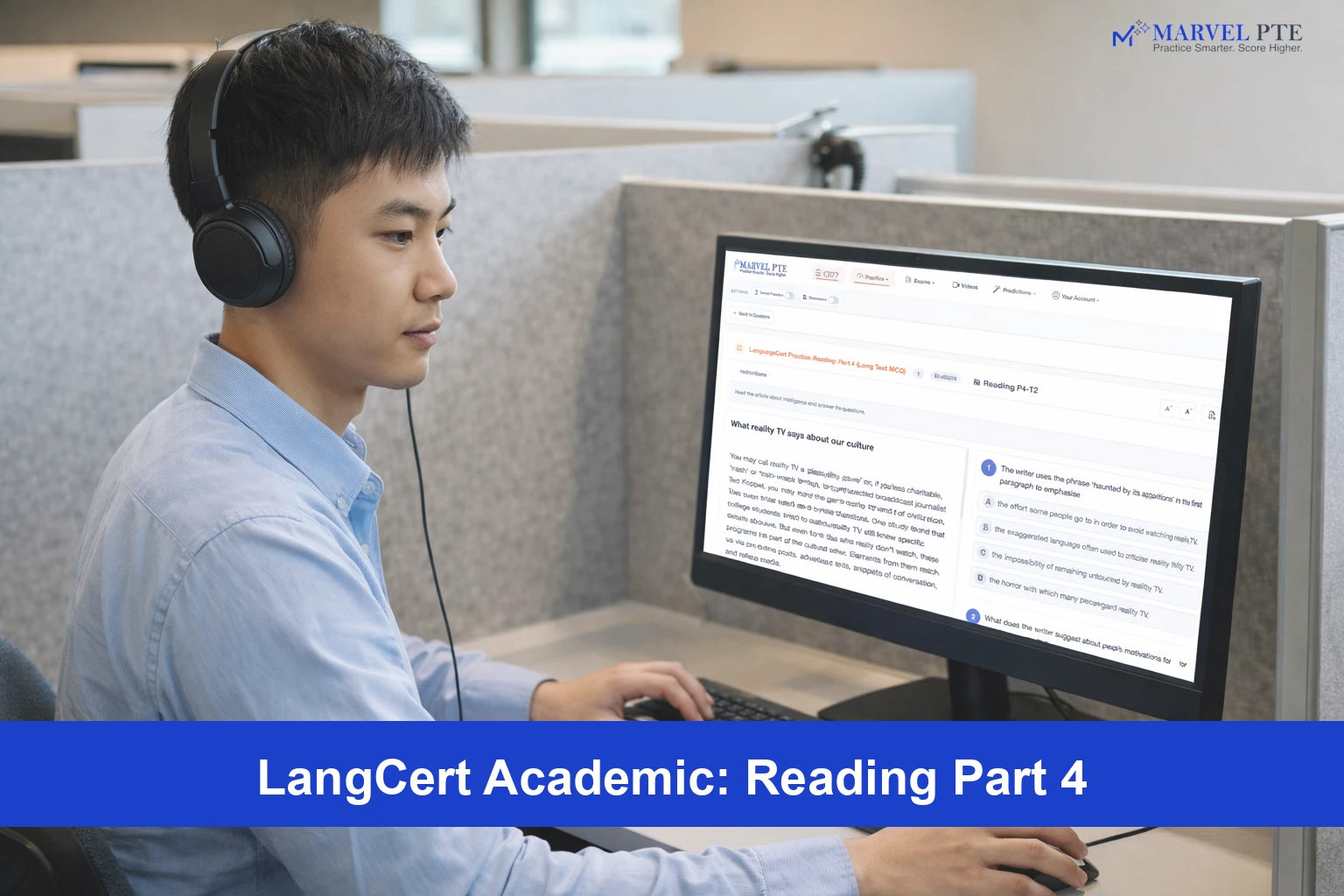
Reading Part 4 represents the final and most demanding section of the LanguageCert Academic Reading test. After working through vocabulary questions, grammar gap-fill, sentence matching, and multi-text comparison in Parts 1 through 3, you now face a longer academic passage with six multiple-choice questions that test deep comprehension and inference skills.
Part 4 completes the 50-minute Reading section that contains 30 questions across 5 parts. This final part tests your ability to understand complex academic argumentation, identify writer’s opinions, and draw logical conclusions from extended text.
The official instruction reads:
“Read a longer text with academic argumentation and answer six four-option multiple-choice questions.”
Here’s where Part 4 fits in the Reading test structure:
| Part | Questions | What It Tests | Time Suggestion |
|---|---|---|---|
| Part 1a | 6 | Vocabulary in context (4 options) | 6 minutes |
| Part 1b | 5 | Grammar gap-fill (3 options) | 5 minutes |
| Part 2 | 6 | Sentence matching (8 options) | 10 minutes |
| Part 3 | 7 | Text matching (4 texts) | 11-12 minutes |
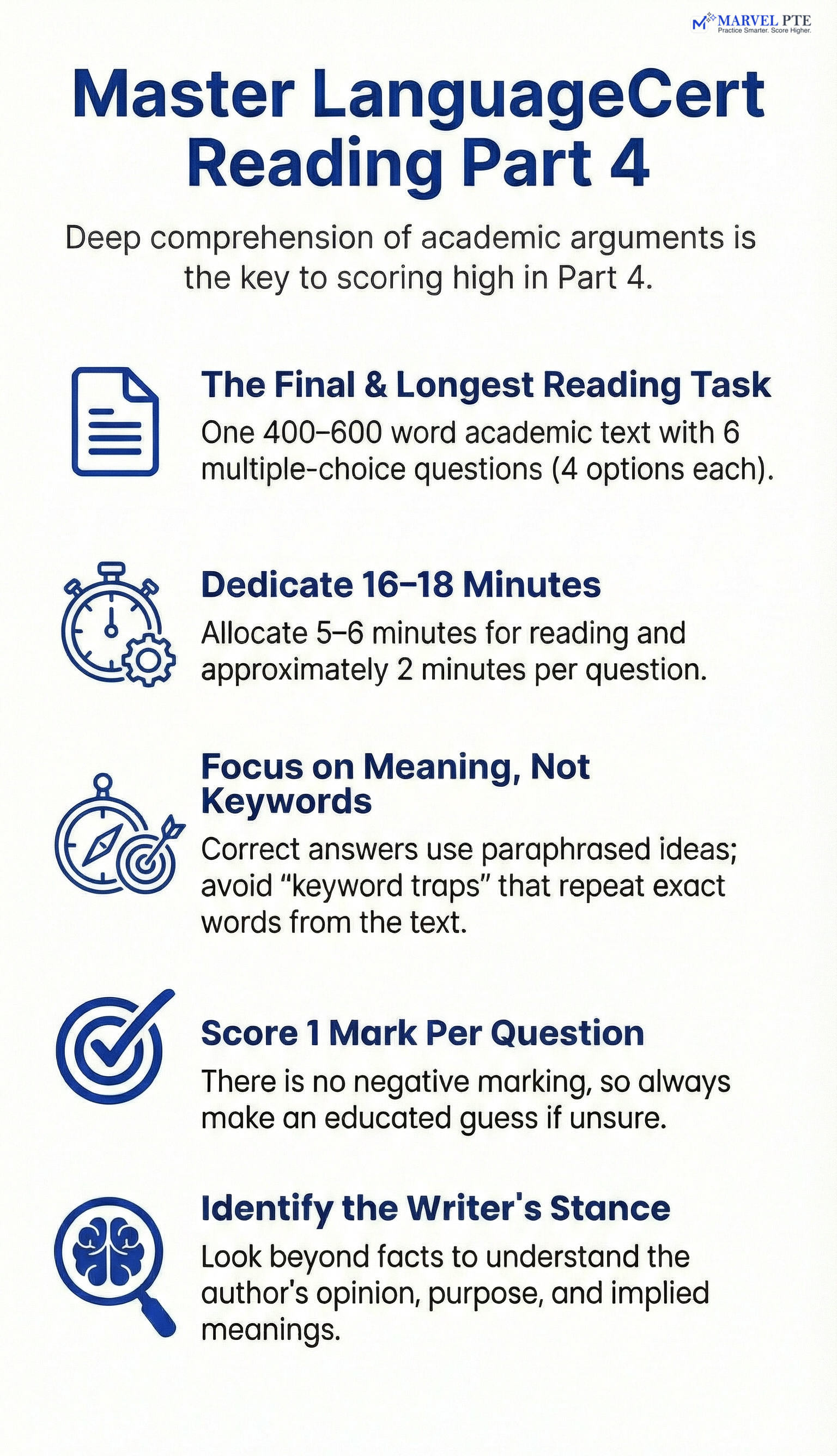
| Part 4 | 6 | Long text MCQ (4 options) | 16-18 minutes |
| Total | 30 | 50 minutes |
Part 4 differs from earlier parts because the passage is substantially longer and the questions require deeper analysis. You cannot simply scan for keywords; you must understand how ideas connect across paragraphs and recognise the writer’s underlying argument.
Key Point: Part 4 passages present academic argumentation. The writer takes a position, presents evidence, and may acknowledge counterarguments. Questions often ask about the writer’s attitude, purpose, or implied meaning.
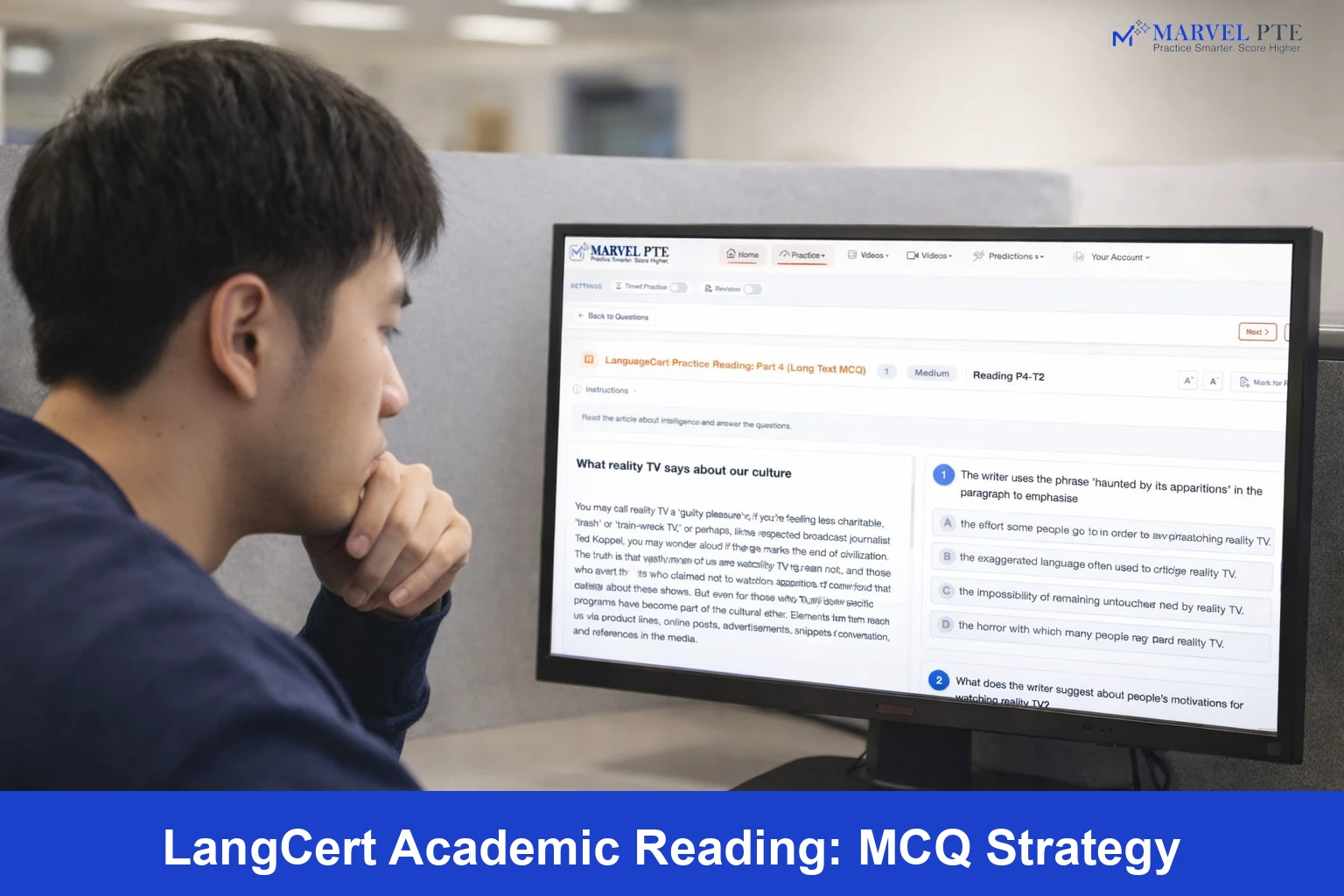
Part 4 presents one extended academic passage on the left side of the screen with six multiple-choice questions on the right. Each question offers four options (A, B, C, D), and you select your answer using radio buttons.
What the interface looks like:
Types of questions you’ll see:
Important to understand:
Practice smarter with AI-powered mock tests and instant feedback.
Each correctly answered question earns one mark toward your overall Reading score. LanguageCert Academic scores each skill separately, and your Reading score depends on accuracy across all 30 questions.
How scoring works:
Why accuracy matters in Part 4:
Part 4 questions test deeper understanding than earlier parts. Rushing through the passage often leads to misunderstanding the writer’s argument or missing subtle implications that questions target.
For Australian immigration purposes:
| Level | Reading Score | PR Points |
|---|---|---|
| Competent | 60 | 0 |
| Proficient | 71 | 10 |
| Superior | 83 | 20 |
Six correct answers in Part 4 contribute significantly toward reaching these thresholds.
Master long text comprehension with authentic academic passages.
Here’s how Part 4 works in practice:
Sample passage excerpt on “Urban Green Spaces”:
“The expansion of urban green spaces has become a priority for city planners worldwide. Advocates argue that parks and gardens provide essential recreational opportunities for city dwellers while also improving air quality and reducing the urban heat island effect. However, creating new green spaces often requires displacing existing residents or businesses, raising difficult questions about whose interests should take priority.
Critics of aggressive green space expansion point out that well-intentioned policies can inadvertently contribute to gentrification. When a neighbourhood gains an attractive park, property values tend to rise, potentially forcing long-term residents to relocate. This outcome contradicts the very purpose of creating spaces that benefit the community. Some urban planners have responded by advocating for community-led design processes that give local residents more control over how green spaces are developed and maintained.”
Sample questions:
“What is the writer’s main purpose in paragraph 1?”
Answer: B (The paragraph presents both positive aspects and “difficult questions”)
“What does ‘This outcome’ in paragraph 2 refer to?”
Answer: B (Reading the context: rising property values “forcing long-term residents to relocate” contradicts the community benefit purpose)
“According to the passage, some urban planners suggest that…”
Answer: B (Final sentence mentions “community-led design processes”)
How to approach these questions:
Identifying main ideas versus supporting details
Part 4 questions often ask about the writer’s central argument or the purpose of specific paragraphs. You must distinguish between the main point and the examples or evidence used to support it.
Understanding reference words
Questions frequently ask what words like “this,” “they,” “which,” or “such” refer to in context. These questions test whether you’re following the logical connections between sentences.
Recognising writer’s opinion, tone, and purpose
Academic texts often express viewpoints. Questions may ask what the writer believes, whether they support or oppose something, or why they include certain information.
Making logical inferences
Some answers aren’t stated directly. You must combine information from the passage to draw reasonable conclusions that the writer implies but doesn’t explicitly state.
Distinguishing fact from opinion
Part 4 passages blend factual information with the writer’s interpretations. Questions may test whether you can identify which statements are presented as facts versus opinions.
The reading skills you develop for Part 4 also support success in comprehending lectures and other academic content. Whether you encounter these texts in a university seminar or a professional report, the ability to identify main arguments and supporting evidence remains essential.
Skim the passage first for structure
Before reading in detail, spend 1-2 minutes understanding how the passage is organised. Note how many paragraphs there are and what each one seems to be about. This mental map helps you locate information quickly when answering questions.
Read questions before deep reading
After your initial skim, glance at the questions. This gives your detailed reading a purpose. You’ll naturally pay more attention to sections that questions target.
Focus on paragraph-level meaning
Don’t get lost in individual sentences. After reading each paragraph, pause to summarise its main point in your mind. This helps you understand how the argument develops.
Match ideas, not identical words
Correct answers often paraphrase the passage rather than repeating exact words. A question might ask about “financial difficulties” while the passage says “economic challenges.” Focus on meaning.
Eliminate wrong answers systematically
When unsure, evaluate each option against the passage. Wrong options often contain information that’s true but doesn’t answer the question, or they misrepresent what the passage says.
Pro Tip: Extreme language in options (always, never, completely, the only) is often a sign of a wrong answer. Academic writing typically uses more qualified language.
You have approximately 16-18 minutes for Part 4’s 6 questions. Here’s how to use that time effectively:
Recommended approach:
Time allocation breakdown:
| Task | Time | Purpose |
|---|---|---|
| Skim passage | 1-2 min | Understand structure |
| Detailed read | 4-5 min | Comprehend argument |
| Answer 6 questions | 10-12 min | ~2 min per question |
| Review | 2 min | Check uncertain answers |
| Total | 16-18 min |
When to move on:
If you’ve spent more than 3 minutes on a single question without deciding, make your best guess based on elimination and continue. You can return to it later if time permits.
Balancing Part 4 with the overall Reading section:
Part 4 requires the most time per question because of the passage length. If you’re running short from earlier parts, focus on questions you can answer confidently and make educated guesses on others.
LanguageCert allows you to revisit any Reading question before time runs out. This flexibility is particularly valuable for Part 4 because your understanding of the passage may deepen as you work through questions.
When review helps:
When review wastes time:
Smart review strategy:
As you answer, mentally note which questions felt uncertain. If you finish with time remaining, return to those specific questions rather than reviewing everything.
Choosing answers based on personal knowledge
The correct answer must be supported by the passage, even if you know additional information about the topic. Base your answers only on what the text says or clearly implies.
Falling for keyword-matching traps
Wrong options often contain exact words from the passage. An option mentioning “air quality” isn’t automatically correct just because the passage discusses air quality. Check that the option accurately represents what the passage says about that topic.
Ignoring qualifying words
Pay attention to words like “some,” “mainly,” “often,” and “rarely.” A question asking “What does the writer mainly argue?” needs a different answer than “What point does the writer mention?”
Spending too much time on one question
Every question is worth one mark. If you’re struggling, eliminate what you can, make your best choice, and move on. Don’t let one difficult question cost you time for easier ones.
Assuming only one paragraph matters
Part 4 questions sometimes require synthesising information from multiple paragraphs. Don’t assume the answer to question 3 is only in paragraph 3.
Preparing for Part 4 requires developing skills in extended text comprehension and academic argumentation. Marvel Edu provides targeted practice that builds these abilities.
| Feature | What You Get |
|---|---|
| Authentic Long-Text Practice | Academic passages matching LanguageCert format and difficulty |
| Targeted Part 4 Sets | Questions focused on inference, opinion, and detailed comprehension |
| Detailed Explanations | Learn why each option is correct or incorrect with passage references |
| Timed Practice Mode | Build exam-day stamina with realistic 16-minute Part 4 sessions |
| Full Reading Mock Tests | Complete coverage from Part 1a through Part 4 |
| Inference Training | Exercises that develop your ability to identify implied meaning |
The Reading practice on Marvel Edu includes authentic academic topics with the argumentative structure you’ll encounter on exam day.
Before your test, review these principles for Part 4 success:
Applying these principles consistently leads to better accuracy and confidence on exam day.
The LanguageCert Academic test is available at approved test centres worldwide, including locations across Australia, the UK, and internationally. When booking the LanguageCert Academic exam, you can choose between taking the test at a physical test centre or completing it as LanguageCert Academic online from home with remote proctoring.
Unlike paper-based English tests that require filling in an answer sheet, the LanguageCert Academic exam is entirely computer-delivered. You select answers by clicking radio buttons or dragging items on screen, and assessing writing performance happens through typed responses rather than handwritten scripts.
Before your exam day, review your test results requirements. For Australian immigration applications, you need specific scores in listening, reading, writing, and speaking. The LanguageCert Academic test meets English language requirements for skilled migration visas and is widely accepted for university admission at degree level programmes.
LanguageCert Academic is recognised as a secure English language test (SELT) for immigration and university admission purposes. This English test sits among approved tests accepted by the Australian Department of Home Affairs, alongside PTE Academic and IELTS. Many test takers preparing for the LanguageCert Academic exam choose it specifically because the speaking section features a human examiner rather than AI assessment.
Your test score reflects your English language proficiency across all four components: listening, reading, writing, and speaking. LanguageCert Academic provides separate results for each language skill, giving a clear picture of your proficiency in different areas. This differs from some English language tests that provide only an overall score.
For Australian visa purposes, only specific tests meet the English language requirement, and LanguageCert Academic SELT is one of them. The qualification demonstrates English proficiency at academic level, aligned with CEFR levels from B2 to C2. This makes it suitable for degree level study and positions requiring strong comprehension of academic texts.
Effective preparation includes using practice tests and practice papers that mirror the actual exam structure. The official qualification handbook provides sample questions and a qualification overview, though many test takers find that working with additional practice materials builds confidence and leads to exam success.
For Reading Part 4 specifically, practise with long academic passages that present arguments and opinions. Building strong academic vocabulary helps you understand texts on familiar topics as well as unfamiliar academic subjects. This language skill transfers well to higher education and professional contexts where you must understand and evaluate extended written arguments in an academic setting.
Consistent practice with targeted materials helps develop the specific comprehension and inference abilities Part 4 requires. Many candidates benefit from timed practice sessions that simulate exam conditions, similar to what they would experience at a test centre or through LanguageCert Academic online proctoring.
In the LanguageCert Academic Reading test, what is the primary focus of Part 4 compared to the earlier sections?
Why is it often a mistake to choose an answer option because it contains words identical to those in the passage?
How should a candidate handle a single question that is proving particularly difficult and time-consuming?
What is the 'Pro Tip' for identifying potentially incorrect multiple-choice options?
Which skill is being exercised when a candidate is asked to distinguish if a statement is something the writer believes versus something that is proven?
Which part of the LanguageCert Academic Reading test consists of a long text with six multiple-choice questions?
Part 4
How many marks is each correctly answered question worth in Part 4?
1 mark per correct answer
Is there negative marking for incorrect answers in LanguageCert Reading?
No, there is no negative marking
What is the recommended time allocation for completing Part 4?
Approximately 16-18 minutes
What cognitive skill is tested when questions ask for conclusions not explicitly stated?
Making logical inferences
What do reference word questions (this, they, which) specifically test?
The ability to follow logical connections and cohesive devices within the text
What does extreme language (always, never, completely) often indicate in MCQ options?
A likely incorrect distractor - be cautious when selecting such options
Why should test takers match ideas rather than identical words?
Correct answers use paraphrasing while distractors may use exact keywords misleadingly
When should you use personal knowledge to answer Part 4 questions?
Never - answers must be based only on what the passage says or clearly implies
What Reading score is required for Proficient status for Australian immigration?
71
Access mock tests covering all 5 Reading parts with detailed explanations.

LanguageCert Academic Speaking Part 2 tests your ability to handle real conversations in academic settings. …
LanguageCert Academic Speaking Part 3 tests two skills in one task: reading aloud and expressing an opinion. …

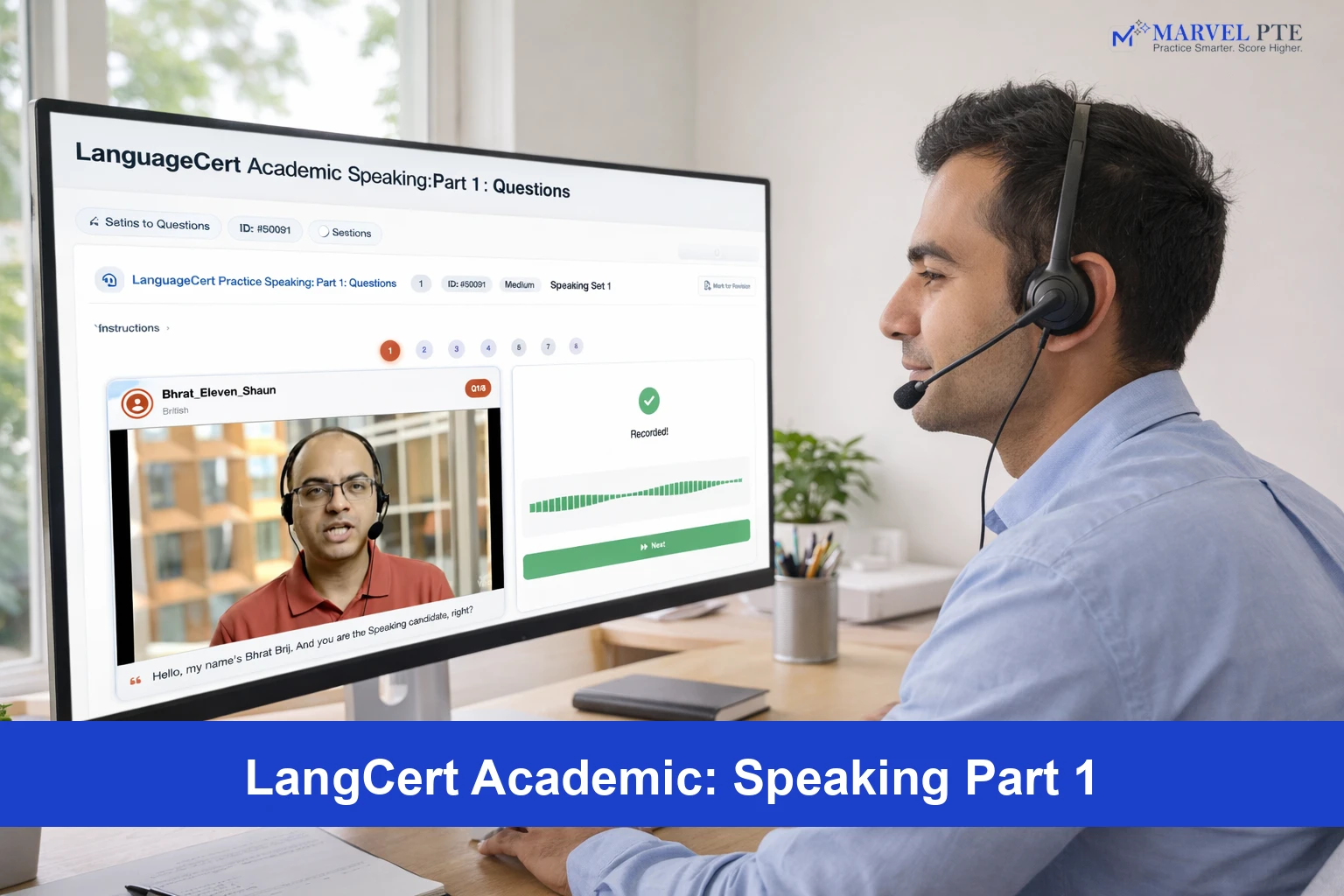
LanguageCert Academic Speaking Part 1 is the opening section of the speaking test, where the examiner asks you …
