
LanguageCert Academic
LanguageCert Academic Speaking Part 2: Role Play Task Format, Scoring, and Strategies
LanguageCert Academic Speaking Part 2 tests your ability to handle real conversations in academic settings. …

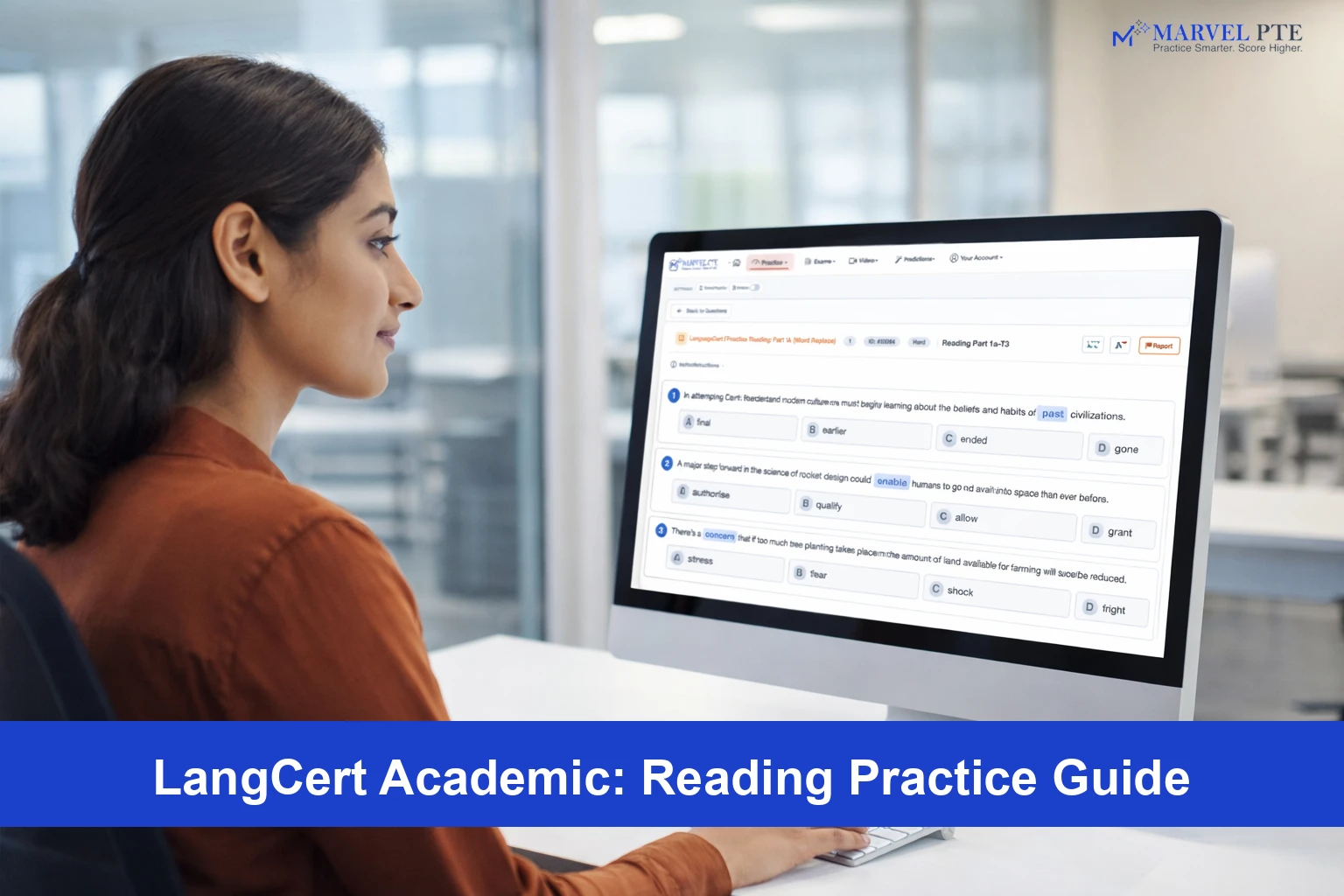
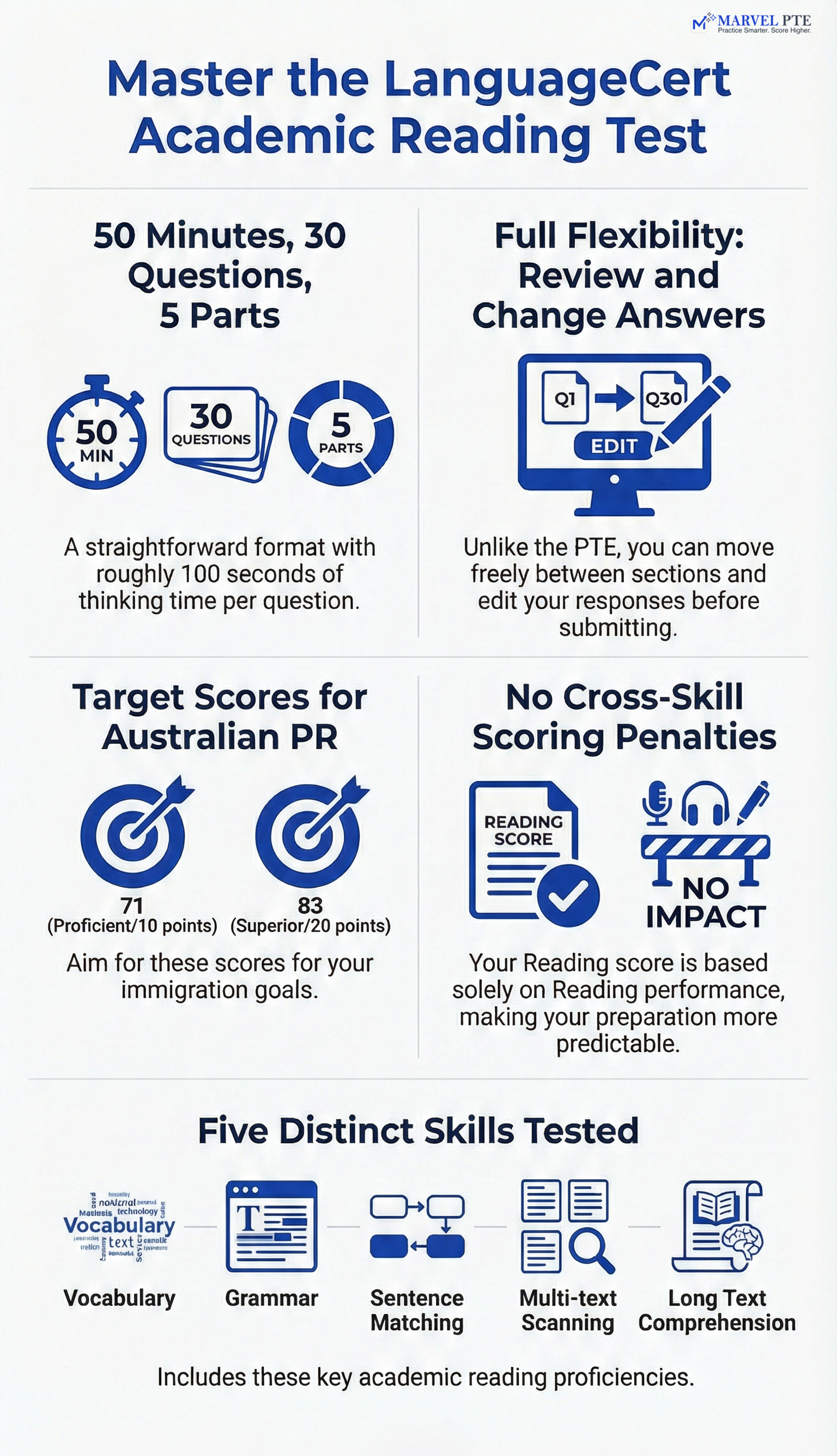
The LanguageCert Academic Reading section gives you 50 minutes for 30 questions across 5 parts. Each part tests a different skill, from vocabulary to detailed comprehension. If you’re preparing for Australian PR or academic admission, here’s exactly what to expect and how to practise effectively with LanguageCert reading practice materials.
The Reading section is one of the written exam components you complete at the test centre, alongside Listening and Writing. Unlike PTE where you can’t go back to previous questions, LanguageCert lets you review and change your answers. That alone makes it less stressful for many test takers.
The LanguageCert test follows a consistent format across all test centre exams worldwide. Whether you take the LanguageCert Academic exam in Sydney, Melbourne, or any LanguageCert approved test centre globally, the reading section remains identical. LanguageCert International ESOL is the broader qualification framework, with LanguageCert Academic being the specific test accepted for Australian immigration.
Here’s the structure at a glance:
| Part | Questions | What It Tests | Time Suggestion |
|---|---|---|---|
| Part 1a | 5 | Vocabulary in context | 5 minutes |
| Part 1b | 5 | Grammar (gap-fill) | 5 minutes |
| Part 2 | 6 | Sentence matching | 10 minutes |
| Part 3 | 7 | Multi-text scanning | 12 minutes |
| Part 4 | 7 | Long text comprehension | 18 minutes |
| Total | 30 | 50 minutes |
One thing I appreciate about this format: the question types are straightforward. You know exactly what each part demands. No surprises.
Pro Tip: Start with the parts you find easiest. Since you can move freely between questions, build confidence early before tackling the trickier sections.
Practice all 5 question types with instant feedback.
Let’s break down each part of the LanguageCert test so you know precisely what you’re walking into on test day at the test centre.
You read a short text with 5 highlighted words. For each word, you choose the best synonym from 3 options.
This isn’t about knowing dictionary definitions. It’s about understanding how words work in context. The same word can mean different things in different sentences. Strong English vocabulary skills are essential here.
Example approach:
Most students find this part manageable if they’ve been reading academic English regularly. News articles, research summaries, and textbooks all help build this skill. Using practice paper materials with vocabulary exercises accelerates your preparation significantly.
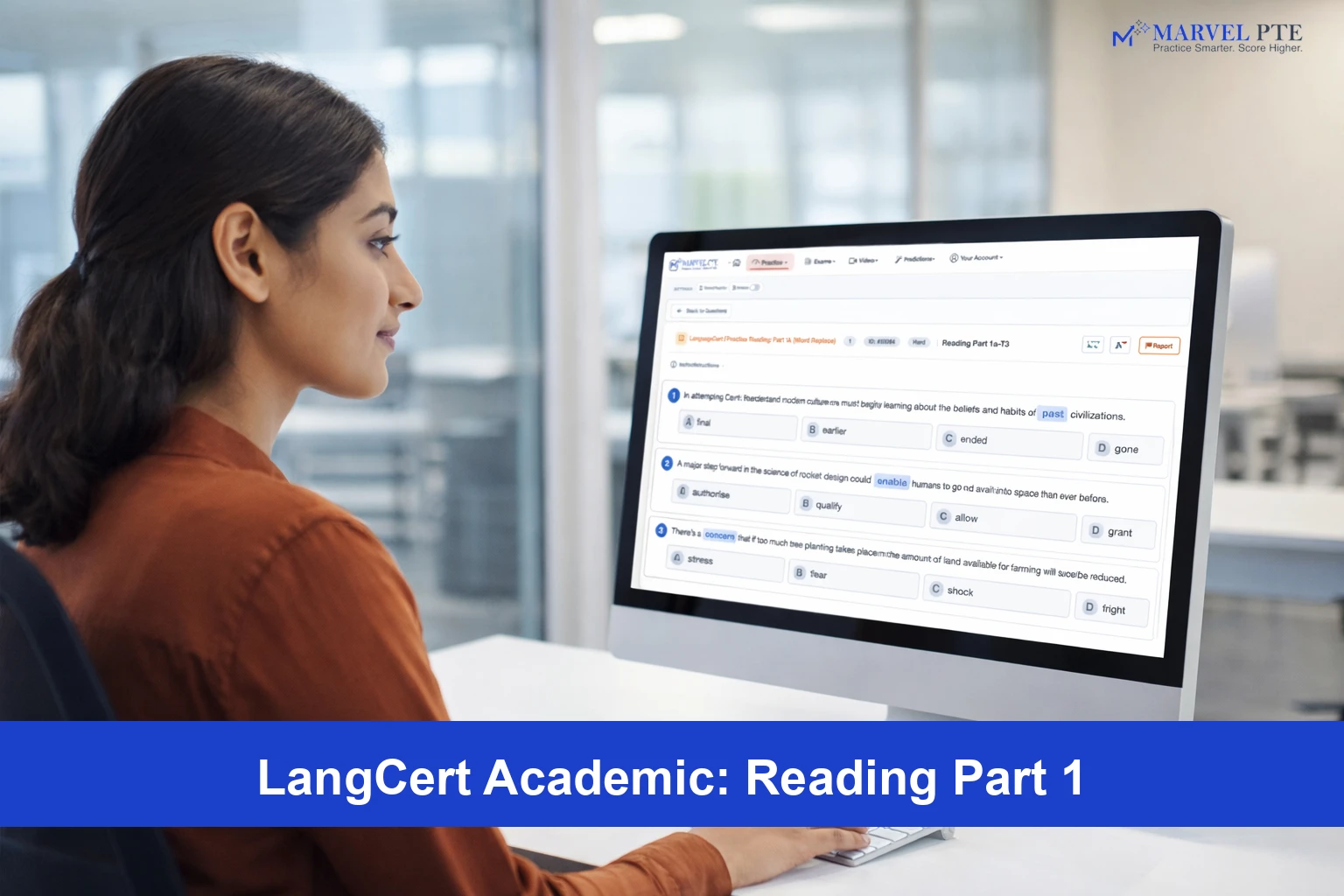
Same text as Part 1a, but now with 5 gaps. Each gap has 3 options. You’re being tested on English grammar: prepositions, articles, verb forms, conjunctions.
These questions reward students who read actively. If you’ve noticed patterns in how English sentences are constructed, you’ll recognise the correct answers.
Common gap types:
Key Point: Read the complete sentence, not just the words around the gap. English grammar choices often depend on information earlier or later in the sentence.
Simulate real test conditions and get your estimated score.
This is where things get interesting. You have a text with 6 sentences removed. Your job is to put them back in the right places. But here’s the catch: you’re given 8 options. Two are distractors that don’t belong anywhere.
This tests cohesion, how sentences connect to each other. You need to look for:
Strategy:
The distractors are designed to sound plausible. Don’t rush this part. Practice paper exercises focusing on cohesion markers help tremendously.
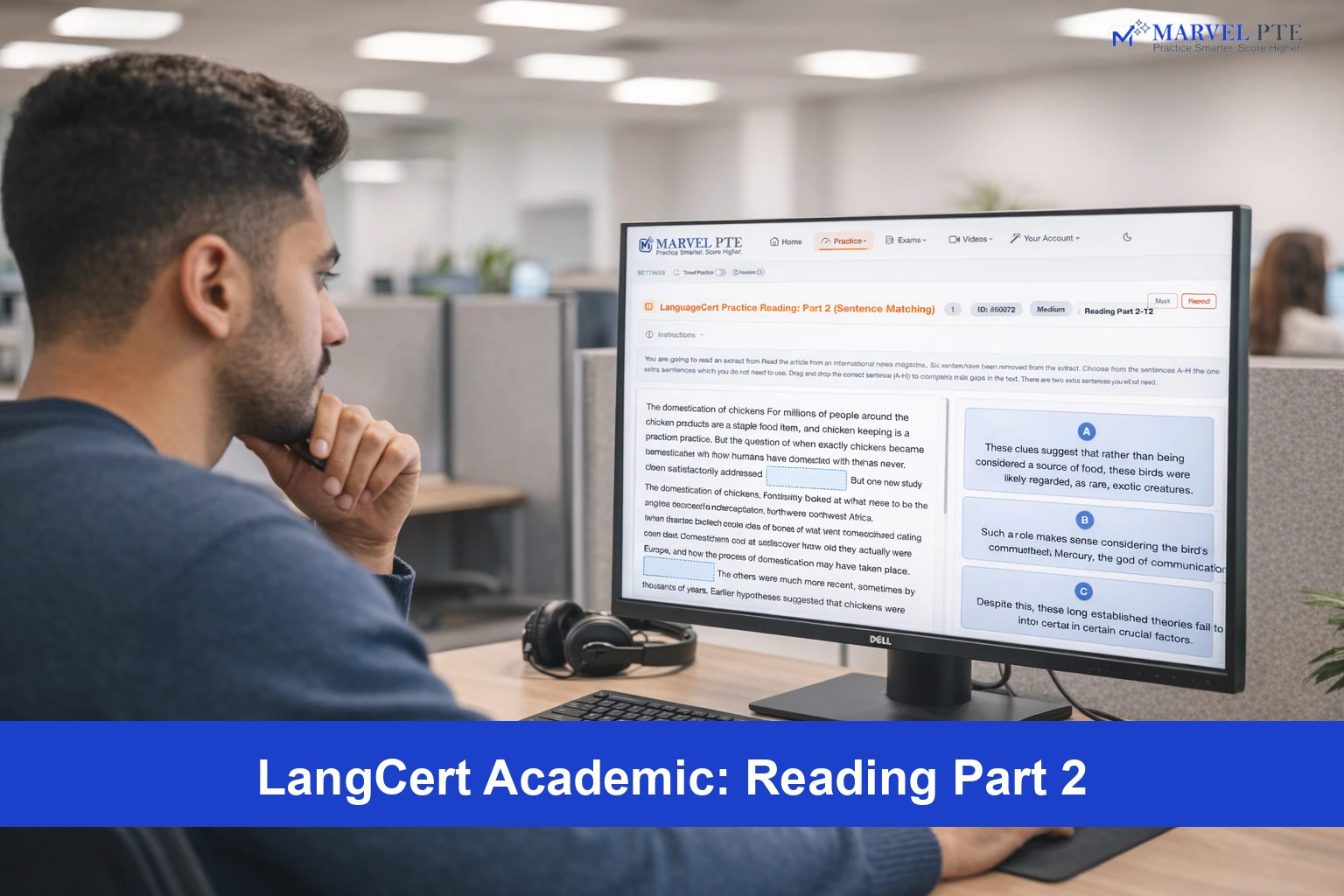
You get 4 short texts on a related theme (for example, 4 different reviews of the same product, or 4 opinions on a topic). Questions ask you to find specific information: “Which text mentions…?” or “According to Text B, what…?”
This is a scanning exercise. You don’t need to read every word carefully. You need to locate relevant information quickly.
Time-saving approach:
The final part is an academic text (600-800 words) with multiple-choice questions. This tests detailed comprehension and inference, understanding what the text implies, not just what it states directly.
Questions typically ask about:
This part demands careful reading. Skim first to get the structure, then read more closely for the questions.
Pro Tip: For inference questions, the answer is always supported by the text. If you’re guessing based on your own knowledge, you’re probably on the wrong track.
Your Reading score maps to CEFR levels and Australian immigration requirements. Here’s what you need:
| English Level | CEFR | Reading Score | PR Points |
|---|---|---|---|
| Competent | B2 | 60 | 0 |
| Proficient | C1 | 71 | 10 |
| Superior | C2 | 83 | 20 |
Unlike PTE where your Writing performance affects your Reading score (yes, that’s how PTE works), LanguageCert keeps sections separate. Your Reading score reflects only your Reading performance. This makes preparation more predictable.
Each question in Reading carries equal weight. There’s no negative marking, so always answer every question, even if you’re unsure.
Access questions for Listening, Writing, and Speaking too.
Effective LanguageCert reading practice isn’t just about doing lots of questions. It’s about building the right skills with the right practice paper resources. Here’s how to structure your preparation for the LanguageCert exams.
Before diving into practice paper resources, understand what you’re preparing for. LanguageCert International ESOL covers multiple proficiency levels from A1 to C2. For Australian immigration, you specifically need LanguageCert Academic, which tests at B2, C1, and C2 levels. The LanguageCert International ESOL framework ensures consistency across all test centres globally.
For genuine LanguageCert reading practice, look for:
Many test centres offer preparation courses that include comprehensive practice paper resources. These LanguageCert exams preparation materials follow the exact format you’ll encounter on test day. A good practice paper set will include answer keys and explanations.
Part 1a tests vocabulary in context. The best way to prepare:
For Part 1b, grammar drills help, but reading helps more. When you read, notice:
Strong English grammar foundations make these questions straightforward. Consider using dedicated practice paper materials that focus specifically on gap-fill exercises.
Part 3 requires quick scanning. Practice with:
Part 4 inference questions ask what the text suggests or implies. To get better:
Key Point: Quality matters more than quantity. Doing 5 practice tests with thorough review beats doing 20 practice tests without analysing your mistakes.
Let’s look at how these two tests differ in their Reading sections. This matters because many students consider both options when preparing for exams.
| Aspect | LanguageCert Reading | PTE Reading |
|---|---|---|
| Duration | 50 minutes | 23-30 minutes |
| Questions | 30 | 13-18 |
| Time per question | ~1.7 minutes | ~1.5-2 minutes |
| Question types | 5 distinct parts | Mixed (MCQ, fill-in-blanks, reorder) |
| Review answers | Yes | No |
| Integrated scoring | No | Yes (Writing affects Reading) |
| Navigate freely | Yes | No |
You can go back. In PTE, once you move to the next question, you can’t return. Made a mistake? Too bad. In the LanguageCert test, you can review everything before submitting.
No cross-skill penalties. PTE’s integrated scoring means a weak Writing section can drag down your Reading score. The LanguageCert test scores each section independently.
Clear question types. Each LanguageCert part tests one specific skill. PTE mixes different question types, which some find disorienting.
More thinking time. With 50 minutes for 30 questions, you average about 100 seconds per question. PTE’s Reading is faster-paced.
Faster results. PTE results come in 1-5 days. LanguageCert takes 5 working days.
No human element. Everything is computer-scored. Some prefer this consistency.
Shorter section. If Reading isn’t your strength, a shorter section might feel less overwhelming.
The Bottom Line: If you find PTE’s “no going back” rule stressful, or if your Writing is weaker than your Reading, the LanguageCert test removes those pressure points.
The LanguageCert Academic Reading test works well if you:
The LanguageCert test might be challenging if you:
For Australian PR, the Reading requirements are achievable with consistent preparation. The 71 needed for Proficient (10 points) is roughly equivalent to IELTS 7.0 in Reading. Most students who read English regularly can reach this level with 4-8 weeks of focused preparation using quality practice tests and practice paper materials.
Marvel Edu’s LanguageCert practice platform gives you everything you need for Reading success:
| Feature | What You Get |
|---|---|
| All 5 Parts Covered | Practice every Reading question type with real exam format |
| Instant Scoring | See your score immediately after each practice session |
| Detailed Explanations | Understand why each answer is correct or incorrect |
| Vocabulary Builder | Targeted practice for Part 1a synonym questions |
| Grammar Drills | Gap-fill exercises matching Part 1b format |
| Timed Mode | Build exam-day stamina with realistic timing |
The same AI technology trusted by 85,000+ PTE test takers is now available for LanguageCert. Practice with confidence knowing your mock test scores match what you’ll achieve on test day.
Why Marvel Edu? Our LanguageCert Reading practice includes 2000+ questions across all parts, with difficulty levels matched to CEFR B2, C1, and C2 requirements.
Here’s what to remember about the LanguageCert Academic Reading test:
Format:
Part Breakdown:
Score Requirements:
Practice Focus:
How many questions are in the LanguageCert Reading section?
How much time do you have for the Reading section?
What makes Part 2 challenging for most test takers?
Which part tests vocabulary in context?
What is a key advantage of LanguageCert Reading over PTE Reading?
How many parts does the LanguageCert Reading section have?
5 parts with 30 questions total
How much time is allocated for LanguageCert Reading?
50 minutes
What does Part 1a test?
Vocabulary in context (choosing synonyms for highlighted words)
What does Part 1b test?
Grammar through gap-fill questions
What makes Part 2 unique?
You match 6 removed sentences from 8 options (2 are distractors)
What skill does Part 3 primarily test?
Scanning for specific information across 4 short texts
What type of questions appear in Part 4?
Multiple-choice questions on a long academic text
Can you go back and change answers in LanguageCert Reading?
Yes, unlike PTE where you cannot review previous answers
What score do you need for Proficient English (10 PR points)?
71 in Reading
Does LanguageCert Reading have integrated scoring?
No, Reading is scored independently from other sections
Video strategies, mock tests, and practice questions in one package.

LanguageCert Academic Speaking Part 2 tests your ability to handle real conversations in academic settings. …
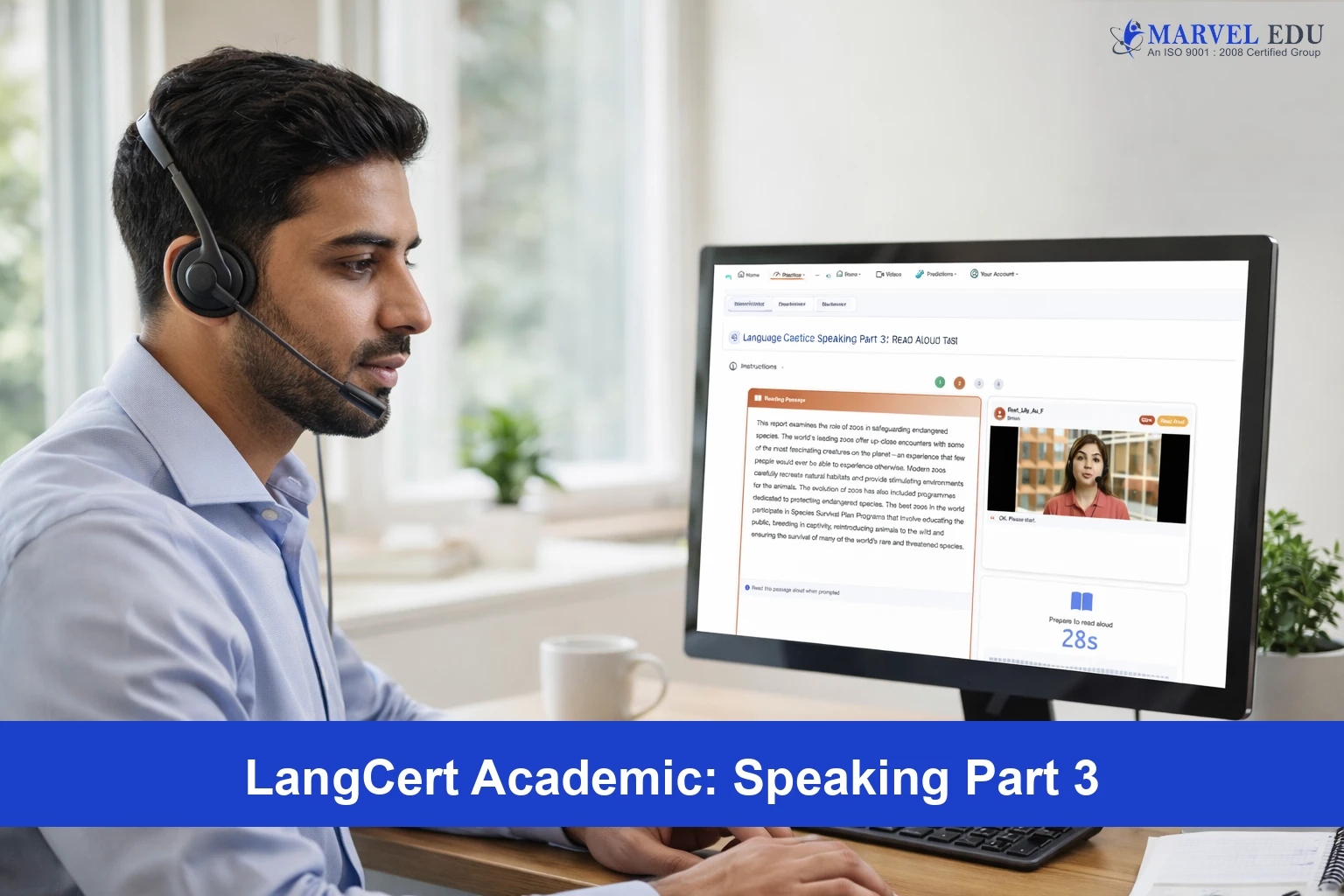
LanguageCert Academic Speaking Part 3 tests two skills in one task: reading aloud and expressing an opinion. …

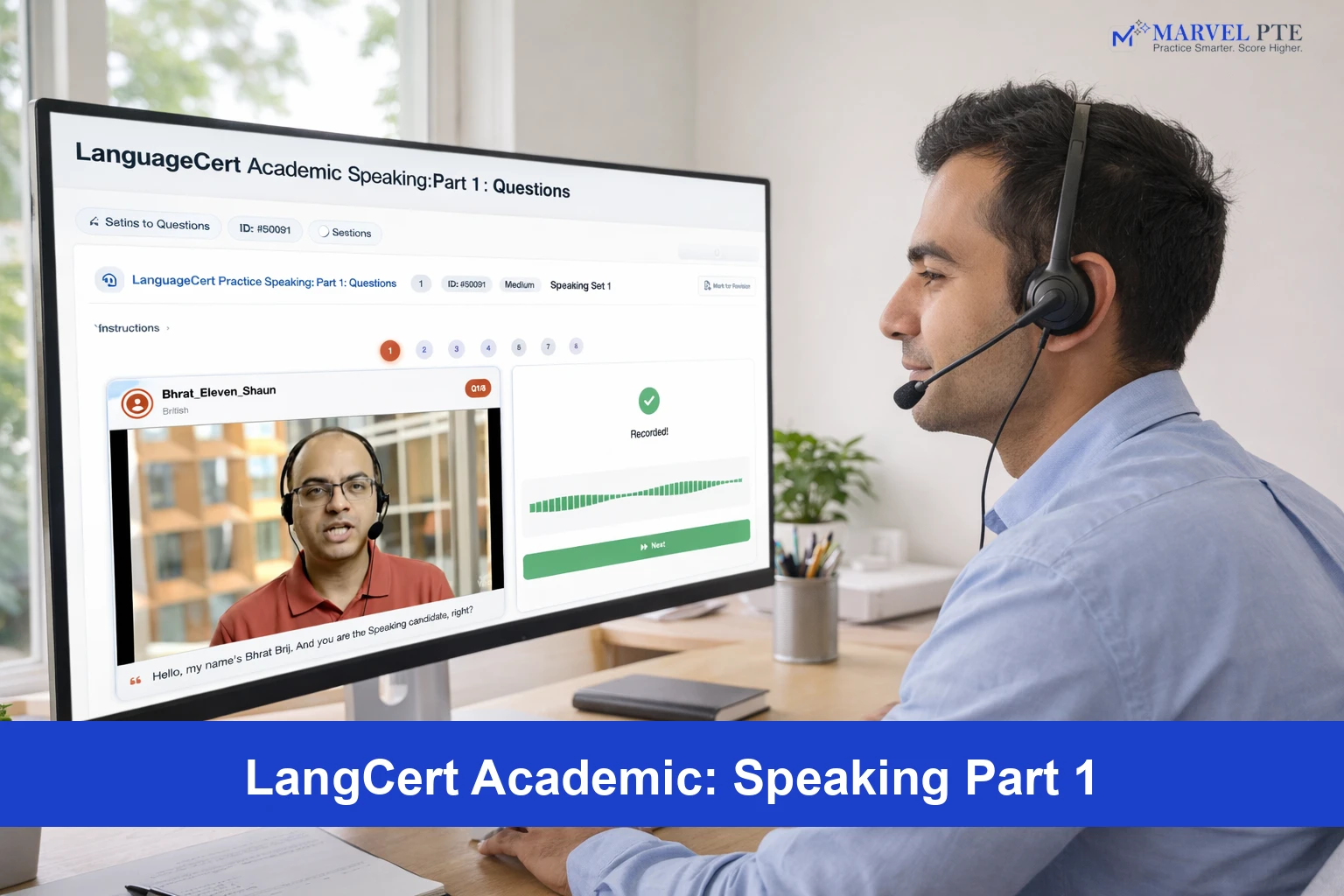
LanguageCert Academic Speaking Part 1 is the opening section of the speaking test, where the examiner asks you …
