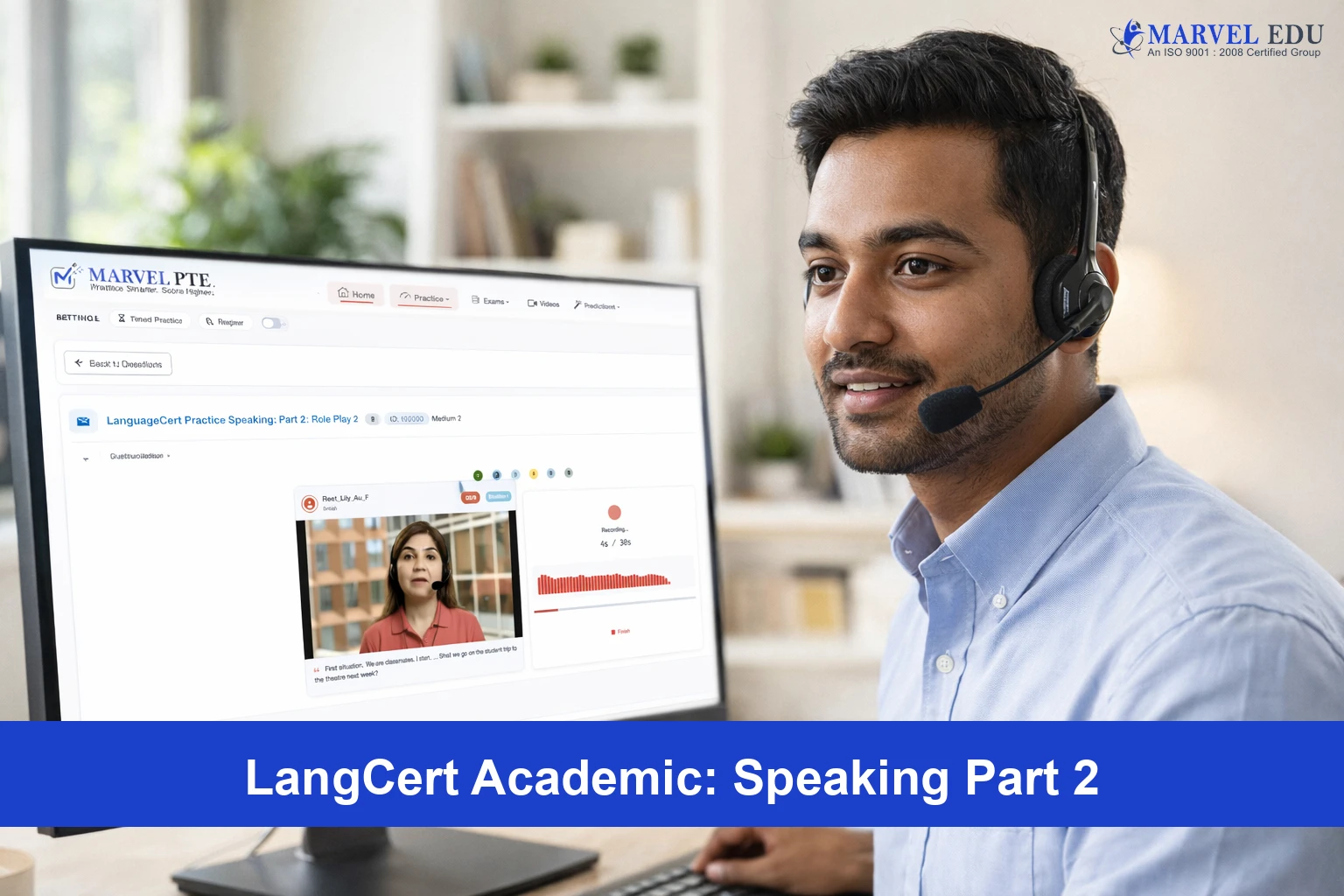
LanguageCert Academic
LanguageCert Academic Speaking Part 2: Role Play Task Format, Scoring, and Strategies
LanguageCert Academic Speaking Part 2 tests your ability to handle real conversations in academic settings. …

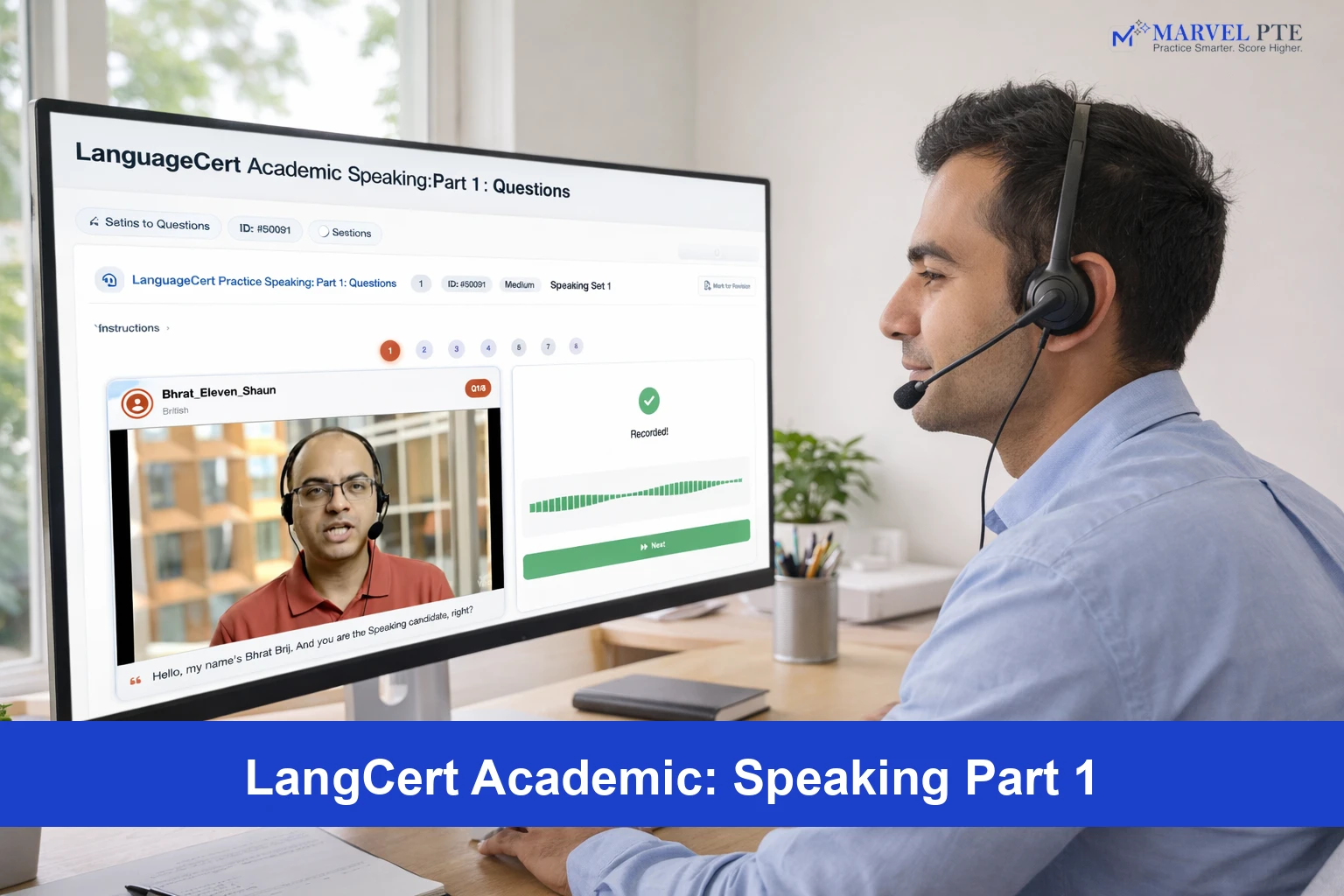
LanguageCert Academic Speaking Part 1 is the opening section of the speaking test, where the examiner asks you personal questions about everyday topics. This is widely considered the most approachable part of the entire exam. You are simply having a conversation about yourself.
As a secure english language test (SELT) approved for Australian immigration, LanguageCert Academic assesses your english language proficiency across listening reading writing and speaking. Part 1 of the speaking section is designed to put test takers at ease before the more challenging tasks. Every test taker begins with this section, regardless of their target score.
If you are preparing for Australian permanent residency or a student visa, Speaking Part 1 sets the tone for the rest of your english test. A confident start here can carry into the more challenging parts that follow. This guide covers everything you need to know about LanguageCert Speaking Part 1: the question format, what the examiner is looking for, sample questions, practical strategies, and how this compares to IELTS and PTE speaking tests.
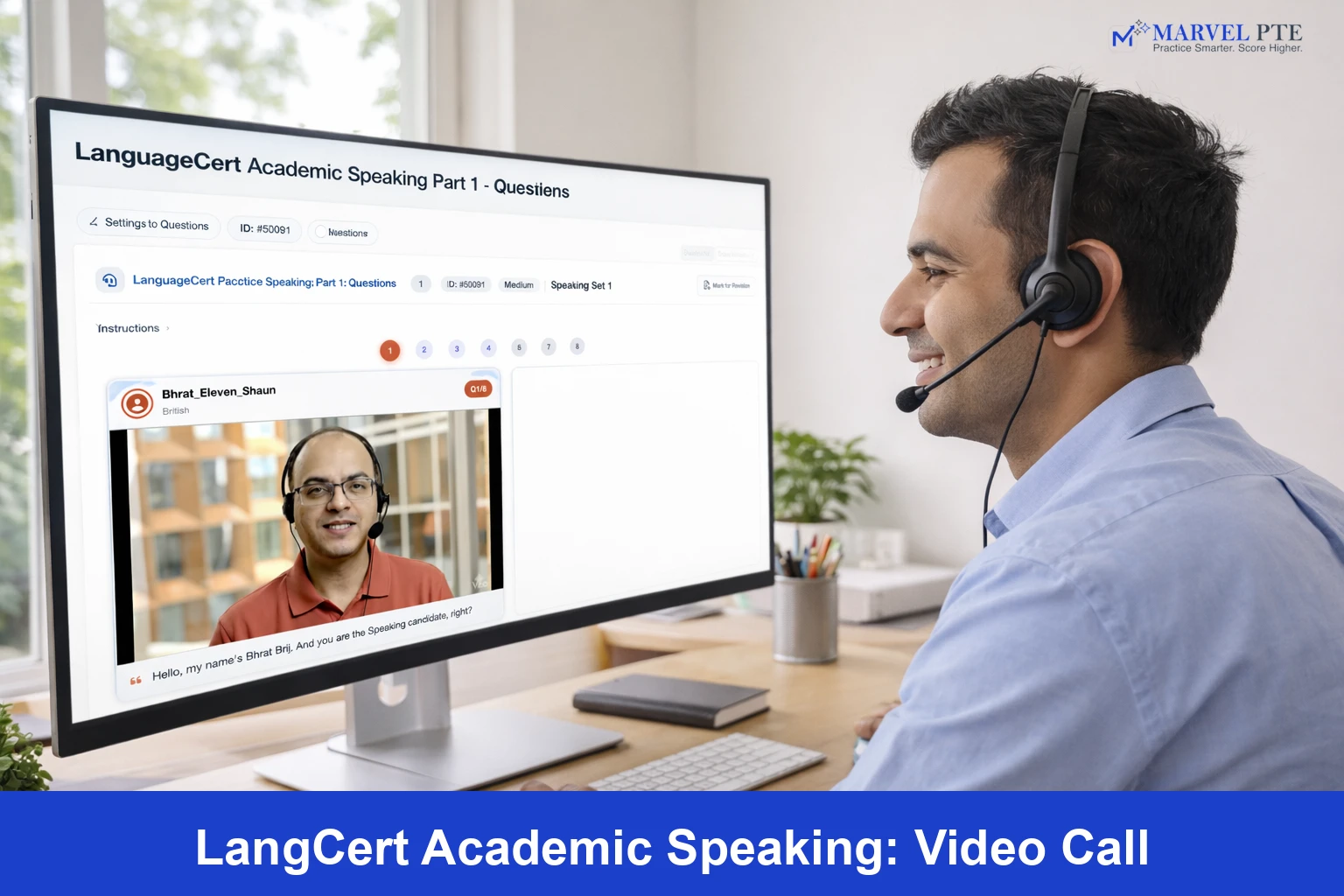
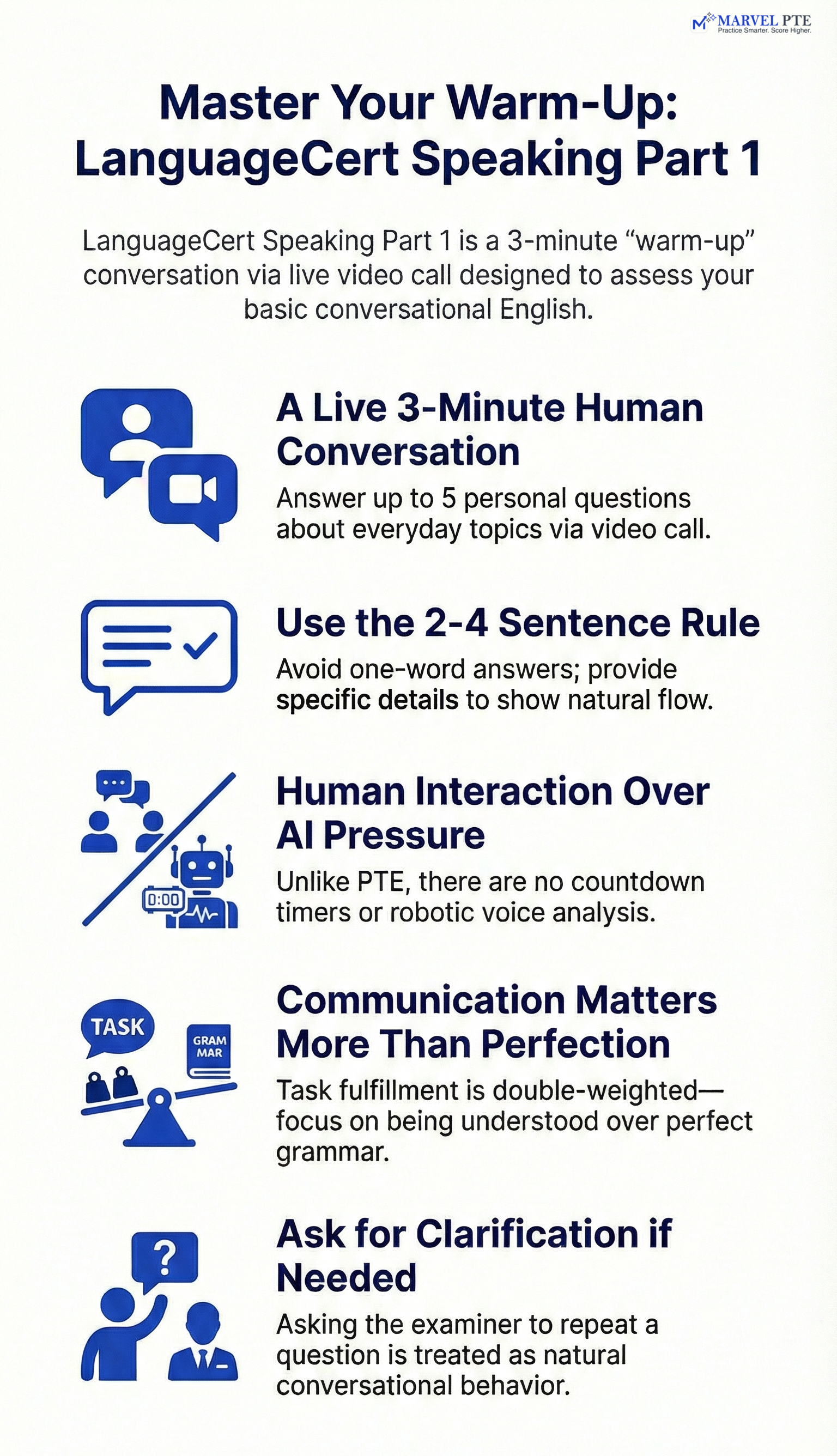
The LanguageCert Academic test, part of the LanguageCert International ESOL qualification framework, uses the Common European Framework of Reference (CEFR) to assess your language skills. Speaking Part 1 begins immediately when you connect with the examiner via live video call. The interlocutor greets you, asks you to state your name, spell it, and confirm your country of origin. After this brief introduction, you answer up to five questions on different everyday topics.
| Aspect | Details |
|---|---|
| Position in test | First of 4 speaking parts |
| Question count | Up to 5 questions |
| Topics | Everyday personal topics |
| Format | Live video call with human examiner |
| Prep time | None (spontaneous responses) |
| Purpose | Warm-up and assess basic conversational English |
The questions are deliberately straightforward. The examiner wants you to relax into the conversation before the more demanding Role Play, Read Aloud, and Presentation tasks that follow.
Practice answering personal questions with realistic scenarios and AI feedback.
Part 1 questions cover familiar ground. The examiner selects from a bank of topics designed to be universally accessible. You do not need specialist knowledge.
Common topic areas:
A student I worked with in Parramatta was nervous about the speaking test after two failed PTE Academic attempts. Within seconds of Part 1 starting, she realised the examiner was simply asking about her job and weekend plans. No countdown timer. No robotic voice analysis. Just a friendly conversation. For test takers who struggle with AI-scored english language tests, this human interaction makes a significant difference.
Experience all 4 speaking parts under real exam conditions.
Here are examples of Part 1 questions with guidance on answering effectively:
Question: What do you do for work?
Weak answer: “I work in IT.”
Better answer: “I work as a software developer at a tech company in Sydney. Most of my day involves writing code and collaborating with the design team on new features.”
The difference is development. Give enough detail to demonstrate natural conversation flow without rambling.
Question: What do you enjoy doing in your free time?
Weak answer: “I like reading.”
Better answer: “I enjoy reading, mostly historical fiction. Recently I finished a novel set during the Second World War, and I’m looking for something similar now.”
Adding specifics makes your response feel genuine rather than rehearsed.
Question: Tell me about your hometown.
“I grew up in a small town about two hours from Mumbai. It’s known for its textile industry, though these days more people work in services. I moved to Australia three years ago, but I still visit my family there every year.”
This gives context, personal connection, and natural flow.
Your Part 1 performance contributes to the overall Speaking score, which is marked out of 100 by human examiners. All four speaking parts carry equal weight.
| Criterion | What the Examiner Looks For |
|---|---|
| Task Fulfilment | Did you answer the question? Did you communicate your meaning? |
| Coherence | Are your responses organised and logical? |
| Grammar | Are you using grammatical structures accurately? |
| Vocabulary | Are you using appropriate words for the context? |
| Pronunciation | Are you clear and understandable with natural intonation? |
Task Fulfilment is double-weighted, meaning communication effectiveness matters most. The examiner awards marks for this in real time, while a second examiner reviews the recording for the other criteria.
What this means for Part 1:
You do not need perfect grammar. If you communicate your meaning clearly and respond appropriately to each question, you are doing well. Natural hesitation and self-correction are completely acceptable.
Access our library of Q&A, Role Play, Read Aloud, and Presentation tasks.
One-word or single-sentence answers leave the examiner little to assess. Aim for responses of 2-4 sentences that include some detail or example.
Instead of: “Yes, I like cooking.”
Try: “Yes, I enjoy cooking. I usually make something simple during the week, but on weekends I like experimenting with new recipes. Last Sunday I tried making butter chicken from scratch.”
There is no timer counting down. Take your time. Rushing suggests nervousness and can affect clarity. The examiner is not measuring your words per minute.
Think about common topics (work, hobbies, hometown, family) and have some genuine things to say about each. Do not memorise answers. The examiner can tell, and scripted responses sound unnatural.
The examiner nods, reacts, and may smile. This is a human interaction, not a computer interface. Make eye contact with the camera, respond to their cues, and let the conversation flow.
If you do not understand a question, it is completely fine to say: “Sorry, could you repeat that?” or “Do you mean…?” This is natural conversational behaviour.
Part 1 has no strict time limit per question. The section typically takes 2-3 minutes total. You cannot control how many questions the examiner asks, but you can control how efficiently you respond.
Key points:
Unlike PTE, where a progress bar creates pressure, LanguageCert Part 1 feels like a relaxed warm-up because that is exactly what it is.
When choosing an english language test for Australian immigration, understanding how each exam assesses your speaking skills helps you pick the right one. Here is how LanguageCert Speaking Part 1 compares to IELTS Academic and PTE Academic:
| Aspect | LanguageCert Part 1 | IELTS Part 1 | PTE |
|---|---|---|---|
| Format | Video call, up to 5 questions | In-person, 4-5 questions | No direct equivalent |
| Examiner | Human (live) | Human (in-person) | AI only |
| Topics | Everyday personal | Everyday personal | N/A |
| Prep time | None | None | N/A |
| Duration | ~2-3 minutes | ~4-5 minutes | N/A |
| Pauses penalised | No | No | Yes (in other tasks) |
Why LanguageCert has an edge:
PTE Academic does not have a conversational personal questions section. All PTE Speaking tasks are AI-scored activities like Read Aloud, Repeat Sentence, and Describe Image. If you struggle with AI scoring, speaking into a microphone with no human feedback, or the time pressure of tasks like Describe Image (40 seconds), LanguageCert Speaking Part 1 offers a more natural entry point.
IELTS Academic Part 1 is structurally similar to LanguageCert Part 1. Both involve a human examiner asking personal questions. The difference is convenience: the LanguageCert Academic test is taken online from home via video call, while IELTS requires an in-person appointment at a test centre. For test takers needing flexibility, LanguageCert Academic online delivery is a significant advantage.
Giving one-word answers
The examiner needs enough speech to assess. “Yes” or “No” responses do not demonstrate your abilities.
Memorising scripted answers
Examiners are trained to spot rehearsed responses. They will ask follow up questions or rephrase to test genuine communication. Students often underestimate how easily experienced examiners detect scripted language.
Speaking too fast
Rushing reduces clarity and increases errors. Slow down. There is no timer.
Apologising for your English
Avoid saying things like “Sorry, my English is not good.” Just speak. The examiner is there to assess, not judge.
Overthinking vocabulary
Simple, accurate language is better than complex words used incorrectly. Say what you mean clearly.
Preparing for a human-examined speaking test requires practice that mirrors the real experience. Our platform provides tools specifically designed for the LanguageCert exam, including practice papers and mock tests aligned with the official qualification handbook.
Realistic Q&A simulations
Practice responding to personal questions across all common topics. Get comfortable formulating answers naturally without scripting. Our practice tests follow the exact format of the LanguageCert Speaking Part 1 questions.
AI feedback on clarity and fluency
While LanguageCert uses human examiners, our AI analysis helps you identify hesitation patterns, pacing issues, and clarity problems before the real test. This feedback targets the specific language skills assessed in Part 1.
Topic-based practice sessions
Work through sets of questions organised by topic (work, hobbies, hometown, future plans). Build confidence across the full range of Part 1 content. Each practice paper includes follow-up questions to simulate real examiner behaviour.
Full speaking mock tests
Experience all four parts in sequence under realistic conditions. Part 1 sets the tone, so practising the complete flow helps you carry momentum into Parts 2, 3, and 4. Test your english proficiency across all speaking tasks before exam day.
LanguageCert Academic is accepted as proof of english language ability for Australian skilled visas. Like other approved english language tests, your speaking score must meet specific thresholds. For Australian permanent residency, these are the Speaking score requirements:
| Level | Score | PR Points |
|---|---|---|
| Competent | 70/100 | 0 |
| Proficient | 82/100 | 10 |
| Superior | 89/100 | 20 |
Part 1 contributes equally with Parts 2, 3, and 4 to your final Speaking score. A strong start in Part 1 builds confidence for the more challenging sections ahead.
What is the primary role of LanguageCert Speaking Part 1?
How many questions will the examiner ask during Speaking Part 1?
Which assessment criterion is double-weighted in LanguageCert Speaking?
What is the recommended response length for Part 1 questions?
What Speaking score is required for Superior English (Australian PR)?
Where does Speaking Part 1 rank in the speaking test sequence?
First of the 4 speaking parts.
How many personal questions does the examiner ask in Part 1?
Up to 5 questions on everyday topics.
How is the LanguageCert Speaking test conducted?
Via live video call with a human examiner.
How long does Speaking Part 1 typically take?
About 2-3 minutes total.
Which scoring criterion is double-weighted?
Task Fulfilment (communication effectiveness).
What is the ideal response length for Part 1 questions?
2-4 sentences with some detail or examples.
What Speaking score is needed for Competent English?
70/100 (0 PR points).
What Speaking score is needed for Proficient English?
82/100 (10 PR points).
What Speaking score is needed for Superior English?
89/100 (20 PR points).
How does LanguageCert Part 1 differ from PTE Speaking?
LanguageCert uses a human examiner; PTE is entirely AI-scored.
Before the test:
During Part 1:
What to remember:
Part 1 is designed to ease you into the test. Approach it as a conversation, not an examination, and you will be well positioned for the more demanding parts that follow. Whether you are taking the LanguageCert Academic test for the first time or retaking after a previous english language requirement result, this section gives you the best opportunity to start strong.
Watch expert strategies for each speaking part with sample responses.

LanguageCert Academic Speaking Part 2 tests your ability to handle real conversations in academic settings. …
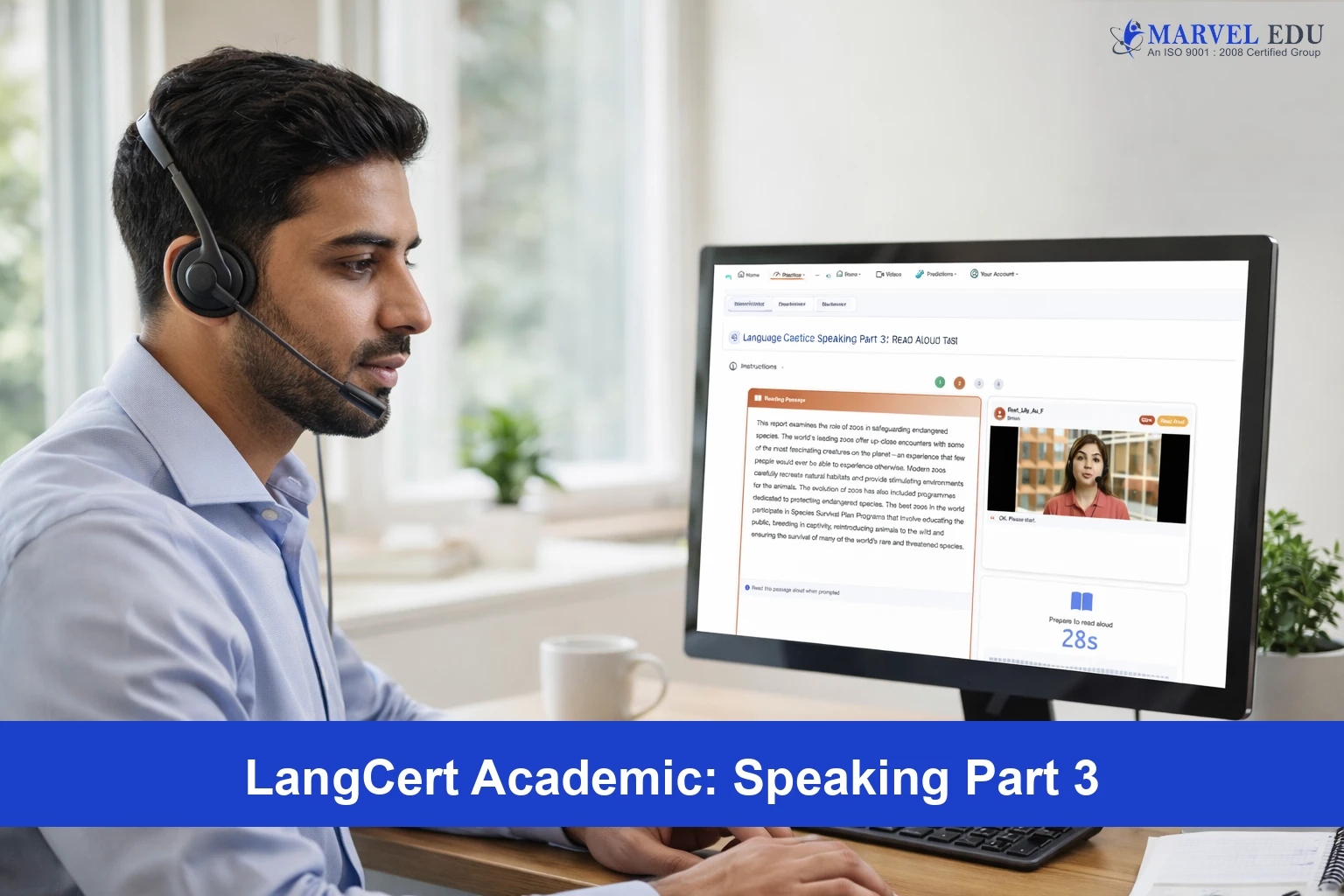
LanguageCert Academic Speaking Part 3 tests two skills in one task: reading aloud and expressing an opinion. …

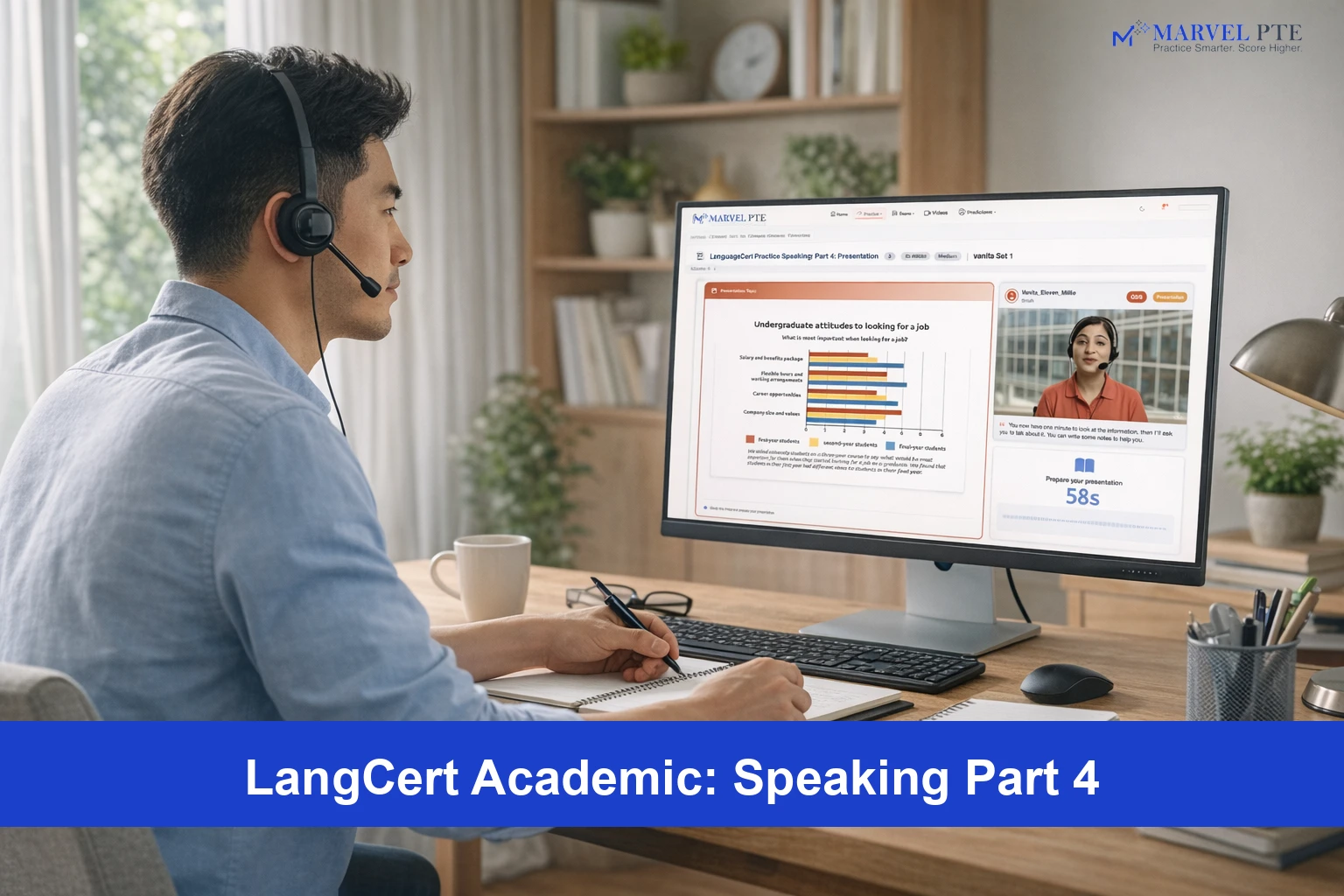
LanguageCert Academic Speaking Part 4 is the final section of the speaking test, where you deliver a …
