LanguageCert Academic
LanguageCert Academic Speaking Part 3: Read Aloud and Opinion Task Guide
LanguageCert Academic Speaking Part 3 tests two skills in one task: reading aloud and expressing an opinion. …

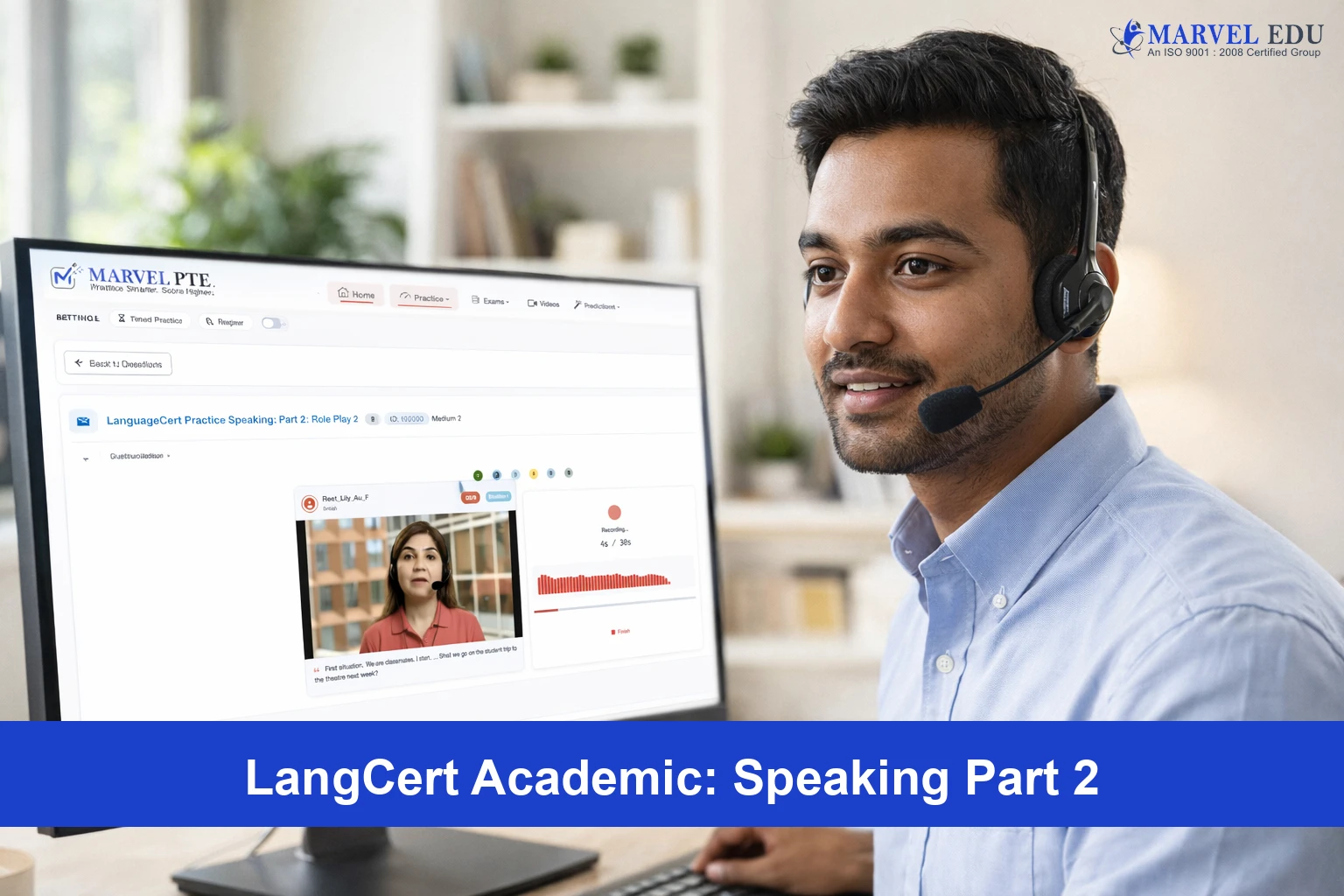
LanguageCert Academic Speaking Part 2 tests your ability to handle real conversations in academic settings. You participate in two role plays where the examiner plays a character, perhaps a university administrator, a supervisor, or a classmate, and you respond naturally while also initiating conversation when appropriate. Unlike PTE where you speak to a microphone, Part 2 involves genuine back-and-forth interaction with a human.
This section comes after Part 1’s personal questions, so you have already had time to settle into the speaking test. By Part 2, the examiner has a sense of your speaking style, and you should feel more comfortable with the video call format. The role play tasks test whether you can communicate effectively in situations you might actually encounter at university.
For candidates preparing for Australian permanent residency, Part 2 demonstrates a key advantage of LanguageCert over other tests. The interactive format rewards natural communication rather than rehearsed responses. If you can hold a conversation in English, even with occasional hesitations, the human examiner will recognise your competence in ways an AI simply cannot.
LanguageCert Academic is a Secure English Language Test (SELT) approved for Australian skilled visas. As an online exam taken from home with remote proctoring, the LanguageCert test offers flexibility that traditional in-centre tests cannot match. The speaking component is conducted via video call, combining the convenience of online testing with the human interaction that many test takers prefer.
The examiner presents two role play scenarios, one at a time. Each scenario is set in an academic context. You might need to speak with library staff about a late book, discuss a project extension with a supervisor, or resolve a misunderstanding with a classmate.
| Aspect | Details |
|---|---|
| Position in test | Second of 4 speaking parts |
| Number of role plays | 2 |
| Scenario type | Academic-related |
| Preparation time | Brief moment to read scenario |
| Duration per role play | 1-2 minutes |
| Format | Live video call with human examiner |
| Can revisit | No (linear interaction) |
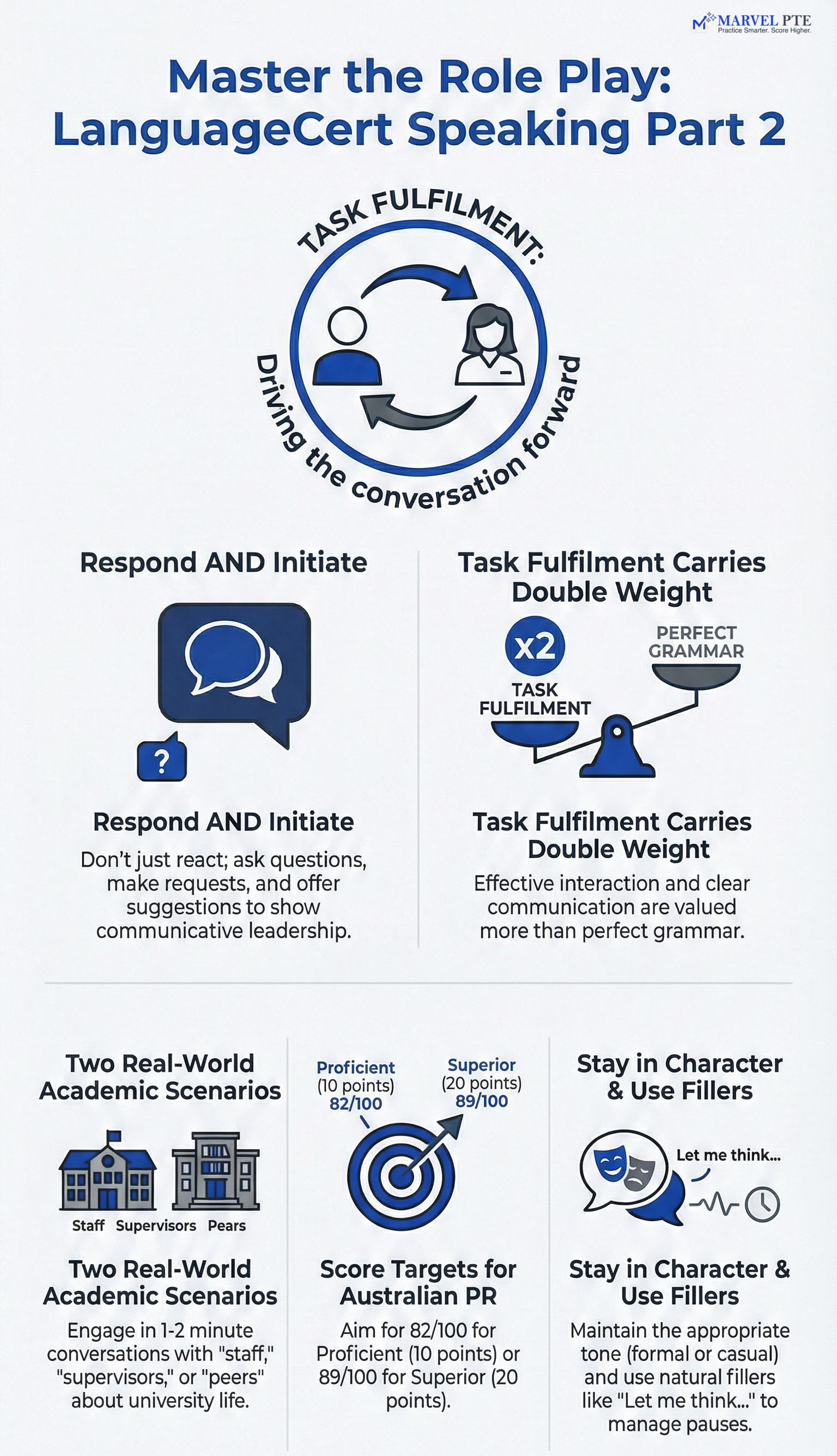
The examiner initiates each role play by describing the situation and their character. You must respond appropriately and, crucially, also initiate parts of the conversation yourself. The task is not simply answering questions. You need to ask questions, make requests, or offer suggestions depending on the scenario.
Practice interactive role play scenarios with varied academic situations.
LanguageCert Speaking is marked on four criteria, each worth up to 8 points. Task Fulfilment carries double weight, meaning your ability to manage the interaction and communicate clearly matters more than perfect grammar.
| Criterion | What the Examiner Assesses |
|---|---|
| Task Fulfilment & Communicative Effect | Did you handle the role play appropriately? Did you respond AND initiate? (Double-weighted) |
| Grammar Accuracy and Range | Control of sentence structures during natural conversation |
| Vocabulary Accuracy and Range | Appropriate word choice for the academic context |
| Pronunciation, Intonation, and Fluency | Natural rhythm, stress, and flow in interactive speech |
Key insight: The examiner marks Task Fulfilment in real time during your performance. A second examiner reviews the recording for the other criteria. This dual assessment ensures fairness and consistency.
Part 2 specifically tests interaction skills. A candidate who delivers perfect grammar but fails to respond appropriately to the examiner’s prompts will score lower than someone who communicates effectively with minor errors. The role play must feel like a conversation, not a monologue.
Experience all 4 speaking parts under real exam conditions with a human examiner simulation.
LanguageCert Academic is accepted as proof of English ability for Australian skilled visas. Your Speaking score must meet specific thresholds:
| Level | Speaking Score | PR Points |
|---|---|---|
| Competent | 70/100 | 0 |
| Proficient | 82/100 | 10 |
| Superior | 89/100 | 20 |
Part 2 contributes equally with Parts 1, 3, and 4 to your overall Speaking score. A strong role play performance demonstrates the interactive communication skills valued by immigration authorities.
Before diving into role play scenarios, it helps to understand where Part 2 fits within the broader LanguageCert Academic test. This English proficiency test comprises four sections: Listening (40 minutes), Reading (50 minutes), Writing (50 minutes), and Speaking (14 minutes). The Speaking section itself has four parts, with Part 2 being the role play component.
The LanguageCert exam is recognised as an English language test for Australian immigration, sitting alongside PTE Academic and IELTS as accepted proof of language proficiency. What distinguishes LanguageCert is its human-marked speaking test combined with the flexibility of online delivery. You take the English test from home, but a qualified examiner assesses your speaking ability through live video interaction.
For the speaking section specifically, you connect with an examiner via the LanguageCert online platform. This is not a pre-recorded assessment. The examiner interacts with you in real time, adapting their questions and responses based on your answers. This human element is central to the LanguageCert Academic qualification and represents a significant departure from AI-scored alternatives.
Access our library of Q&A, Role Play, Read Aloud, and Presentation tasks.
Part 2 scenarios are always academic-related. While the specific situations vary, they fall into predictable categories:
The scenarios are designed to be realistic and familiar to anyone studying at an English-speaking university. You do not need specialist knowledge. You need to communicate clearly about everyday academic situations.

When the examiner describes the scenario, identify your role quickly. Are you a student complaining about something? A student requesting help? A group member coordinating with a peer? Your role determines your tone and approach.
If the scenario says “You need to request an extension from your supervisor,” you are in a polite, slightly formal mode. If it says “You are discussing a project with a classmate,” you can be more casual.
This is crucial. Part 2 requires both responding to the examiner’s prompts and initiating parts of the conversation yourself.
Responding only: Examiner: “How can I help you today?” You: “I need to return these books but I think there might be a fine.”
Responding AND initiating: Examiner: “How can I help you today?” You: “I need to return these books but I think there might be a fine. Could you check my account? And actually, I was also wondering if I could extend the loan period for one of them?”
The second response shows you can drive a conversation forward, not just react to it. This matters for Task Fulfilment.
If you do not understand something the examiner says, ask them to repeat or clarify. This is not a weakness. It demonstrates communicative competence.
Natural clarification phrases:
Asking for clarification shows you care about understanding and responding appropriately. It is far better than guessing and giving an irrelevant response.
Once the role play starts, commit to the scenario. If you are a student speaking to library staff, maintain that dynamic throughout. Do not break character to ask the examiner about the test format.
Staying in character also means using appropriate language for the relationship. You would speak differently to a supervisor than to a classmate. Match your register to the scenario.
You will need moments to think during the conversation. This is normal. Use natural fillers rather than awkward silence:
These phrases give you time to formulate a response while sounding like a natural speaker. The examiner expects some thinking time in a genuine conversation.
The examiner assesses whether you can function in real academic situations. They are listening for:
Appropriate responses: Does your answer fit what was asked? If the examiner (as library staff) says “Unfortunately, those books are overdue,” do you acknowledge this and respond sensibly?
Initiative: Do you ask questions, make suggestions, or move the conversation forward? A student only answering questions would not manage well at university.
Flexibility: Can you adapt when the conversation takes an unexpected turn? If the examiner introduces new information, do you incorporate it?
Natural interaction: Does the conversation flow like a real exchange, with turn-taking, appropriate pauses, and connected responses?
The examiner is not looking for scripted perfection. They want evidence that you can communicate effectively in English in realistic academic situations.
Treating it as a monologue
Some candidates launch into long prepared speeches instead of engaging with the examiner. Role play is interactive. Speak, then let the examiner respond. Listen to what they say. Respond to that.
Ignoring the examiner’s cues
If the examiner (in character) says “I am afraid we cannot do that,” acknowledge it. Do not continue as if they said yes. Responding appropriately to refusals or complications shows real communicative skill.
Using memorised scripts
Prepared phrases for common scenarios can help, but they should be flexible. If your “extension request script” does not fit the actual scenario, adapt. The examiner will notice if you force a pre-planned response into a situation where it does not belong.
Over-complicating your language
Simple, clear language is better than complex sentences that confuse you or the listener. “Can I have more time for my assignment?” works perfectly. You do not need “I would like to respectfully request a temporal extension regarding the submission deadline of the aforementioned academic work.”
Not initiating anything
Answering every question but never asking one yourself limits your Task Fulfilment score. Find moments to ask questions, seek clarification, or make suggestions.
Breaking character
Do not step out of the role play to comment on how the test is going or ask meta-questions. Stay in the scenario until it ends.
Understanding how Part 2 compares to other tests helps you choose the right exam.
The PTE Academic exam takes a fundamentally different approach to assessing spoken English. While both PTE and LanguageCert are valid English proficiency tests for migration, the experience differs dramatically. PTE uses computer algorithms to analyse your speech, while LanguageCert employs trained examiners who understand context and natural communication.
The advantage: LanguageCert Part 2 tests real conversation skills in a structured way. You know you will face academic scenarios, so preparation is possible. But the human examiner means natural communication is rewarded over robotic delivery. For test takers who communicate well in person but struggle with AI scoring, this format is often easier.
Part 2 plays to the strengths of candidates who:
Are comfortable with unscripted conversation. If you can chat naturally in English, even with some errors, Part 2 will feel manageable.
Struggle with PTE’s AI scoring. The strict timing and pitch requirements of PTE Speaking penalise natural speech patterns. Part 2 has no such penalties.
Have experience in academic settings. If you have studied or worked at an English-speaking institution, the scenarios will feel familiar.
Think on their feet. Part 2 rewards quick, appropriate responses over perfectly rehearsed answers.
Prefer interaction over monologue. Some people find it easier to respond to another person than to speak alone into a microphone.
Preparing for role play tasks requires practice that mirrors the real interaction. Our platform provides tools designed specifically for LanguageCert Speaking Part 2.
Comprehensive practice papers
Access LanguageCert practice papers that replicate real exam conditions. Each practice paper includes all four speaking parts, allowing you to experience the full test flow before your actual LanguageCert exam.
Varied role play scenarios
Practice with a range of academic situations: library enquiries, supervisor meetings, classmate discussions, and administrative requests. Build familiarity with common scenario types that appear on the LanguageCert Academic test.
Interactive practice format
Work through role plays that require both responding and initiating. Get feedback on whether you are driving the conversation forward, not just reacting. Our practice questions mirror what you will encounter on the actual examination.
Human-style feedback
Our analysis focuses on communicative effectiveness, appropriate responses, and natural interaction patterns. We assess what a human examiner would notice, helping you prepare for the real LanguageCert online speaking test.
Timed simulations
Experience the pace of Part 2 with timed practice. Get comfortable managing conversation flow within the expected duration, preparing you for the speaking assessment component of this English language proficiency test.
| Element | Part 2 Details |
|---|---|
| Task type | Interactive role play |
| Number of role plays | 2 |
| Scenario context | Academic-related |
| Examiner role | Plays a character (staff, supervisor, classmate) |
| Your role | Respond AND initiate |
| Scoring focus | Task Fulfilment (double-weighted) |
| Key skill | Managing real conversation |
How many role plays are included in Speaking Part 2?
Which scoring criterion is double-weighted in LanguageCert Speaking?
What type of scenarios appear in Part 2 role plays?
Can you ask the examiner for clarification during Part 2?
What Speaking score is required for Proficient English (10 PR points)?
What is the main task in Speaking Part 2?
Two interactive role plays in academic-related scenarios.
Who scores LanguageCert Speaking Part 2?
A human examiner (interlocutor), not AI.
How many role plays are in Part 2?
Two role plays.
Is there formal preparation time for Part 2?
No formal prep time. You respond to scenarios spontaneously.
Which criterion is double-weighted in scoring?
Task Fulfilment and Communicative Effect.
Can you ask for clarification during the role play?
Yes, it is natural and acceptable.
Does PTE have a role play task?
No. PTE Speaking is one-way communication with AI scoring.
What Speaking score is needed for Competent English?
70/100 (0 PR points).
What Speaking score is needed for Proficient English?
82/100 (10 PR points).
What Speaking score is needed for Superior English?
89/100 (20 PR points).
Before each role play:
During the role play:
For effective communication:
What to remember:
Part 2 is where LanguageCert shows its difference from other tests. The interactive format rewards candidates who can hold a real conversation. Engage with the scenario, communicate clearly, and let the human examiner see that you can function in English-speaking academic environments.
As a SELT-approved English language test, LanguageCert Academic provides a reliable pathway to demonstrating your language proficiency for Australian immigration. The speaking component, including Part 2’s role plays, is what makes this examination distinctive. Whether you are comparing LanguageCert against PTE Academic, Cambridge English, or IELTS, the human examiner format remains LanguageCert’s defining feature for candidates who communicate better in natural conversation than in AI-assessed environments.
Watch expert strategies for each speaking part with sample responses.

LanguageCert Academic Speaking Part 3 tests two skills in one task: reading aloud and expressing an opinion. …
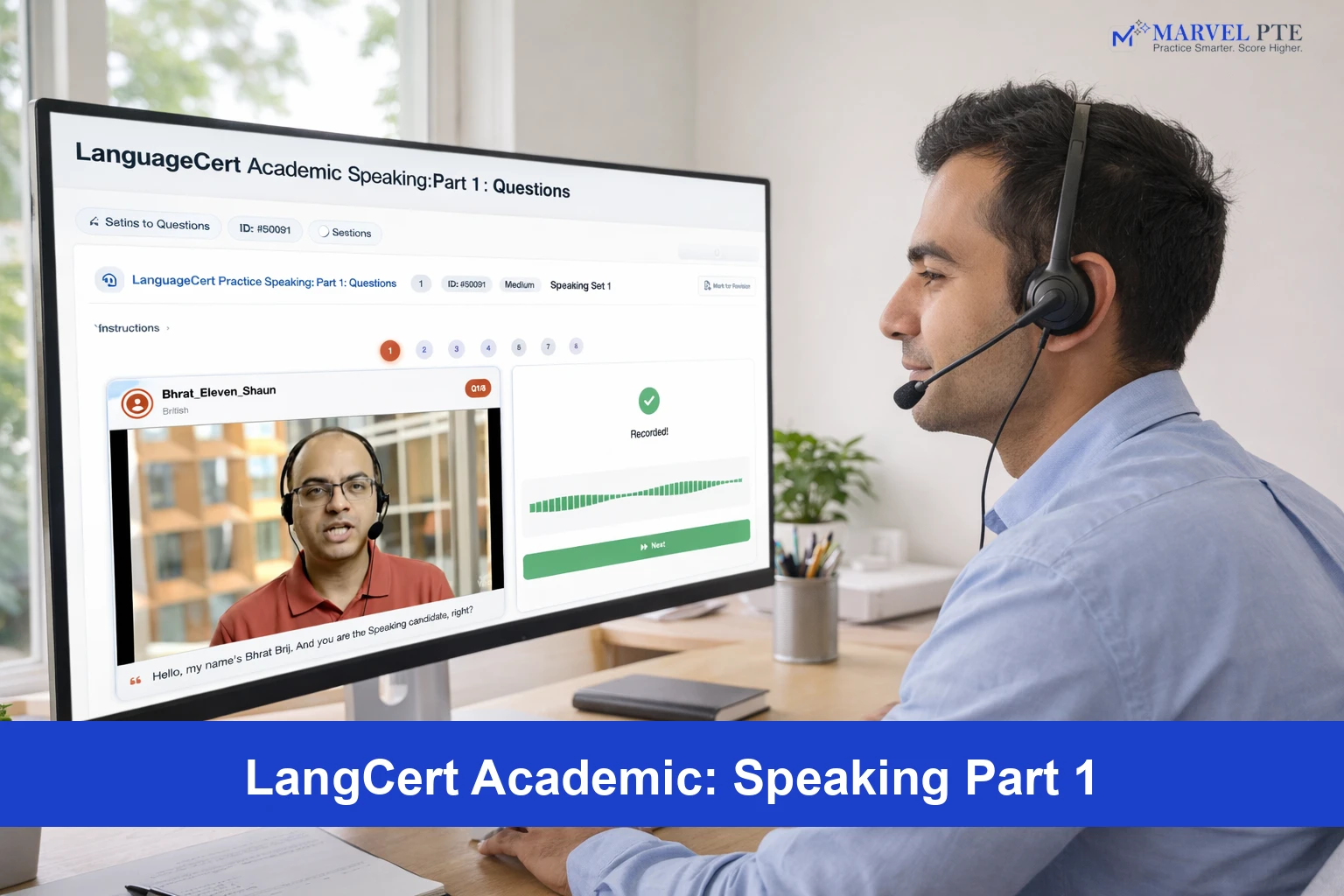
LanguageCert Academic Speaking Part 1 is the opening section of the speaking test, where the examiner asks you …

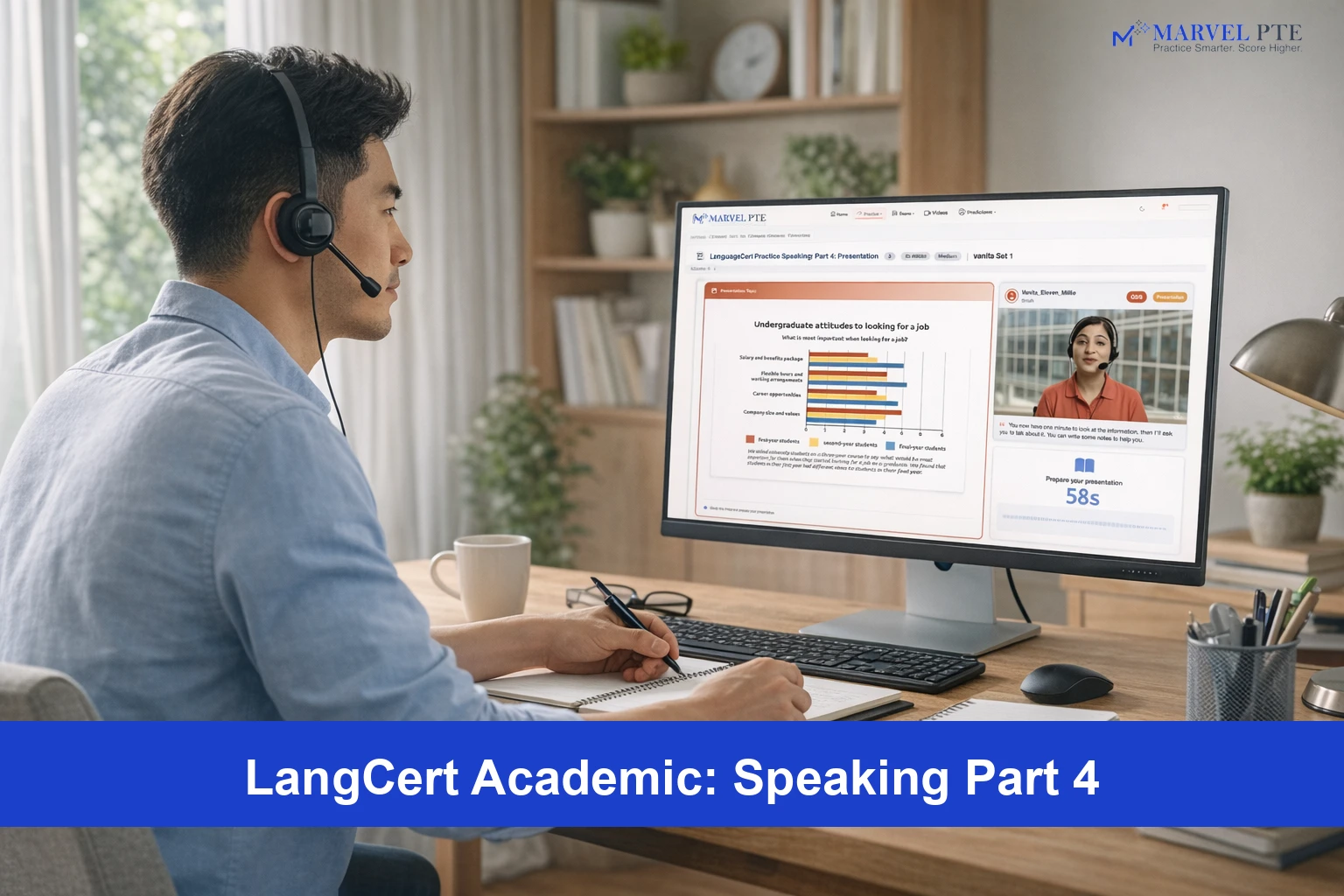
LanguageCert Academic Speaking Part 4 is the final section of the speaking test, where you deliver a …