
LanguageCert Academic
LanguageCert Academic Speaking Part 2: Role Play Task Format, Scoring, and Strategies
LanguageCert Academic Speaking Part 2 tests your ability to handle real conversations in academic settings. …

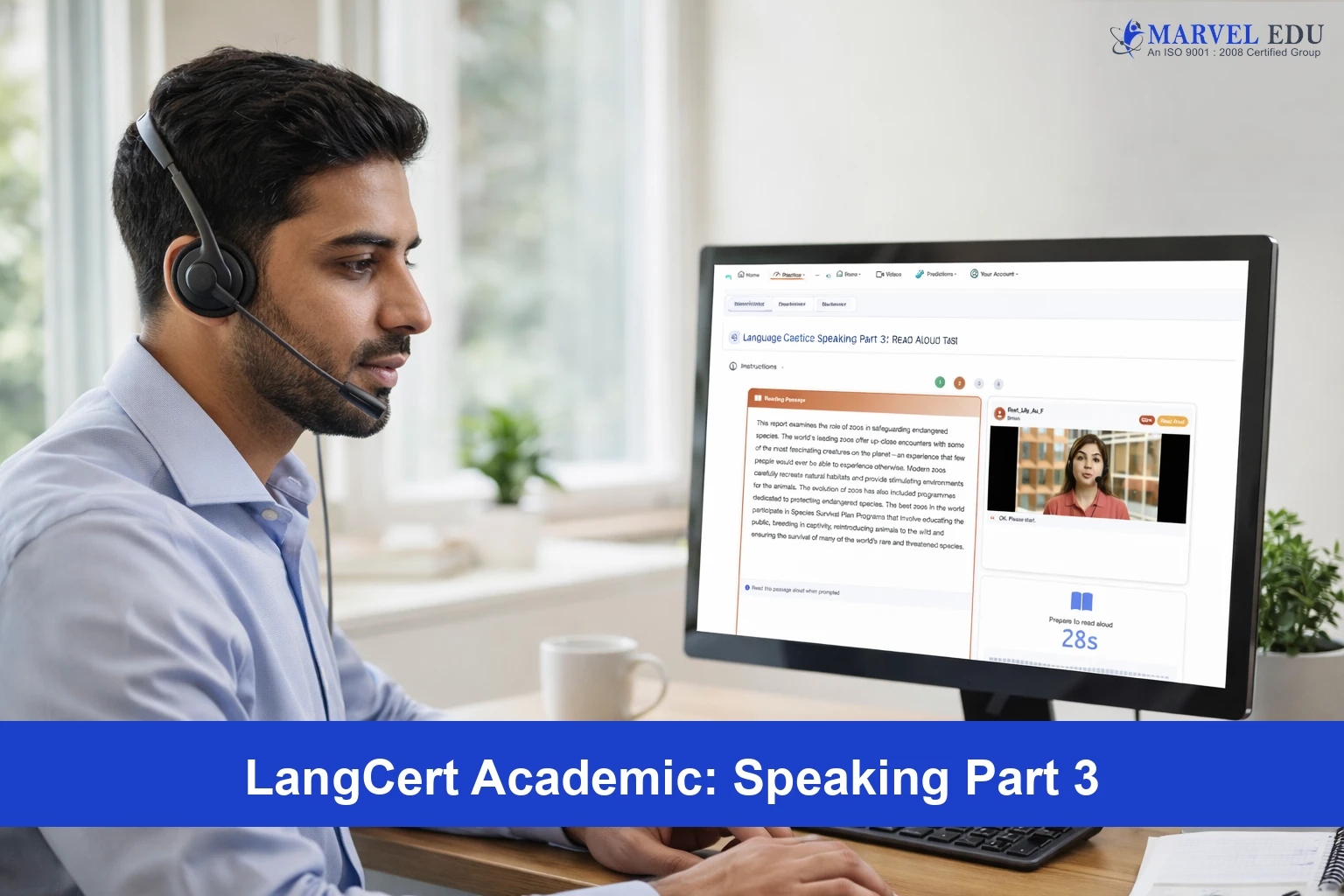
LanguageCert Academic Speaking Part 3 tests two skills in one task: reading aloud and expressing an opinion. You read a short academic passage while the examiner listens, then answer a follow-up question about the topic. Unlike PTE’s AI-scored Read Aloud, a human examiner evaluates your performance in real time.
This section sits in the middle of the 14-minute speaking test, after the personal questions and role play. By Part 3, you should be warmed up and comfortable with the examiner. The task combines the structured nature of PTE’s read aloud with the human interaction of IELTS, making it more forgiving for test takers who struggle with AI scoring.
For those preparing for Australian permanent residency, Speaking Part 3 is where many candidates see the difference between LanguageCert and other english language tests. There are no AI penalties for accent variations or natural pauses. The examiner understands context. If you have struggled with PTE’s strict pitch and speed requirements, this section may feel like a relief.
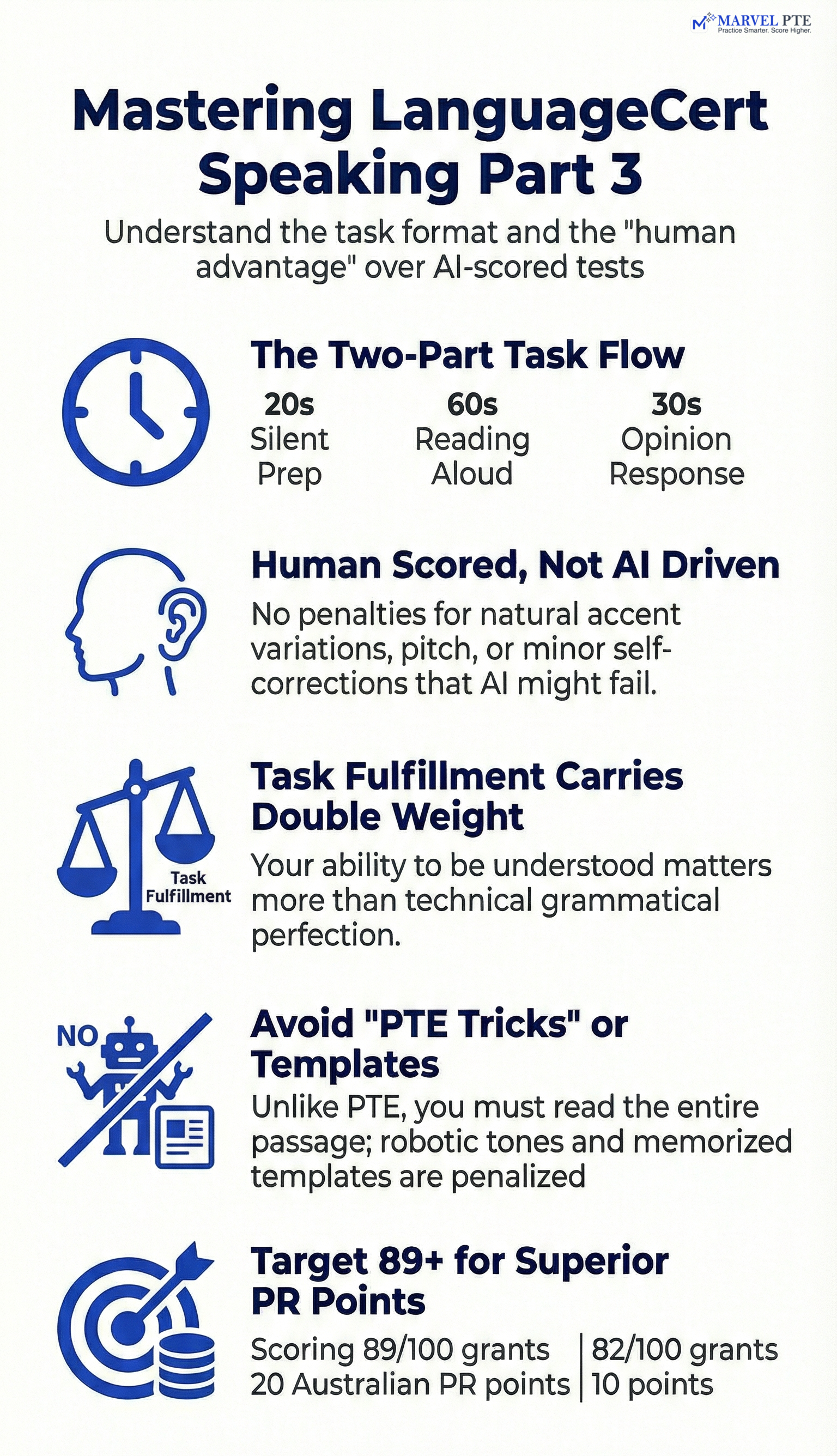
The examiner presents you with a passage on screen. You have 30 seconds to silently scan the text before reading it aloud. After you finish reading, the examiner asks a follow-up question related to the passage topic. You respond with your opinion in about 30 seconds.
| Aspect | Details |
|---|---|
| Position in test | Third of 4 speaking parts |
| Tasks | Read Aloud + Opinion question |
| Prep time | 30 seconds (silent scanning) |
| Reading time | 30-60 seconds |
| Opinion response | ~30 seconds |
| Format | Live video call with human examiner |
| Can revisit | No (linear interaction) |
The passage is typically academic in nature but accessible. Topics might include education, technology, health, or social issues. The opinion question asks for your view on something related to the passage.
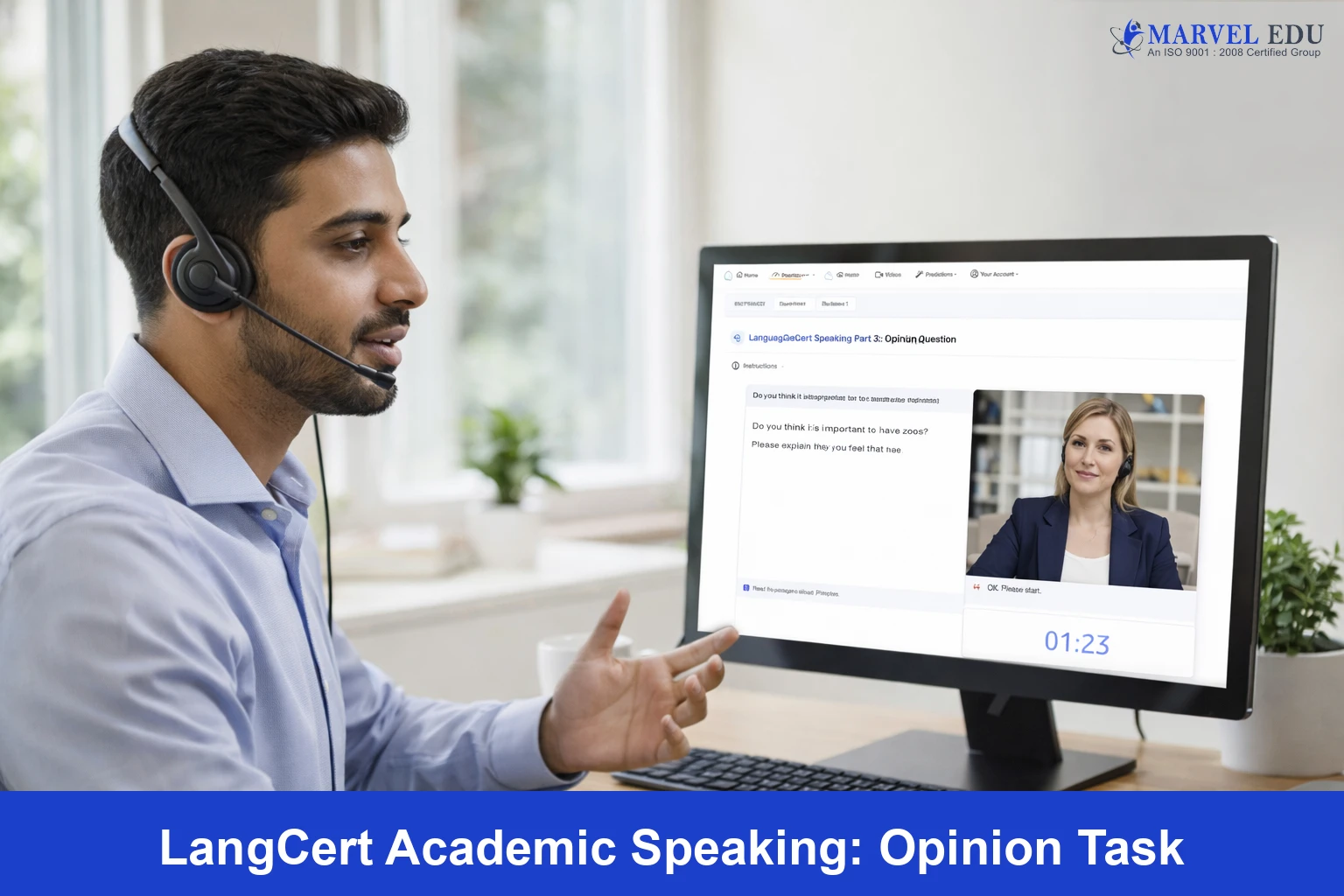
Practice Read Aloud passages with human-style feedback on fluency and pronunciation.
LanguageCert Speaking is marked on four criteria, each worth up to 8 points. Task Fulfilment carries double weight, meaning your ability to communicate clearly matters more than technical perfection.
| Criterion | What the Examiner Assesses |
|---|---|
| Task Fulfilment & Communicative Effect | Did you read clearly? Did your opinion make sense? (Double-weighted) |
| Grammar Accuracy and Range | Sentence control during reading and response |
| Vocabulary Accuracy and Range | Correct pronunciation of academic terms |
| Pronunciation, Intonation, and Fluency | Natural rhythm, stress, and pauses |
Key insight: The examiner marks Task Fulfilment in real time during your performance. A second examiner reviews the recording for the other criteria. This dual assessment ensures consistency across all test takers.
The focus on communicative effect means you do not need robotic perfection. A slight stumble that you correct naturally will not tank your score. The examiner is listening for whether a listener would understand you, not whether you hit every syllable with machine precision.
Experience all 4 speaking parts under real exam conditions with a human examiner simulation.
LanguageCert Academic is accepted as proof of english language ability for Australian skilled visas. Your Speaking score must meet specific thresholds:
| Level | Speaking Score | PR Points |
|---|---|---|
| Competent | 70/100 | 0 |
| Proficient | 82/100 | 10 |
| Superior | 89/100 | 20 |
Part 3 contributes equally with Parts 1, 2, and 4 to your overall Speaking score. A strong Read Aloud performance sets up momentum for the Presentation task in Part 4.
Those 30 seconds before reading are crucial. Do not waste them staring blankly at the passage.
What to do in 30 seconds:
Scan for difficult words - Look for long words, technical terms, or unusual names. Mentally rehearse their pronunciation.
Note punctuation - Commas, full stops, and semicolons indicate natural pauses. Plan where you will breathe.
Identify the topic - Understanding what the passage is about helps you read with appropriate expression.
Check sentence length - Long sentences need careful pacing. Identify where to break for breath without disrupting meaning.
A student I worked with in Melbourne had failed PTE Read Aloud three times. Her pronunciation was fine, but the AI penalised her for pauses in the wrong places. In LanguageCert Part 3, she used the prep time to mark pause points mentally. Her score improved immediately because the human examiner understood her natural rhythm.
Access our library of Q&A, Role Play, Read Aloud, and Presentation tasks.
Imagine you are reading the passage to a friend who needs to understand the content. This mindset produces natural intonation and stress. You emphasise important words because they matter to the meaning, not because you are trying to impress an algorithm.
English has a rhythm. Key words receive stress while function words (the, a, of, to) are spoken more lightly. Pauses occur at punctuation marks. Do not rush through commas. A brief pause at a full stop feels natural.
Example approach:
“Climate change [pause] is affecting agricultural patterns [pause] across many regions of the world.” [pause]
The pause after “climate change” emphasises the topic. The pause after “patterns” lets the listener absorb the point. The pause after “world” signals the sentence has ended.
If you have prepared for PTE, you may have learned to maintain constant speed and pitch. Forget those strategies here. The “one line strategy” (reading only one line to avoid mistakes) does not work when a human is watching you skip content. The examiner expects you to read the entire passage.
Similarly, artificially slowing down to avoid AI penalties is unnecessary. The human examiner values natural delivery over mechanical precision.
If you mispronounce a word and catch yourself, correcting it naturally is fine. Say the word again correctly and continue. The examiner recognises this as normal human behaviour. Just do not stop and restart repeatedly.
After reading, the examiner asks your view on something related to the passage. You have about 30 seconds to respond. This is not a debate. It is a simple expression of opinion with a reason.
One clear opinion + One supporting reason
“I think renewable energy is essential for the future because traditional sources are running out and causing environmental damage.”
That is it. You do not need multiple arguments, counterpoints, or a formal conclusion. The examiner is assessing whether you can communicate a relevant opinion clearly, not your debating skills.
If the passage was about urbanisation and the question asks your opinion on city living, talk about city living. Do not pivot to an unrelated topic you feel more confident about. Relevance matters for Task Fulfilment.
Unlike essay writing, there is no template that works for opinion questions. Phrases like “There are many advantages and disadvantages” or “In my humble opinion” sound rehearsed. Speak naturally.
“Honestly, I believe…” or “From my experience…” are natural ways to introduce your view.
Simple vocabulary delivered clearly scores better than complex words used awkwardly. If you naturally use academic language, great. If you prefer straightforward expressions, that works too.
Skipping lines or paraphrasing
You must read the passage as written. Skipping lines or substituting your own words will hurt your Task Fulfilment score.
Reading in a flat, robotic tone
Monotone delivery suggests you are not engaged with the content. Vary your pitch and pace naturally.
Applying PTE speed strategies
Rushing through the passage to avoid AI timing penalties does not apply here. The human examiner values comprehension over speed.
Overcorrecting every mistake
One natural self-correction is fine. Stopping to fix every small error disrupts your flow and makes you seem uncertain.
Memorising templates for opinions
The examiner can tell when you are delivering a pre-prepared structure. Genuine responses sound better.
Understanding how Part 3 compares to other english language tests helps you choose the right exam.
The advantage: LanguageCert Part 3 combines the task-based structure of PTE (Read Aloud) with the human judgement of IELTS. You get a defined task with clear expectations, but a human who understands context evaluates your performance. For test takers who have failed PTE multiple times due to AI scoring issues, this is often the deciding factor.
Several features make LanguageCert Part 3 more manageable than equivalent tasks in other tests:
No AI scoring for pitch or accent
The human examiner does not penalise you for speaking too slowly, too quickly, or with an accent. If you communicate clearly, you score well.
Context understanding
If you hesitate because a word is genuinely difficult, the examiner recognises this. They understand that some words are challenging for non-native speakers.
Self-correction accepted
Catching and correcting your own mistakes is seen as competent language use, not a failure.
Flexible scheduling
The speaking test can be taken on a different day from the written sections, within a 14-day window. This reduces test-day pressure and lets you prepare specifically for speaking.
Less time pressure
Unlike PTE where a countdown timer creates anxiety, LanguageCert Part 3 flows naturally. The examiner manages the pace.
Preparing for a human-examined Read Aloud task requires practice that mirrors the real experience. Our platform provides tools designed specifically for LanguageCert Speaking Part 3.
Realistic Read Aloud passages
Practice with academic passages similar to those in the actual test. Build fluency by reading aloud regularly.
Human-style fluency feedback
While we use AI for analysis, our feedback targets the criteria human examiners use: communicative effect, natural pauses, and stress patterns. We do not penalise you for things the real examiner would accept.
Timed simulations
Experience the exact Part 3 format: 30 seconds prep, reading, then opinion question. Get comfortable with the rhythm before test day.
Opinion question practice
Work through sets of follow-up questions across different topics. Build confidence expressing opinions clearly in 30 seconds.
How much preparation time do you get before reading the passage aloud?
Which scoring criterion is double-weighted in LanguageCert Speaking?
How is LanguageCert Part 3 scored compared to PTE Read Aloud?
Can you revisit or redo your response in Speaking Part 3?
What Speaking score is required for Superior English (20 PR points)?
What two tasks make up Speaking Part 3?
Read Aloud (reading a passage) followed by an opinion question.
How long is the preparation time before reading?
30 seconds to silently scan the passage.
How long does the Read Aloud portion take?
Approximately 30 to 60 seconds.
How long do you have to answer the opinion question?
About 30 seconds.
Who scores LanguageCert Speaking Part 3?
A human examiner (interlocutor), not AI.
Which criterion is double-weighted in scoring?
Task Fulfilment and Communicative Effect.
Can you go back and redo your response?
No, the speaking test is linear and live.
What Speaking score is needed for Competent English?
70/100 (0 PR points).
What Speaking score is needed for Proficient English?
82/100 (10 PR points).
What Speaking score is needed for Superior English?
89/100 (20 PR points).
During the 20-second prep:
While reading aloud:
For the opinion question:
What to remember:
Part 3 is where many test takers feel the difference between LanguageCert and other english language tests. The combination of a defined task and human scoring creates a fair assessment environment. Read clearly, express your opinion simply, and trust that the examiner understands natural speech.
Watch expert strategies for each speaking part with sample responses.

LanguageCert Academic Speaking Part 2 tests your ability to handle real conversations in academic settings. …
LanguageCert Academic Speaking Part 1 is the opening section of the speaking test, where the examiner asks you …

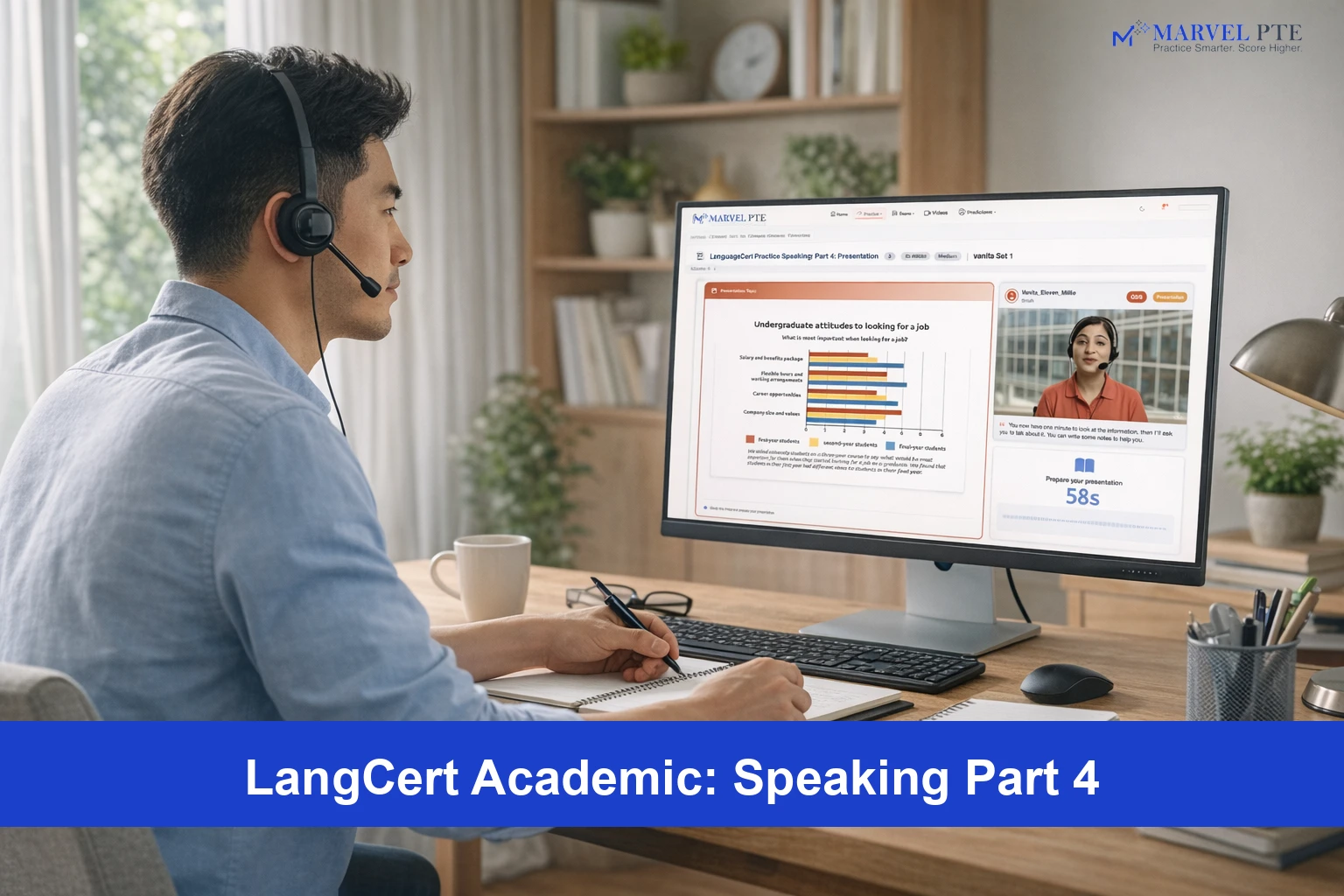
LanguageCert Academic Speaking Part 4 is the final section of the speaking test, where you deliver a …