
LanguageCert Academic
LanguageCert Academic Speaking Part 2: Role Play Task Format, Scoring, and Strategies
LanguageCert Academic Speaking Part 2 tests your ability to handle real conversations in academic settings. …


LanguageCert Academic Speaking Part 4 is the final section of the speaking test, where you deliver a presentation on an academic topic. Unlike casual conversation, this task requires you to organise your thoughts and speak continuously for up to 2 minutes. It is the most demanding spoken component of the exam, but also the one where strong candidates can demonstrate their ability to communicate complex ideas clearly.
As a secure english language test (SELT) approved for Australian immigration and UK visas, LanguageCert Academic is part of the LanguageCert International ESOL exam family. This multilevel B1-C2 exam assesses your english language proficiency across four exam components: listening, reading, writing, and speaking. Part 4 tests your ability to produce extended discourse on academic subjects, the kind of language skills you need for higher education or professional environments. Whether you take the LanguageCert online exam from home or at a test centre, the spoken exam format remains the same.
If you are preparing for Australian permanent residency or a student visa, Speaking Part 4 carries significant weight. A confident, well-structured presentation can make the difference between a good score and a great one. This complete guide covers everything you need to know: the exam structure, how to use your preparation time, step-by-step strategy, scoring criteria, and how this compares to IELTS Academic and PTE Academic speaking tasks.
Unlike Cambridge English exams or other english tests, LanguageCert Academic SELT is specifically designed for visa and academic purposes. The english language requirement for skilled migration means you need to demonstrate english proficiency at the appropriate level. Understanding the exact format helps you prepare effectively for this qualification.
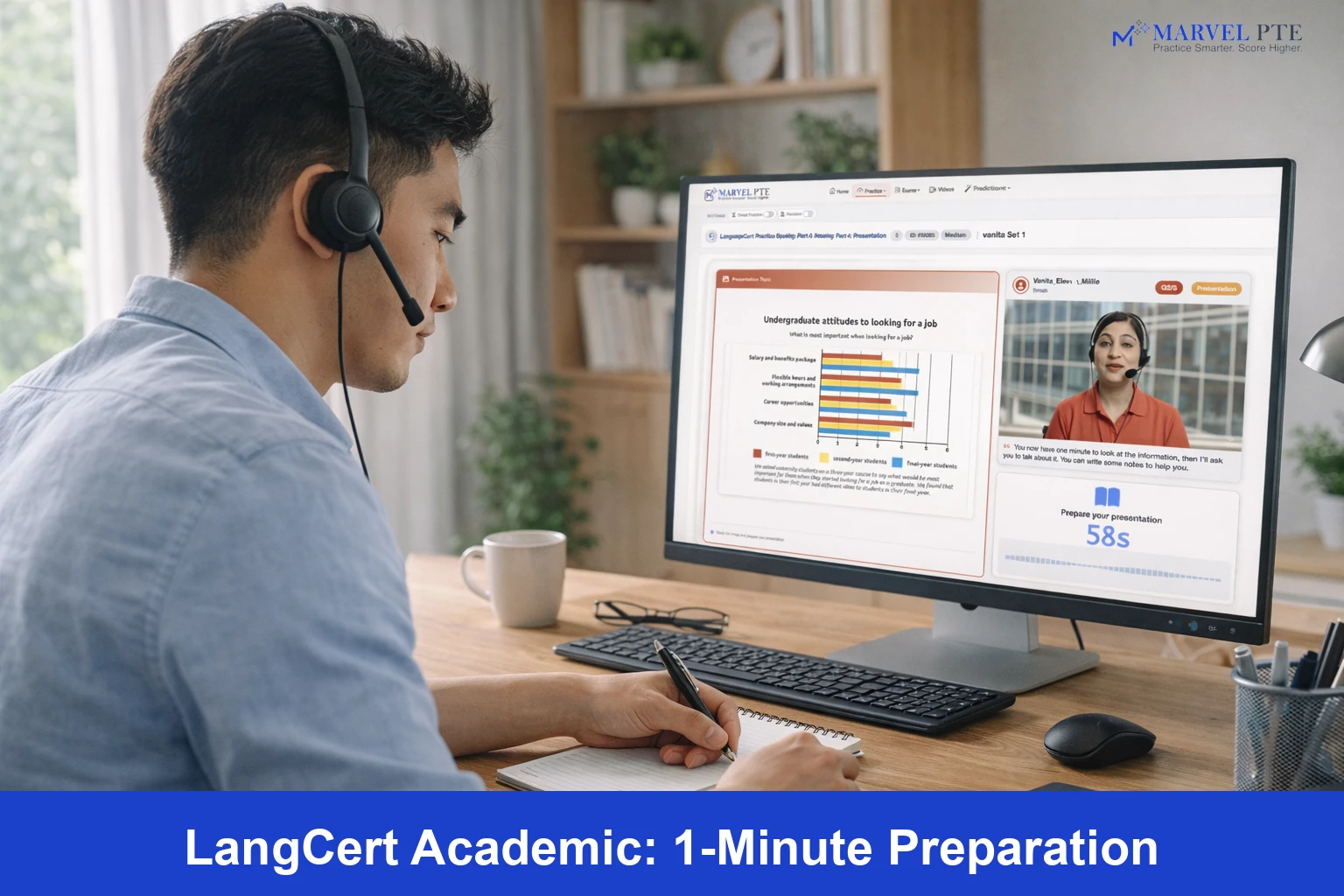
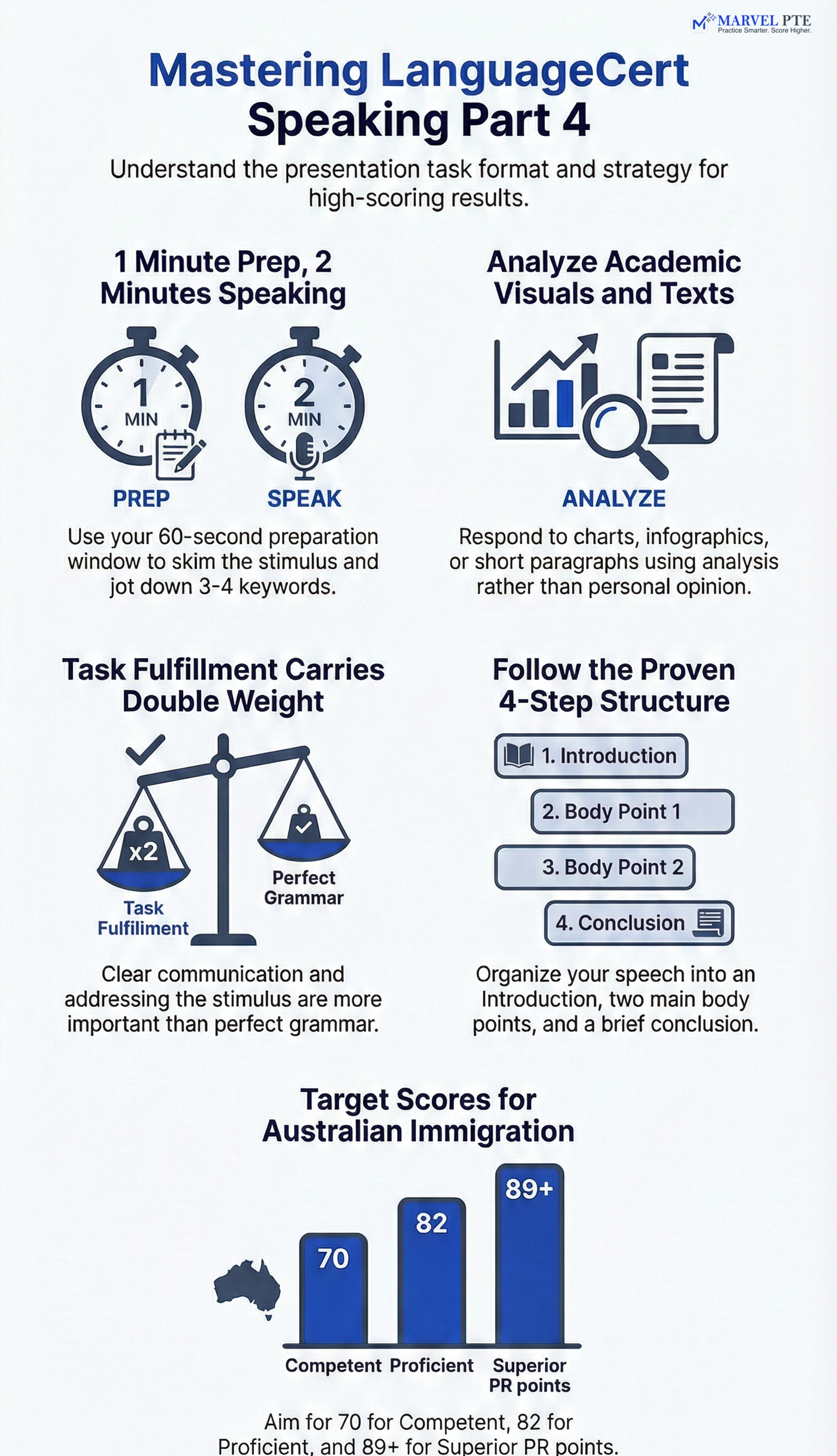
The LanguageCert Academic test uses the Common European Framework of Reference (CEFR) to assess your language skills. Speaking Part 4 comes after you have completed the Personal Questions, Role Play, and Read Aloud sections. The examiner provides you with a stimulus, either a visual (chart, infographic, diagram) or a short text on an academic topic. You have 1 minute to prepare, then up to 2 minutes to deliver your presentation.
| Aspect | Details |
|---|---|
| Position in test | Fourth (final) speaking part |
| Preparation time | 1 minute |
| Speaking time | Up to 2 minutes |
| Stimulus type | Visual or text on academic topic |
| Follow-up | 1-2 examiner questions |
| Purpose | Assess extended academic discourse |
After your presentation, the examiner asks 1-2 follow-up questions related to your topic. These are brief and test your ability to respond spontaneously while maintaining the academic register.
Practice timed presentations with academic prompts and AI feedback.
The stimulus material covers academic subjects and academic texts that require analysis rather than personal opinion. You are not asked what you think, you are asked to discuss, explain, or analyse. This reflects the academic argumentation skills needed for academic english in university settings.
Common topic areas:
Stimulus formats:
The examiner expects you to engage with the stimulus, not ignore it. If you receive a chart showing study habits of university students, your presentation should discuss what the data shows and what it might mean.
Experience all 4 speaking parts under real exam conditions.
Your Part 4 performance contributes to the overall Speaking score, which is marked out of 100 by human examiners. All four speaking parts carry equal weight.
| Criterion | What the Examiner Looks For |
|---|---|
| Task Fulfilment | Did you address the stimulus? Did you communicate your ideas clearly? |
| Coherence | Is your presentation logically structured? Do ideas flow? |
| Grammar | Are you using varied grammatical structures accurately? |
| Vocabulary | Are you using appropriate academic vocabulary? |
| Pronunciation | Is your speech clear with natural stress and intonation? |
Task Fulfilment is double-weighted. This means the examiner prioritises whether you completed the task and communicated effectively. Perfect grammar with poor content scores lower than imperfect grammar with clear, well-developed ideas.
What this means for Part 4:
You need to actually address the stimulus. A presentation that ignores the chart or text and delivers a memorised template will score poorly on Task Fulfilment, regardless of how fluent it sounds.
Your preparation time is short, so you need a system. Do not waste time reading the entire stimulus carefully. Skim for the key information.
In the first 20 seconds:
In the remaining 40 seconds:
A student I worked with in Campbelltown used to panic during prep time, trying to write complete sentences. Once she switched to just noting three key words, her presentations became much more natural.
Introduction (20-30 seconds)
Paraphrase the stimulus and state what you will discuss.
Example: “This infographic shows the study habits of university students in three countries. I’ll discuss what the data reveals about digital learning and suggest why these patterns exist.”
Main Body (1-1.5 minutes)
Develop 2 clear points. For each point:
Point 1: “The data shows that students in Country A spend significantly more time on online courses compared to traditional lectures. This could be because…”
Point 2: “Another interesting finding is that study group participation varies widely. In my view, this reflects…”
Conclusion (10-15 seconds)
Summarise your main observation and add a general statement.
“Overall, the data suggests that learning habits are changing rapidly. As technology becomes more accessible, we can expect these trends to continue.”
Access our library of Q&A, Role Play, Read Aloud, and Presentation tasks.
Here is a sample outline for a prompt about online education statistics:
Stimulus: An infographic showing that 60% of university students now prefer blended learning over purely face-to-face classes.
Sample response structure:
“This infographic presents data on student preferences for different learning formats. I’m going to discuss two key observations.
First, the majority of students, around 60%, now prefer blended learning. This combines online and in-person instruction. One reason for this preference might be flexibility. Students can watch lectures at their own pace while still attending practical sessions in person.
Second, it’s notable that only 15% prefer purely online courses. This suggests that despite the convenience of digital learning, most students still value some form of face-to-face interaction with instructors and classmates.
To conclude, the data indicates a clear shift towards flexible learning models. Universities may need to adapt their teaching approaches to meet these changing expectations.”
This response directly engages with the stimulus, presents two developed points, and ends with a summary.
Unlike PTE, where a progress bar creates pressure, LanguageCert Part 4 gives you flexibility. There is no countdown on screen. However, you should still manage your time effectively.
How to pace your 2 minutes:
| Section | Time | Content |
|---|---|---|
| Introduction | 20-30 sec | Topic + what you will cover |
| Point 1 | 30-40 sec | Main idea + example/evidence |
| Point 2 | 30-40 sec | Second idea + explanation |
| Conclusion | 10-15 sec | Summary + final thought |
What to do if you forget a word:
Paraphrase. Say “the thing that…” or “what I mean is…” and continue. The examiner understands this is natural speech.
What to do if you finish early:
Expand your conclusion or add “One more point I’d like to mention…” Do not just stop abruptly.
Handling follow-up questions:
Stay calm. These questions are brief and relate to what you just discussed. A sentence or two is usually sufficient.
Understanding how different tests assess extended speaking helps you choose the right exam for your skills.
| Aspect | LanguageCert Part 4 | IELTS Part 2 | PTE |
|---|---|---|---|
| Format | Academic stimulus + presentation | Cue card with points | No direct equivalent |
| Prep time | 1 minute | 1 minute | N/A |
| Speaking time | Up to 2 minutes | 1-2 minutes | 40 sec (Describe Image) |
| Examiner | Human (live video) | Human (in-person) | AI only |
| Follow-up | 1-2 questions | Yes (Part 3) | No |
| Pauses penalised | No | No | Yes |
Why LanguageCert has advantages over other SELT exams:
PTE Academic has no equivalent to a 2-minute presentation. The closest tasks are Describe Image (40 seconds with a timer) and Re-tell Lecture (40 seconds after listening to audio). If you struggle with strict time limits and AI scoring, LanguageCert Part 4 offers more flexibility. Many test takers who find PTE Academic challenging switch to LanguageCert for a more human-centred approach.
IELTS Academic Part 2 is similar in format. You receive a cue card with specific points to cover and have 1-2 minutes to speak. The main difference is that IELTS Academic provides explicit bullet points, while LanguageCert gives you a broader academic stimulus requiring more independent structuring.
Cambridge English exams like C1 Advanced also include extended speaking, but these are not accepted for Australian visa purposes. Among accepted english language tests, LanguageCert stands out for its combination of human examiners and flexible timing.
For test takers who perform well with human interaction and need time to develop ideas, LanguageCert Part 4 is more forgiving than AI-scored alternatives like PTE Academic.
Ignoring the stimulus
Some candidates prepare generic templates and deliver them regardless of the prompt. Examiners immediately recognise this. Your presentation must engage with the specific material provided.
Finishing too early
Stopping after 60 seconds leaves the examiner with insufficient speech to assess. Aim for at least 90 seconds. If you run short, expand an example or add a concluding thought.
Memorising templates
Phrases like “This infographic shows three things: firstly, secondly, thirdly” sound robotic when overused. Vary your language naturally.
Speaking too fast
Many candidates who previously took PTE develop the habit of rushing. There is no timer countdown. Slow down and articulate clearly.
No clear structure
Jumping between ideas without transitions confuses the examiner. Use simple signposting: “First…”, “Another point is…”, “To conclude…”
Preparing for a 2-minute presentation requires practice with realistic prompts and feedback on structure. Our platform provides tools specifically designed for the LanguageCert Academic exam format.
Timed presentation simulations
Practice with the exact format: 1 minute prep, 2 minutes speaking. Our prompts mirror the academic topics and stimulus types used in real exams.
Academic prompt library
Access a range of infographics, charts, and text stimuli covering education, technology, environment, and society. Each prompt includes suggested points and example responses for self-study.
Structured feedback on your recordings
Record your presentations and receive AI feedback on:
Practice handling follow-up questions
Our mock tests include examiner-style follow-up questions after each presentation. Build confidence responding spontaneously while staying on topic.
Before you book your LanguageCert exam, make sure you have practised the spoken component thoroughly. The LanguageCert online option allows you to take the exam from home, while test centres offer a more traditional setting. Either way, the spoken exam is conducted via live video with a human examiner.
Preparation resources:
When you book the exam, consider which format suits your situation. The online exam offers flexibility but requires a quiet room and stable internet. Test centre bookings may have limited availability but provide a controlled environment.
LanguageCert Academic is accepted as proof of english language ability for Australian skilled visas. Unlike the Occupational English Test (OET) which is healthcare-specific, LanguageCert Academic covers general academic topics. Your speaking score must meet specific thresholds:
| Level | Score | PR Points |
|---|---|---|
| Competent | 70/100 | 0 |
| Proficient | 82/100 | 10 |
| Superior | 89/100 | 20 |
Part 4 contributes equally with Parts 1, 2, and 3 to your final Speaking score. A well-structured, stimulus-focused presentation demonstrates the kind of academic communication skills that earn higher band scores.
How much preparation time is given for Speaking Part 4?
What is the maximum speaking time for the presentation?
What type of material does the examiner provide as stimulus?
Which scoring criterion is double-weighted in Speaking Part 4?
What happens after you finish your presentation?
Where does Speaking Part 4 rank in the speaking test sequence?
Final (fourth) of the 4 speaking parts.
How much preparation time do you get for Part 4?
1 minute to read the stimulus and plan your response.
How long should your Part 4 presentation be?
Up to 2 minutes of continuous speaking.
What type of stimulus is provided?
Visual (chart, diagram, infographic) or text on an academic topic.
Are there follow-up questions after the presentation?
Yes, the examiner asks 1-2 related questions.
Which scoring criterion is double-weighted?
Task Fulfilment (communication effectiveness).
What is the ideal structure for your presentation?
Introduction, 2 main points with examples, conclusion.
What Speaking score is needed for Competent English?
70/100 (0 PR points).
What Speaking score is needed for Proficient English?
82/100 (10 PR points).
What Speaking score is needed for Superior English?
89/100 (20 PR points).
Before the test:
[ ] Understand the 1-minute prep, 2-minute speaking format
[ ] Practice with various academic topics (education, technology, environment)
[ ] Develop a consistent structure: intro, 2 points, conclusion
[ ] Get comfortable speaking for 90-120 seconds continuously
During preparation (1 minute):
[ ] Skim the stimulus for key information
[ ] Identify 2-3 main points
[ ] Jot down 3-4 key words only
[ ] Plan one example or explanation per point
During your presentation (2 minutes):
[ ] Start by paraphrasing the stimulus
[ ] State what you will discuss
[ ] Develop each point with evidence or examples
[ ] Use clear transitions between ideas
[ ] Conclude with a summary statement
[ ] Speak at a natural, measured pace
For follow-up questions:
[ ] Listen carefully to the question
[ ] Respond briefly but completely
[ ] Stay on the topic of your presentation
Part 4 is the final and most demanding speaking task. Approach it with a clear structure, engage directly with the stimulus, and speak at a pace that allows you to develop your ideas fully. With practice, a 2-minute presentation becomes a comfortable opportunity to demonstrate your academic communication skills.
Watch expert strategies for each speaking part with sample responses.

LanguageCert Academic Speaking Part 2 tests your ability to handle real conversations in academic settings. …
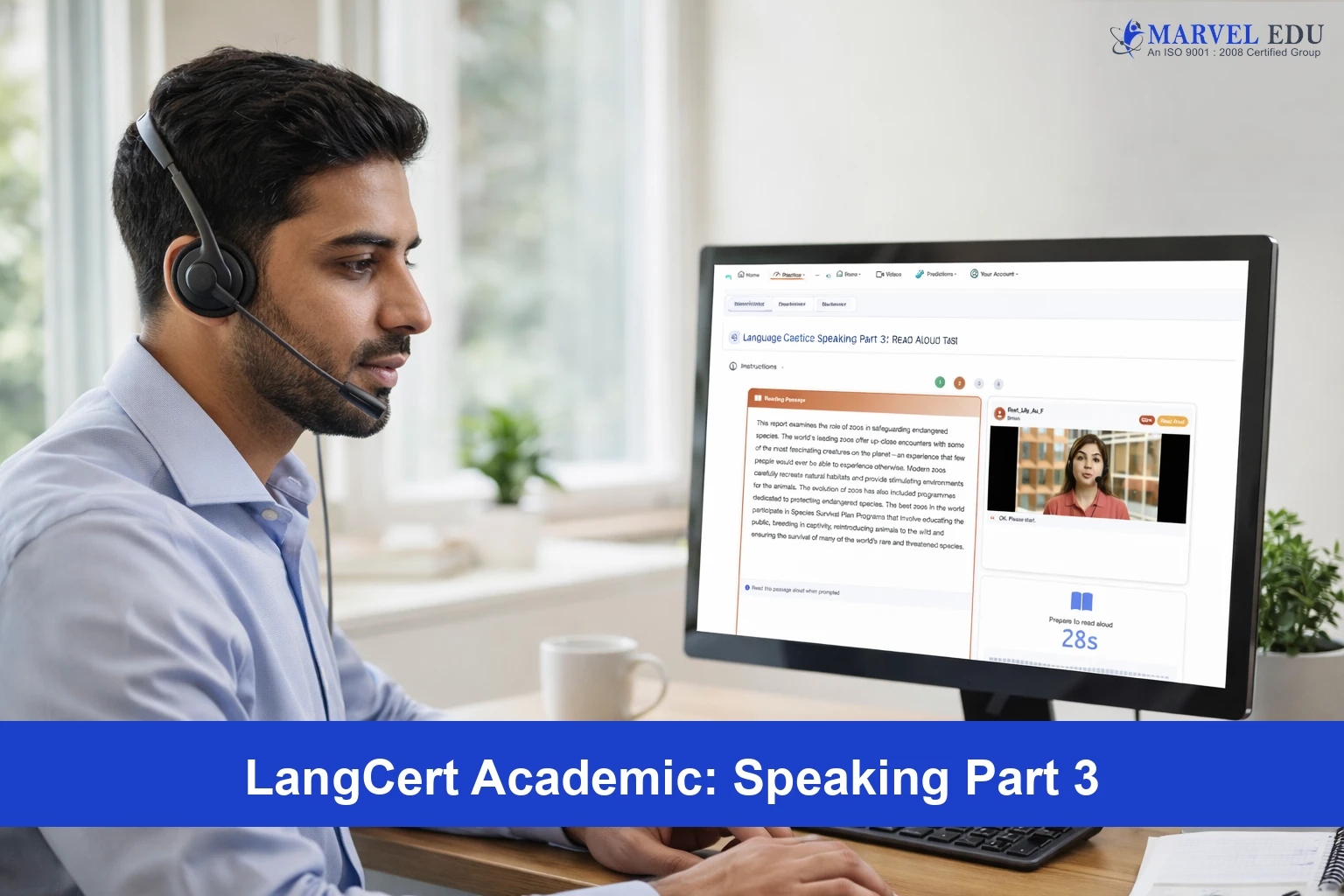
LanguageCert Academic Speaking Part 3 tests two skills in one task: reading aloud and expressing an opinion. …

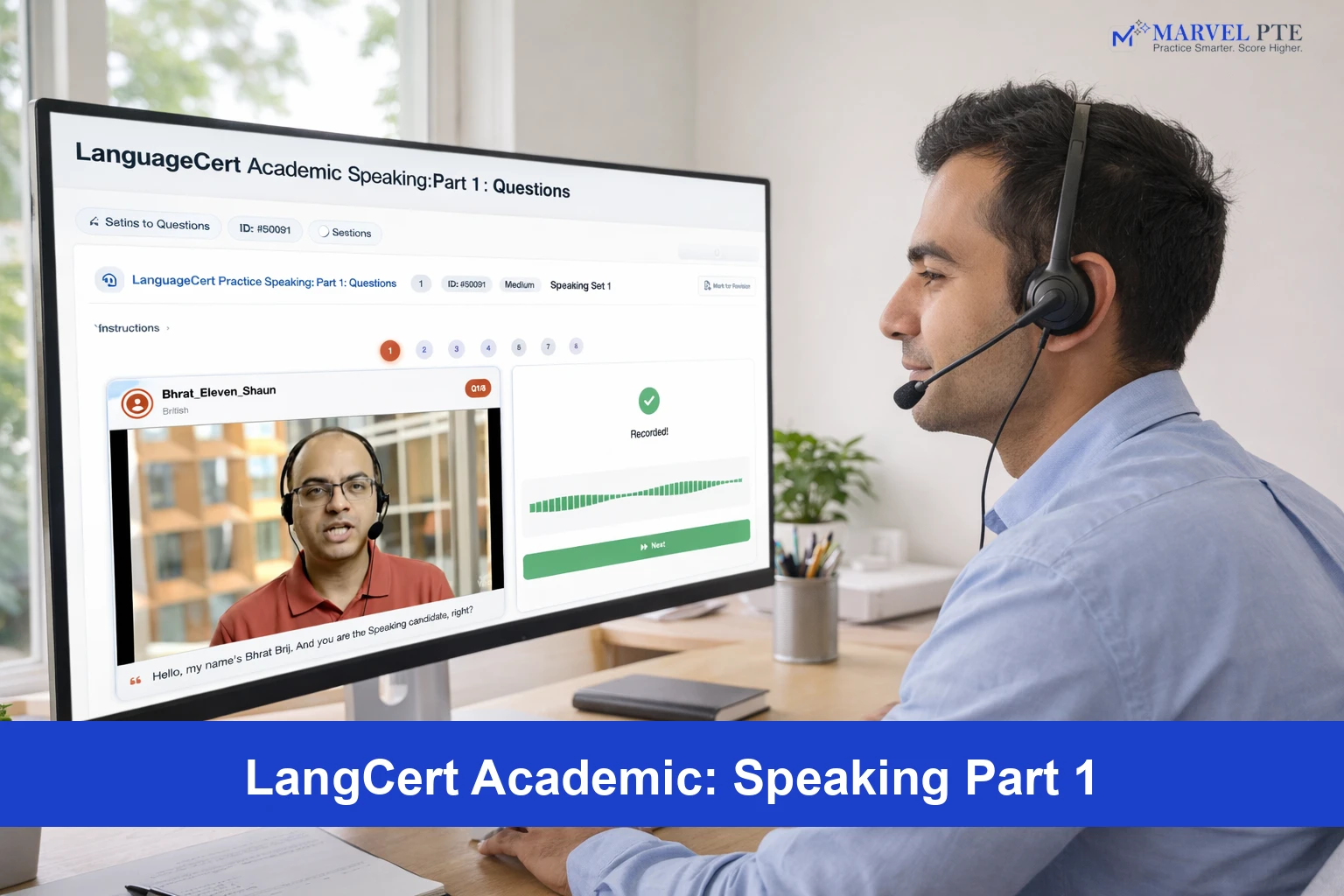
LanguageCert Academic Speaking Part 1 is the opening section of the speaking test, where the examiner asks you …
