New
  • **AI Mock Test Analyzer** just launched — deeper skills breakdown now live. Try it now

  • Live Webinar Friday: Crack PTE Speaking (limited seats). Register

  • October coaching enrollment window opens soon — early spots fill fast. View coaching

Marvel Edu logo Marvel Edu logo
  • PTE
    Overview
    • About Exam
    • Fees & Registration
    Structure
    • Exam Pattern
    • Result & Score
    Student Resources
    • Read Aloud
    • Repeat Sentence
    • Describe Image
    • Retell Lecture
    • Answer Short Question
    • Summarize Group Discussion
    • Respond to A Situation
    All Speaking Guides →
    • Summarize Written Text
    • Write Essay
    All Writing Guides →
    • Fill in the Blanks (Dropdown)
    • Multiple Choice, Multiple Answers
    • Re-order Paragraphs
    • Fill in The Blanks (Drag & Drop)
    • Multiple Choice, Single Answer
    All Reading Guides →
    • Summarize Spoken Text
    • Multiple Choice, Multiple Answers
    • Fill in the Blanks (Type In)
    • Highlight Correct Summary
    • Multiple Choice, Single Answer
    • Select Missing Word
    • Highlight Incorrect Words
    • Write From Dictation
    All Listening Guides →
    AI Practice Software Real exam interface • AI scoring • Instant feedback
    Explore Features
    Overview
    • About Exam
    • Fees & Registration
    Structure
    • Exam Pattern
    • Result & Score
    Student Resources
    • Read Aloud
    • Repeat Sentence
    • Describe Image
    • Respond to A Situation
    • Answer Short Question
    All Speaking Guides →
    • Summarize Written Text
    • Write Email
    All Writing Guides →
    • Reading and Writing Fill in the Blanks
    • Multiple Choice, Multiple Answers
    • Re-order Paragraphs
    • Reading Fill in the Blanks
    • Multiple Choice, Single Answer
    All Reading Guides →
    • Summarize Spoken Text
    • Multiple Choice, Multiple Answers
    • Listening Fill in Blanks
    • Multiple Choice, Single Answer
    • Select Missing Word
    • Highlight Incorrect Words
    • Write from Dictation
    All Listening Guides →
    AI Practice Software CLB scoring • Canada PR ready • Real exam feel
    Explore Features
  • LanguageCert
    Why LanguageCert?
    vs PTE Academic
    • Listening plays twice
    • Review questions anytime
    • No integrated scoring
    • Templates work effectively
    Full Comparison
    Overview
    • About Exam
    • Fees & Registration
    Structure
    • Exam Pattern
    • Result & Score
    Student Resources
    • Part 1: Questions
    • Part 2: Role Play
    • Part 3: Read Aloud
    • Part 4: Presentation
    All Speaking Guides →
    • Part 1: Report on Visual
    • Part 2: Essay
    All Writing Guides →
    • Part 1A: Word Replace
    • Part 1B: Gap Fill
    • Part 2: Sentence Matching
    • Part 3: Multi-Text Attribution
    • Part 4: Long Text MCQ
    All Reading Guides →
    • Part 1: Short Dialogues
    • Part 2: Long Conversation
    • Part 3: Monologue
    • Part 4: Extended Listening
    All Listening Guides →
    AI Practice Software Interlocutor prep • Live interview simulation • AI feedback
    Explore Features
  • Pricing
  • Coaching
    🇦🇺Australia
    • Parramatta One-to-One PTE coaching in Parramatta, Sydney
    • Narellan Expert PTE coaching in Narellan, Campbelltown area
    • Online Australia One-to-One & Group classes from anywhere in Australia
    🇮🇳India
    • Zirakpur PTE coaching classes in Zirakpur, Chandigarh
    🇦🇺Australia
    • Parramatta LanguageCert coaching in Parramatta, Sydney
    • Narellan LanguageCert coaching in Narellan area
    • Online Australia Online LanguageCert classes across Australia
    🇮🇳India
    • Zirakpur LanguageCert coaching in Zirakpur, Chandigarh
  • Support
    Resources
    • Helpdesk FAQs, guides & tutorials for MarvelPTE platform
    • Blog Insider tips, tricks, exam hacks & guides
    Company
    • About Learn how MarvelPTE helps improve English proficiency education
    Contact
    • Contact Us Reach out for assistance, inquiries, or to provide feedback
  • Institute Software
Log In Signup

Menu

  • Pricing
  • Institute Software
Log In Signup
Overview
  • About Exam
  • Fees & Registration
Structure
  • Exam Pattern
  • Result & Score
Student Resources
Why LanguageCert?
vs PTE Academic
  • Listening plays twice
  • Review questions anytime
  • No integrated scoring
  • Templates work effectively
Full Comparison
Overview
  • About Exam
  • Fees & Registration
Structure
  • Exam Pattern
  • Result & Score
Student Resources
  • Mock Tests
  • All Blog Posts
Overview
  • About Exam
  • Fees & Registration
Structure
  • Exam Pattern
  • Result & Score
Student Resources
  • Mock Tests
  • All Blog Posts
  • Read Aloud
  • Repeat Sentence
  • Describe Image
  • Retell Lecture
  • Answer Short Question
  • Summarize Group Discussion
  • Respond to A Situation
  • Summarize Written Text
  • Write Essay
  • Fill in the Blanks (Dropdown)
  • Multiple Choice, Multiple Answers
  • Re-order Paragraphs
  • Fill in The Blanks (Drag & Drop)
  • Multiple Choice, Single Answer
  • Summarize Spoken Text
  • Multiple Choice, Multiple Answers
  • Fill in the Blanks (Type In)
  • Highlight Correct Summary
  • Multiple Choice, Single Answer
  • Select Missing Word
  • Highlight Incorrect Words
  • Write From Dictation
  • Read Aloud
  • Repeat Sentence
  • Describe Image
  • Respond to A Situation
  • Answer Short Question
  • Summarize Written Text
  • Write Email
  • Reading and Writing Fill in the Blanks
  • Multiple Choice, Multiple Answers
  • Re-order Paragraphs
  • Reading Fill in the Blanks
  • Multiple Choice, Single Answer
  • Summarize Spoken Text
  • Multiple Choice, Multiple Answers
  • Listening Fill in Blanks
  • Multiple Choice, Single Answer
  • Select Missing Word
  • Highlight Incorrect Words
  • Write from Dictation
  • Part 1: Questions
  • Part 2: Role Play
  • Part 3: Read Aloud
  • Part 4: Presentation
  • Part 1: Report on Visual
  • Part 2: Essay
  • Part 1A: Word Replace
  • Part 1B: Gap Fill
  • Part 2: Sentence Matching
  • Part 3: Multi-Text Attribution
  • Part 4: Long Text MCQ
  • Part 1: Short Dialogues
  • Part 2: Long Conversation
  • Part 3: Monologue
  • Part 4: Extended Listening
  • PTE Coaching
  • LanguageCert Coaching
Resources
  • Helpdesk FAQs, guides & tutorials for MarvelPTE platform
  • Blog Insider tips, tricks, exam hacks & guides
Company
  • About Learn how MarvelPTE helps improve English proficiency education
Contact
  • Contact Us Reach out for assistance, inquiries, or to provide feedback
LanguageCert Academic Writing

LanguageCert Academic Writing Part 1: Report from Infographic Guide

26 January, 2026 11 Min ReadBy Bhrat Brij
Summarise with AI ChatGPT Grok Perplexity
blog-post
Writing Guide
  • Overview
  • Part 1
  • Part 2
On this page DEBUG
  • Understanding LanguageCert Writing Part 1 in Context
  • What Writing Part 1 Involves
  • How Part 1 Is Scored
  • Understanding the Infographic
  • The Four-Part Response Structure
    • Introduction (1-2 Sentences)
    • Overview (2-3 Sentences)
    • Body Paragraph 1
    • Body Paragraph 2
  • Language for Data Description
  • Common Mistakes to Avoid
  • Strategies That Work
  • Quick Reference
  • How Marvel Edu Helps with Writing Part 1
  • Final Checklist Before Submitting

Writing Part 1 in the LanguageCert Academic exam tests your ability to interpret and report visual information. You receive an infographic or chart and must write a short report summarising the main findings and commenting on what might be the underlying reasons. This requires expressing stance, justification, and reasoned analysis as appropriate.

This task matters because academic and professional settings often require you to interpret and communicate data. Whether you are applying for Australian PR or preparing for university, this skill transfers directly to real-world situations.

Understanding LanguageCert Writing Part 1 in Context

The LanguageCert Academic SELT examination is an English language test accepted for visa applications and higher education admissions. As an English language qualification, it measures your English proficiency across multiple skill areas including writing, which forms part 1 of the writing section.

Before exam day, candidates should understand how the LanguageCert test compares to other English language requirements like PTE Academic, IELTS Academic, IELTS General Training, Cambridge English, and the Occupational English Test. Each English test has different formats, but the underlying language skill assessment focuses on similar competencies.

Achieving successful completion of Writing Part 1 requires demonstrating academic English abilities. Unlike writing a formal letter or informal correspondence, Part 1 tests your capacity to interpret visual data and produce academic writing. This makes the task more about academic purposes than everyday communication. Learning a foreign language requires dedication, and using practice paper exercises helps identify areas for improvement. Each mistake is a learning opportunity that builds your English language skills over time.

Test results from Writing Part 1 contribute to your overall English language proficiency score. Your test result reflects your ability to handle complex subjects presented in infographic form. The test score depends on how well you address the task, not on using advanced vocabulary or elaborate sentence structures.

Ready to ace your LanguageCert exam?

Practice smarter with AI-powered mock tests and instant feedback.

Get started

Try a Sample Infographic

Practice describing visual data with instant feedback on your response.

Try Free

What Writing Part 1 Involves

You have 50 minutes for the entire Writing section, which includes two tasks. Part 1 typically takes around 20 minutes and requires 150-200 words.

The task presents you with an infographic containing visual data. Common formats include:

Visual TypeWhat It Shows
Bar chartsComparisons between categories
Line graphsChanges over time
Pie chartsProportions of a whole
TablesSpecific numerical data
Mixed visualsCombination of formats

Your job is to report what the infographic shows. You select the most important information, describe key trends, and present the data in a clear, organised way. The examiner looks for accuracy and clarity, not creative interpretation.

Test Your Reporting Skills

Complete a timed Part 1 task under exam conditions.

Start Test

How Part 1 Is Scored

Human examiners assess your response across four main areas:

Task Achievement Did you cover the key data accurately? Missing major trends or reporting wrong figures will hurt this score. The examiner checks whether your response actually addresses what the infographic shows.

Organisation and Coherence Is your response structured logically? A clear introduction, overview, and body paragraphs show the examiner you can organise information effectively.

Lexical Range and Accuracy Can you use appropriate vocabulary for describing data? Words like “illustrates,” “accounts for,” “remains stable,” and “increased significantly” demonstrate competence. However, accuracy matters more than complexity. A misused advanced word is worse than a correctly used simple one.

Grammatical Control Are your sentences grammatically correct? Consistent errors in tenses, articles, or sentence structure will lower your score. The good news: you do not need complex grammar. Clear, controlled sentences score well.

Key Point: Data accuracy beats advanced vocabulary. An examiner would rather read a simple sentence with correct figures than an impressive sentence with wrong numbers.

Understanding the Infographic

Before you write anything, spend 3-4 minutes analysing the visual. Here is what to look for:

Main Trends What is the overall pattern? Is something increasing, decreasing, or staying stable? This goes in your overview.

Highest and Lowest Values Which category has the most? Which has the least? These extremes are almost always worth mentioning.

Significant Comparisons Are two things nearly equal? Is one dramatically different from the rest? Comparisons add depth to your report.

Time-Based Changes If the data covers different years or periods, note how things have changed. “Between 2015 and 2020” or “over the five-year period” shows you understand the timeframe.

A student I worked with in Sydney used to panic when she saw complex infographics. We practised a simple routine: title first, then axes, then biggest numbers, then trends. Within two weeks, she could analyse any chart in under four minutes.

Ready to ace your LanguageCert exam?

Practice smarter with AI-powered mock tests and instant feedback.

Get started
LanguageCert Writing Part 1
Click the colored dots to expand/collapse branches

Practice All Chart Types

Access our full library of infographics with model answers.

See Questions

The Four-Part Response Structure

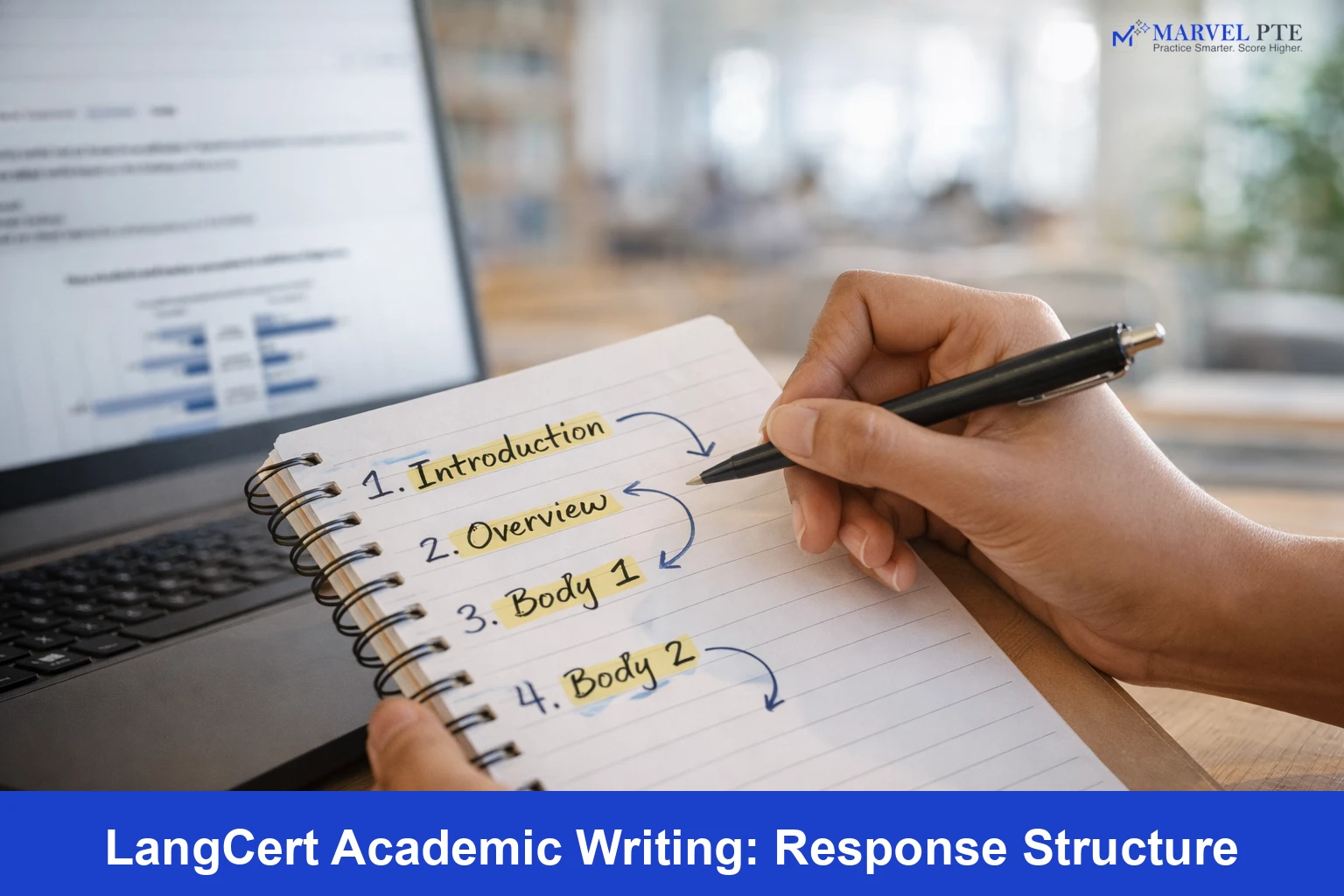
LanguageCert Writing Part 1 response structure notes showing four-part format

A high-scoring response follows a predictable structure:

Introduction (1-2 Sentences)

Paraphrase the task and state what the infographic shows. Do not copy the title word for word. Instead, rephrase it:

  • Original: “Internet usage by age group in Australia, 2020”
  • Paraphrase: “The infographic presents data on how different age groups in Australia used the internet during 2020.”

Overview (2-3 Sentences)

Summarise the main patterns. This is the most important part after task achievement. The examiner wants to see that you can identify what matters:

  • “Overall, younger age groups showed significantly higher internet usage than older demographics.”
  • “The data reveals a clear decline in usage as age increases.”

Body Paragraph 1

Describe the key data points in detail. Use specific figures when available:

  • “Users aged 18-24 recorded the highest rate at 98%, closely followed by the 25-34 group at 95%.”

Body Paragraph 2

Continue with remaining important data. Cover contrasts or secondary trends:

  • “In contrast, those aged 65 and above showed the lowest usage at 57%, nearly half the rate of the youngest group.”

Language for Data Description

Use neutral, academic language throughout. Here are phrases that work well:

FunctionPhrases
Showing dataillustrates, presents, shows, depicts
Increasesrose, increased, grew, climbed
Decreasesfell, dropped, declined, decreased
Stabilityremained stable, stayed constant, held steady
Comparisonscompared to, in contrast to, whereas, while
Proportionsaccounts for, represents, makes up

When exact figures are unclear, use approximate language:

  • “Approximately 60%”
  • “Just under half”
  • “Roughly two-thirds”

This shows flexibility and avoids the trap of guessing specific numbers.

Ready to ace your LanguageCert exam?

Practice smarter with AI-powered mock tests and instant feedback.

Get started

Common Mistakes to Avoid

I have reviewed hundreds of Part 1 responses. These errors appear most frequently:

Unsupported Speculation “I think the government should invest more in digital literacy.” While Part 1 asks you to comment on underlying reasons, avoid recommendations or speculation that goes beyond what the data supports. Stick to reasoned interpretation of the findings.

Wrong Figures Copying numbers incorrectly is surprisingly common under time pressure. Double-check your key figures during review time.

Writing Conclusions or Recommendations “Therefore, companies should target younger audiences.” Part 1 does not ask for your conclusions. Stop after describing the data.

Focusing on Minor Details Mentioning every single data point leaves no room for analysis. Select the most significant information and describe that well.

Skipping the Overview Some candidates jump straight into details. Without an overview, the examiner cannot see that you understood the big picture.

Poor Paragraph Structure A wall of text suggests disorganisation. Use clear paragraph breaks to show logical progression.

Strategies That Work

These approaches consistently help candidates score higher:

Scan Before Writing Look at the infographic for at least three minutes. Identify the two or three most important things before you touch the keyboard.

Plan Your Structure Know where your overview ends and your body begins. A mental outline prevents rambling.

Stick to What You See If the infographic does not show it, do not write it. Assumptions and inferences cost marks.

Keep Sentences Controlled Short, clear sentences with correct grammar beat long, complex sentences with errors. When in doubt, simplify.

Save Time for Review Spending 18 minutes writing and 2 minutes checking catches errors that would otherwise cost marks.

Quick Reference

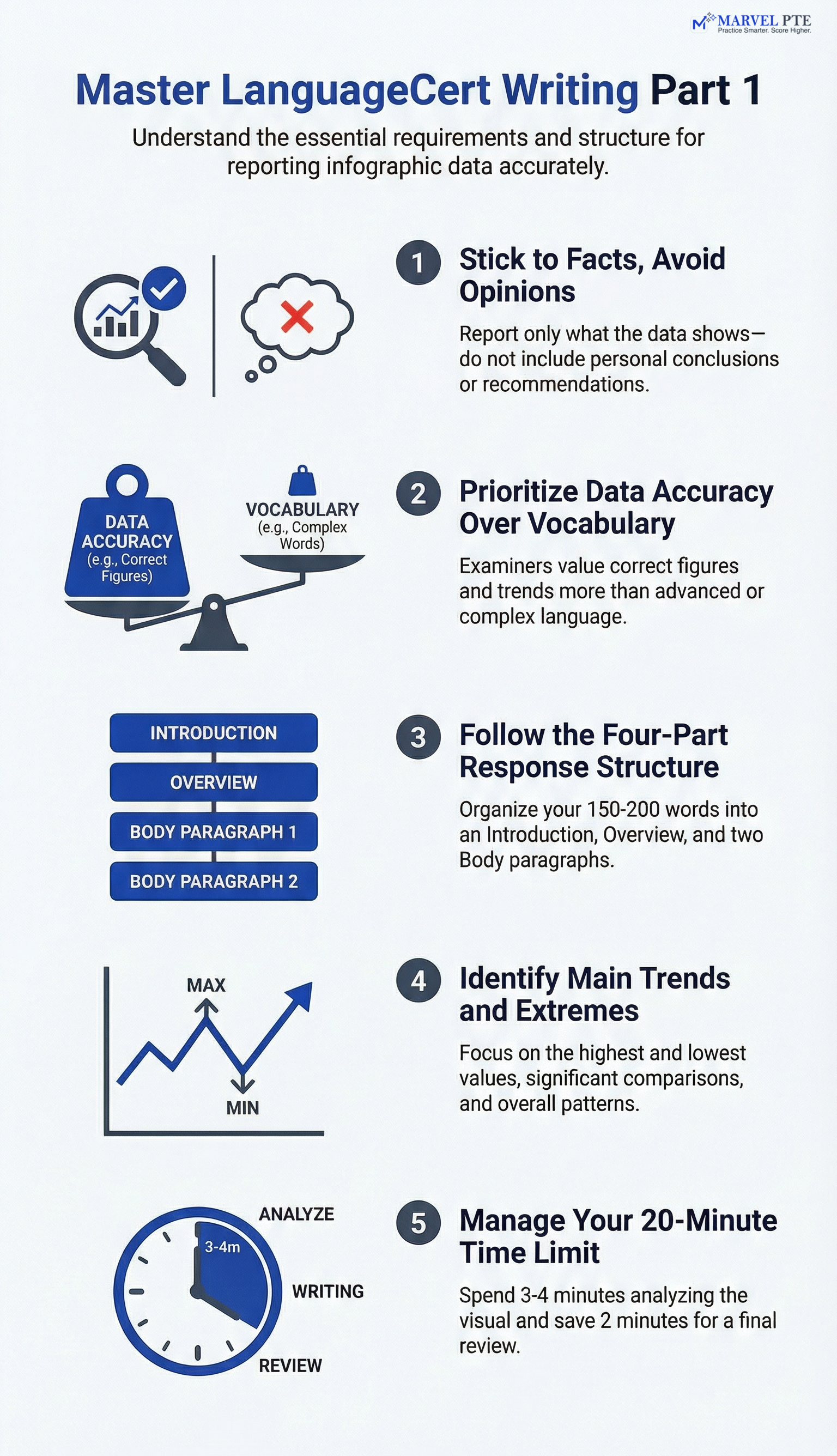
LanguageCert Writing Part 1 infographic showing 5 steps to master the task

Quick Quiz
1 / 5

What is the word count requirement for LanguageCert Writing Part 1?

How much time is recommended for Writing Part 1?

What should you include in the overview paragraph of Part 1?

Which of the following is a common mistake in Part 1?

How is LanguageCert Writing Part 1 scored?

Quiz Complete!

You scored 0 out of 5

How Marvel Edu Helps with Writing Part 1

Preparing for Part 1 requires practice with the right materials. Marvel Edu provides:

Realistic Infographic Tasks Our practice questions use the same visual formats you will see on test day. Bar charts, line graphs, pie charts, and mixed visuals covering academic topics.

Structured Response Templates Not rigid templates that sound robotic, but clear frameworks showing how to organise your introduction, overview, and body paragraphs effectively.

Automated Feedback Our AI analyses your response for task achievement, coherence, and language accuracy. You see exactly where you lost marks and what to improve.

Timed Practice Mode Practice under the same 20-minute conditions you will face. Building speed without sacrificing accuracy takes repetition.

Practice Cards
1 / 10
Press Space to flip, ← → to navigate
Question

What is the word limit for Writing Part 1?

Answer

150-200 words.

Question

How long should you spend on Part 1?

Answer

Around 20 minutes (3-4 min analyse, 12-14 min write, 2-3 min review).

Question

What does Part 1 ask you to do?

Answer

Write a report or article based on an infographic or chart.

Question

What analysis does Part 1 require beyond summarising data?

Answer

Comment on underlying reasons for the findings, expressing stance and justification.

Question

What types of visuals appear in Part 1?

Answer

Bar charts, line graphs, pie charts, tables, and mixed visuals.

Question

What should the introduction do?

Answer

Paraphrase the task and describe what the infographic shows.

Question

What should the overview include?

Answer

The main trends or overall patterns in the data.

Question

Who scores Writing Part 1?

Answer

Human examiners, not AI.

Question

What is more important: accuracy or advanced vocabulary?

Answer

Data accuracy is more important than complex vocabulary.

Question

What should you avoid in the final paragraph?

Answer

Personal conclusions or recommendations not supported by data.

Cards studied: 0 / 10

Final Checklist Before Submitting

Before you move to Part 2, confirm you can answer yes to these questions:

  • Is your word count within 150-200 words?
  • Have you accurately reported all key data points?
  • Does your overview paragraph identify main trends?
  • Is your commentary on reasons supported by the data?
  • Have you checked grammar and spelling?
  • Is your paragraph structure clear and logical?

Writing Part 1 rewards preparation. The format is predictable, the scoring is transparent, and the skills transfer to real academic work. With focused practice and attention to the criteria above, you can approach this task with confidence.

Frequently Asked Questions

Part 1 requires you to write a 150-200 word report or article based on visual information, typically an infographic or chart. You summarise the main findings and comment on what might be the underlying reasons, expressing stance and justification as appropriate.

Around 20 minutes is recommended. This includes 3-4 minutes to analyse the infographic, 12-14 minutes to write, and 2-3 minutes to review and correct any errors.

Common types include bar charts, line graphs, pie charts, tables, and mixed visuals. The data usually relates to academic or general interest topics.

Part 1 asks you to summarise findings AND comment on underlying reasons. This requires some analytical stance and justification, but avoid speculation beyond what the data supports. Focus on reasoned interpretation, not personal recommendations.

For Competent English: 64. For Proficient (10 points): 78. For Superior (20 points): 89.

LanguageCert Part 1 involves interpreting a formatted infographic rather than raw data graphs. The focus is on clarity and accurate reporting, not complex language. Many find it more approachable than IELTS.

Human examiners score all LanguageCert Writing tasks. This means natural, clear writing is rewarded over template-style responses.

Writing under the minimum word count will affect your task achievement score. You may miss key data points, and the examiner will note the response as incomplete.

Learn Data Description

Watch expert strategies for interpreting and reporting visual information.

See Course
Overview
Part 1
3 Part 2
  • Overview: All Writing Tasks
  • Part 1: Report on Visual 1Q · 32 marks · 150-200 words (40%)
  • Part 2: Essay 1Q · 32 marks · ~250 words (60%)
2 questions 50 minutes 64 marks
Previous Overview
Next Part 2
author image

Bhrat Brij

Bhrat Brij is the founder of Marvel Edu and a 90-All Master Trainer with years of experience helping students achieve their PTE goals. His one-to-one personalized coaching approach has helped hundreds of students score 79+ and Superior English (90) on their PTE exams. He specializes in Speaking and Listening modules, developing proven strategies that work for test takers at all levels.

View all posts by Bhrat Brij

Related posts

Show more
blog-post
LanguageCert Academic
Speaking

LanguageCert Academic Speaking Part 2: Role Play Task Format, Scoring, and Strategies

LanguageCert Academic Speaking Part 2 tests your ability to handle real conversations in academic settings. …

author image

by Reet

Jan 28, 2026
blog-post
LanguageCert Academic
Speaking

LanguageCert Academic Speaking Part 3: Read Aloud and Opinion Task Guide

LanguageCert Academic Speaking Part 3 tests two skills in one task: reading aloud and expressing an opinion. …

author image

by Vanita Handa

Jan 28, 2026
blog-post
LanguageCert Academic
Speaking

LanguageCert Academic Speaking Part 1: Personal Questions Format, Tips, and Strategies

LanguageCert Academic Speaking Part 1 is the opening section of the speaking test, where the examiner asks you …

author image

by Gaurav Chhikara

Jan 27, 2026
Marvel PTE Marvel PTE
Our Locations
Sydney Campbelltown Address Smart Work Hub, Level 2, 351 Oran Park Drive Oran Park , NSW Australia
India Address 2nd Floor, SCO 12-13, Ambala - Chandigarh Rd Above Super Mart, Near S S Multispeciality Hospital Zirakpur , Punjab 140603 India
Coaching
  • PTE Coaching in Zirakpur|
  • PTE Coaching in Parramatta|
  • PTE Coaching in Narellan|
  • PTE Coaching in Campbelltown|
  • PTE Coaching in Kingsford
  • PTE Coaching in Randwick
  • PTE Coaching in Chatswood
  • PTE Coaching in Epping
  • PTE Coaching in Ryde
  • PTE Coaching in Strathfield
  • PTE Coaching in Hurstville
  • PTE Coaching in Auburn
  • PTE Coaching in Cabramatta
  • PTE Coaching in Bankstown
  • PTE Coaching in Penrith
  • PTE Coaching in Liverpool
  • PTE Coaching in Fairfield
  • PTE Coaching in Sydney
  • PTE Coaching in Blacktown
Explore
  • Pricing
  • Institute Software
Contact
  • +91-8699-121-121
  • [email protected]
  • Contact Us
  • Pay Now
Policies
  • Terms & Services|
  • Privacy Policy|
  • Cookie Policy|
  • Refund Policy
© 2026 Marvel PTE. All Rights Reserved.