
LanguageCert Academic
LanguageCert Academic Speaking Part 2: Role Play Task Format, Scoring, and Strategies
LanguageCert Academic Speaking Part 2 tests your ability to handle real conversations in academic settings. …

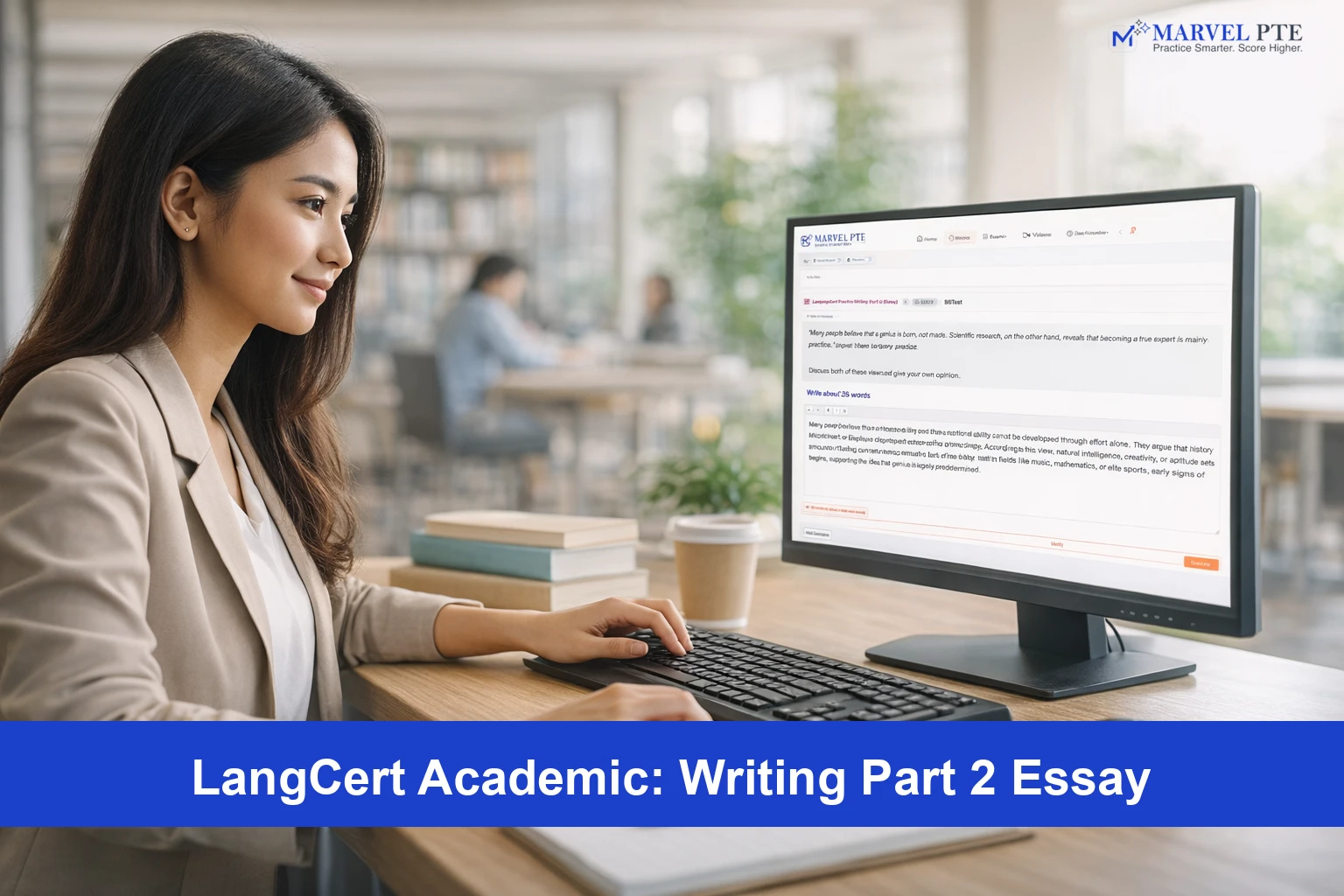
Writing Part 2 in the LanguageCert Academic exam tests your ability to construct and express arguments on academic topics. You receive a statement or proposition and must write a discursive essay of about 250 words, discussing both views and giving your own opinion with clear justification.
This task matters because academic and professional settings often require you to evaluate different perspectives and present reasoned arguments. Whether you are applying for Australian PR or preparing for university, the ability to write a balanced yet decisive essay transfers directly to real-world situations.
Part 2 sits within the 50-minute Writing section of the LanguageCert Academic exam. While Part 1 asks you to interpret visual data, Part 2 tests your ability to engage with ideas and form arguments. You will see a statement on an academic subject and must respond with a structured essay.
The task instruction typically reads: “Read the statement and write about the topic. Discuss both views and give your own opinion.” This means you cannot simply describe the issue. You must take a position.
For candidates targeting Australian immigration or academic admissions, Part 2 carries significant weight. Writing accounts for 60% of your total Writing score (with Part 1 at 40%), so performing well here directly impacts your overall result.
Practice writing a discursive essay with instant feedback on your response.
The LanguageCert Academic is an English language test accepted for UK visa applications, student visa requirements, and Australian immigration. As an English language proficiency assessment, this English test measures your English language skills across all four test sections: listening, reading, writing, and speaking. Your overall score reflects your language proficiency level aligned to CEFR standards.
For test takers seeking to demonstrate English language requirement compliance, the LanguageCert Academic offers advantages over other English language tests like IELTS Academic, IELTS General Training, PTE Academic, Cambridge English, and the Occupational English Test. Each qualification has different test formats, but LanguageCert’s human-scored approach provides consistent test results that reflect genuine language skill.
Your test report shows your test result for each section. Unlike practice paper exercises that focus on exam style practice questions without real scoring, actual test results from LanguageCert carry weight for academic purposes, foreign language requirements, and visa applications across English speaking countries.
Practice smarter with AI-powered mock tests and instant feedback.
Complete a timed Part 2 task under exam conditions.
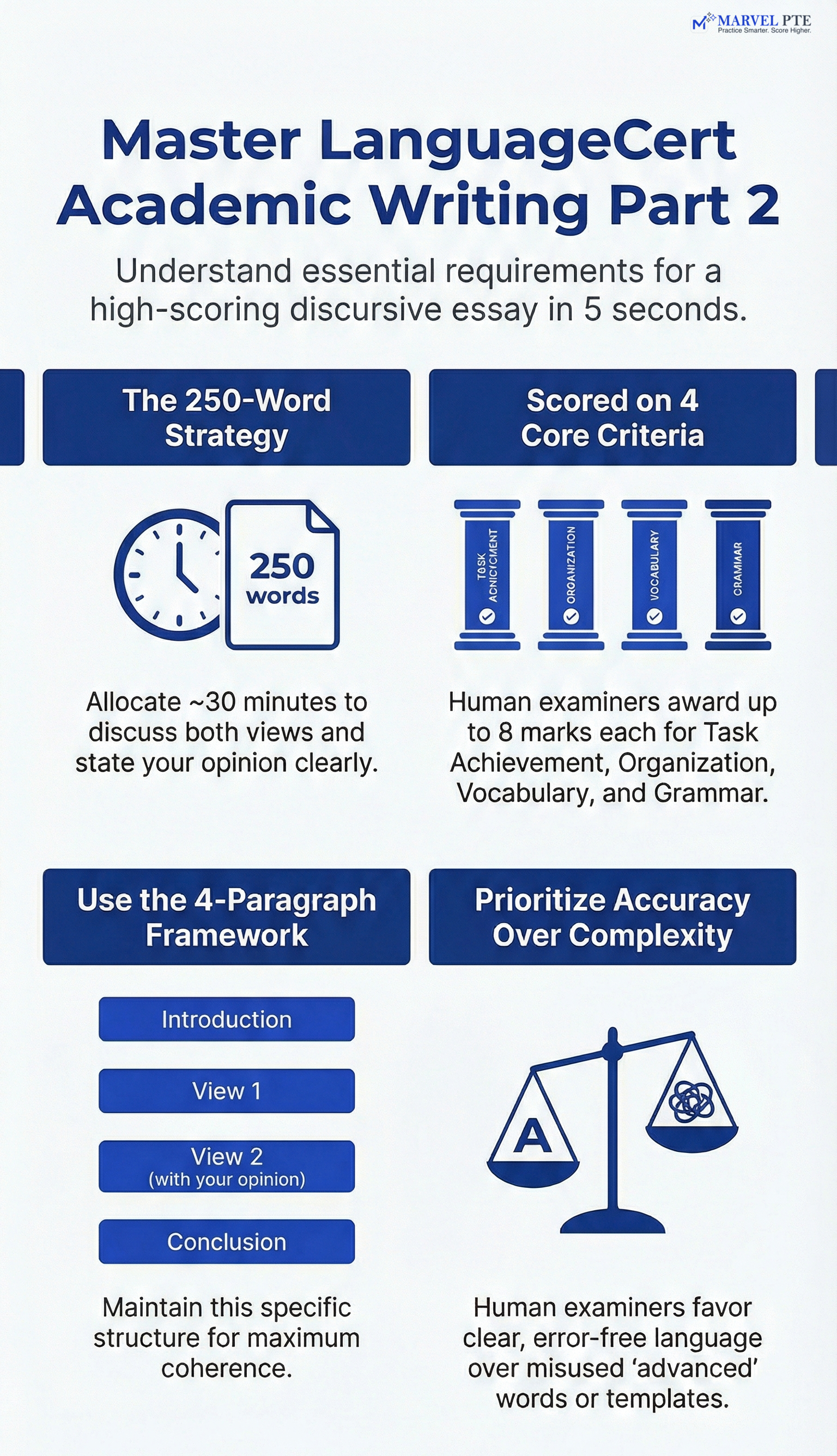
You have 50 minutes for the entire Writing section. Most candidates allocate around 30 minutes to Part 2 since it requires about 250 words and involves more complex argumentation than Part 1.
The essay prompts cover academic subjects but remain accessible to general readers. You do not need specialist knowledge. Topics might include education policy, technology’s impact on society, environmental concerns, or workplace trends.
| Task Element | Details |
|---|---|
| Word count | About 250 words |
| Time allocation | ~30 minutes (suggested) |
| Response type | Discursive essay |
| Task requirement | Discuss both views, give opinion |
| Scoring | Human examiner |
The on-screen interface includes a word counter and basic text editing. You can revise your work before submitting, which many candidates find less stressful than time-boxed exams where you cannot return to previous sections.
What matters most is clarity and structure. Complex vocabulary or elaborate sentence patterns do not score higher than clear, accurate language that addresses the task.
Human examiners assess your response across four main areas, aligned with CEFR descriptors:
Task Achievement (0-8 marks) Did you address the task fully? This means presenting both views AND stating your own opinion. Responses that describe only one side or avoid taking a stance score lower. The examiner checks whether you actually answered what the question asked.
Organisation and Coherence (0-8 marks) Is your essay structured logically? Clear paragraphing, effective linking words, and a progression from introduction through body to conclusion all matter. Punctuation accuracy also falls under this criterion.
Vocabulary Range and Accuracy (0-8 marks) Can you use appropriate vocabulary for academic discussion? Words need not be advanced, but they must be used correctly. Spelling counts here too. A misused complex word hurts more than a correctly used simple one.
Grammar Control (0-8 marks) Are your sentences grammatically accurate? The examiner looks at both range and control. You do not need complex structures, but whatever structures you use should be correct.
Key Point: LanguageCert scoring differs from IELTS band descriptors and PTE algorithms. Human examiners apply CEFR-aligned criteria, which many candidates find more transparent and less template-dependent.
Practice smarter with AI-powered mock tests and instant feedback.
Access our full library of essay prompts with model answers.
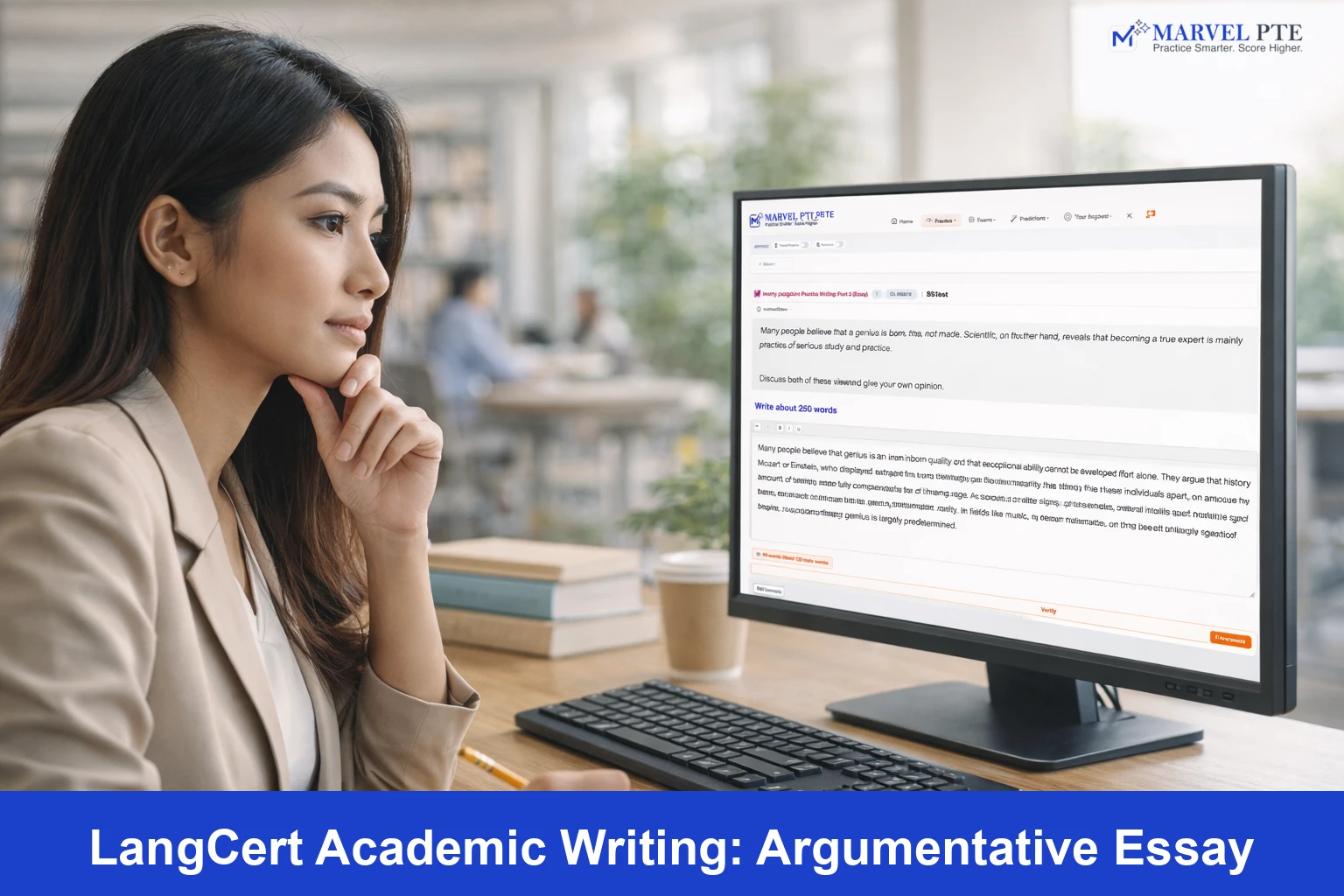
A high-scoring essay follows a predictable structure that demonstrates clear thinking:
Paraphrase the statement and signal your position. You do not need to state everything you will discuss, but the examiner should know where you stand:
Present the first view with supporting reasons. One paragraph, one main idea. Keep it focused:
Present the opposing view or your own position with supporting reasons. Same structure:
Restate your position without introducing new ideas. The conclusion should feel like a natural ending, not an afterthought:
Why Overlong Essays Reduce Accuracy
Writing significantly more than 250 words often leads to more errors. Under time pressure, longer essays tend to include rushed sections where grammar slips and ideas repeat. A focused 250-word essay with accurate language scores better than a 350-word essay with multiple errors.
Part 2 prompts fall into three main categories:
Opinion Essays (Agree/Disagree)
You receive a statement and must decide whether you agree or disagree. The key is taking a clear stance early and maintaining it throughout:
Approach: State your position in the introduction. Each body paragraph should reinforce your stance with different reasons.
Discussion Essays (Both Views + Opinion)
You must present both perspectives before giving your own view. This is the most common format:
Approach: Dedicate one body paragraph to each view. Your opinion can appear in the conclusion or woven throughout.
Problem-Solution Essays
You identify causes of a problem and propose practical solutions:
Approach: Split your body into causes (paragraph 1) and solutions (paragraph 2). Keep solutions realistic and relevant.
Typical Traps
Candidates often struggle when they:
Practice smarter with AI-powered mock tests and instant feedback.
With 50 minutes for both writing tasks and the flexibility to allocate time as you choose, effective planning becomes essential.
Recommended Split
| Activity | Time |
|---|---|
| Planning | 3-5 minutes |
| Writing | 20-22 minutes |
| Reviewing | 3-5 minutes |
Planning Phase
Before writing, jot down:
This prevents mid-essay changes of direction that waste time.
When to Stop Adding Ideas
If you have reached 220 words and covered both views with your opinion, stop developing new arguments. Use remaining words to strengthen transitions or clarify existing points.
Grammar and Spelling Checks That Matter
Focus your review time on:
These errors are easy to fix and directly affect your score.
If you have prepared for IELTS or PTE, understanding the differences helps you adjust your approach:
| Aspect | LanguageCert | IELTS | PTE |
|---|---|---|---|
| Time | 50 min flexible (both tasks) | 40 min fixed (Task 2 only) | 20 min fixed (Essay) |
| Word count | ~250 words | 250+ words | 200-300 words |
| Scoring | Human examiner | Human examiner | AI algorithm |
| Time pressure | Lower (you control split) | Higher (fixed allocation) | Highest (strict timing) |
Difficulty Level Comparison
LanguageCert Part 2 feels more controlled for many non-native speakers. The flexible time allocation means you can spend longer on the task you find harder. There is no penalty for exceeding word counts moderately, unlike PTE where the AI expects specific lengths.
Human vs Algorithm Scoring
IELTS and LanguageCert both use human examiners, but LanguageCert aligns explicitly with CEFR descriptors. PTE uses AI scoring, which rewards certain patterns and penalises others. Some candidates find human scoring more forgiving of natural variation in expression.
Why LanguageCert Feels More Controlled
You can revisit your Writing section before final submission. The interface shows your word count in real time. And because you manage your own time between Part 1 and Part 2, you never feel locked into an insufficient allocation.
When preparing sample answers for Part 2, focus on academic argumentation that demonstrates your ability to engage with academic texts. Test takers who study the qualification handbook and review page content from official sources often develop stronger academic English skills. The key is building genuine English proficiency rather than memorising templates.
Your preparation should include work experience topics, exposure to academic texts about complex subjects, and consistent practice with timed conditions. Trinity College London and other examination bodies recognise that English requirement standards demand authentic language skill assessment for subclass visa applications and student visa processes.
Preparing for Part 2 requires practice with the right materials. Marvel Edu provides:
Timed Essay Practice
Write responses under exam conditions with prompts that mirror real LanguageCert topics. Build stamina and learn to pace yourself within 30 minutes.
Clear Scoring Feedback
Our feedback aligns with LanguageCert’s four criteria. You see exactly where you lost marks and what to improve, whether that is task achievement, organisation, vocabulary, or grammar.
Model Answers Focused on Accuracy
Our sample essays demonstrate clear structure without over-reliance on templates. You learn to write naturally while hitting all the task requirements.
What is the word target for Writing Part 2?
About 250 words.
How long should you spend on Part 2?
Around 30 minutes (3-5 min plan, 20-22 min write, 3-5 min review).
What does Part 2 ask you to write?
A discursive essay on an academic subject.
Do you need to give your own opinion in Part 2?
Yes. You must discuss both views AND give your own opinion.
Who scores Writing Part 2?
Human examiners, not AI.
What essay types appear in Part 2?
Opinion (agree/disagree), discussion (both views), and problem-solution essays.
How should you structure a Part 2 essay?
Introduction, body paragraphs (one idea each), and conclusion.
What matters more: complex vocabulary or accurate language?
Accuracy matters more than complexity.
How does LanguageCert time differ from IELTS?
LanguageCert gives 50 minutes flexible for both tasks; IELTS allocates fixed time per task.
What should you avoid in the conclusion?
Introducing new ideas or arguments not discussed in the body.
Before you finish the Writing section, confirm you can answer yes to these questions:
Writing Part 2 rewards candidates who can think clearly and express ideas in organised, accurate English. You do not need impressive vocabulary or complex grammar. What you need is a clear position, logical structure, and controlled language throughout.
Consistency beats ambition. A focused essay with accurate sentences will outscore an elaborate essay with frequent errors. Plan your response, stick to the structure, and leave time to review. With targeted practice, Part 2 becomes a reliable source of marks rather than a source of stress.
Watch expert strategies for structuring arguments and expressing opinions.

LanguageCert Academic Speaking Part 2 tests your ability to handle real conversations in academic settings. …
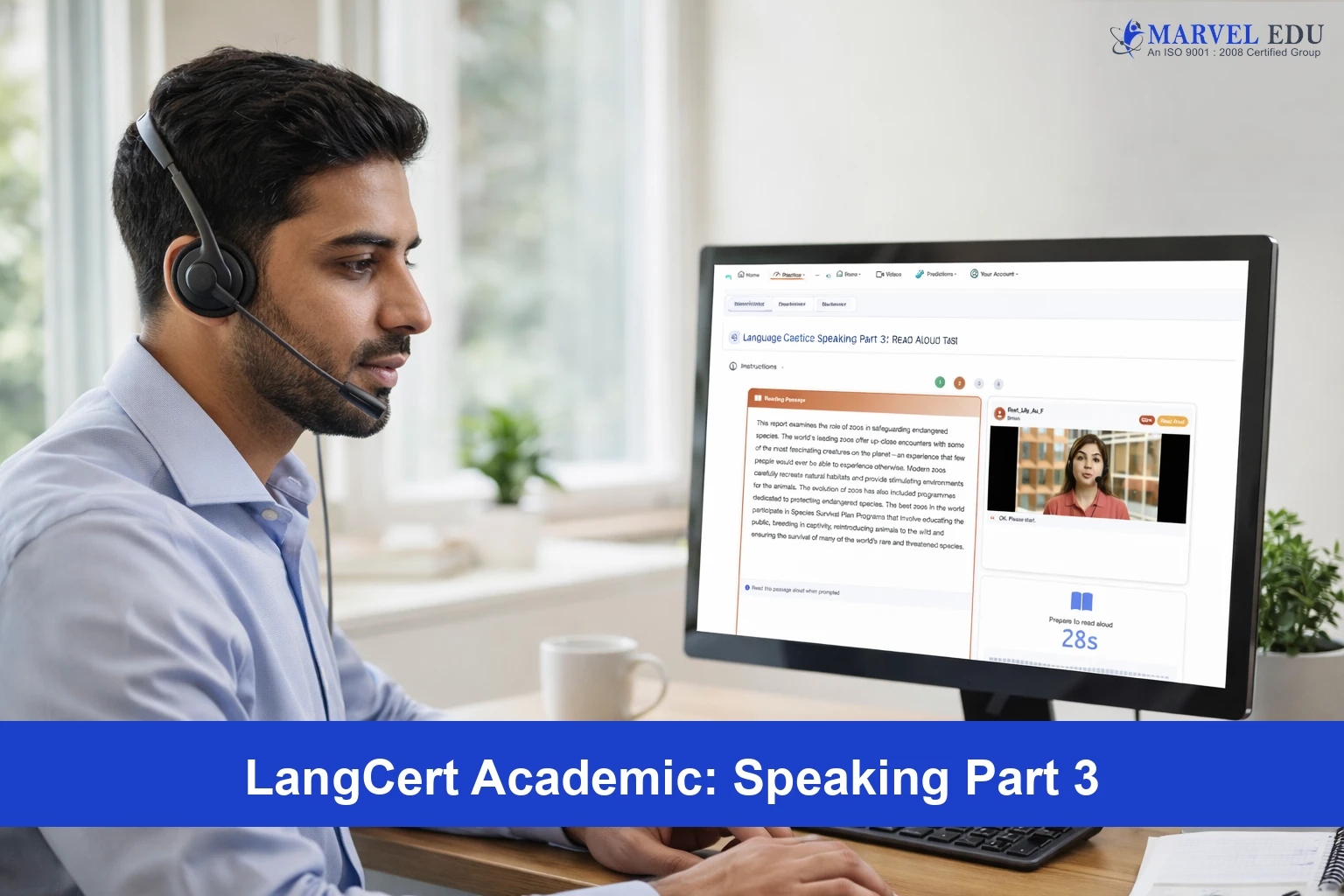
LanguageCert Academic Speaking Part 3 tests two skills in one task: reading aloud and expressing an opinion. …

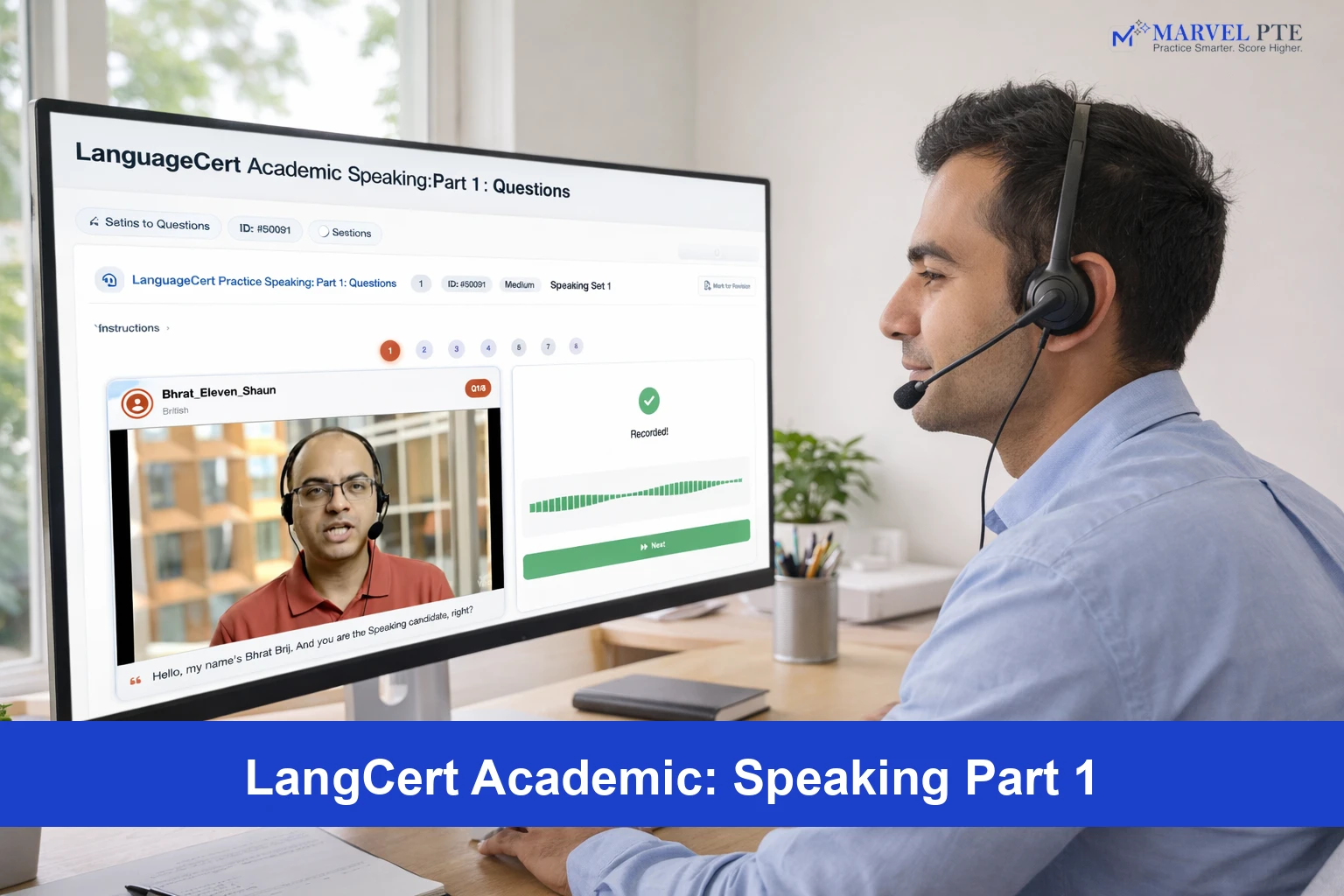
LanguageCert Academic Speaking Part 1 is the opening section of the speaking test, where the examiner asks you …
