
LanguageCert Academic
LanguageCert Academic Speaking Part 2: Role Play Task Format, Scoring, and Strategies
LanguageCert Academic Speaking Part 2 tests your ability to handle real conversations in academic settings. …

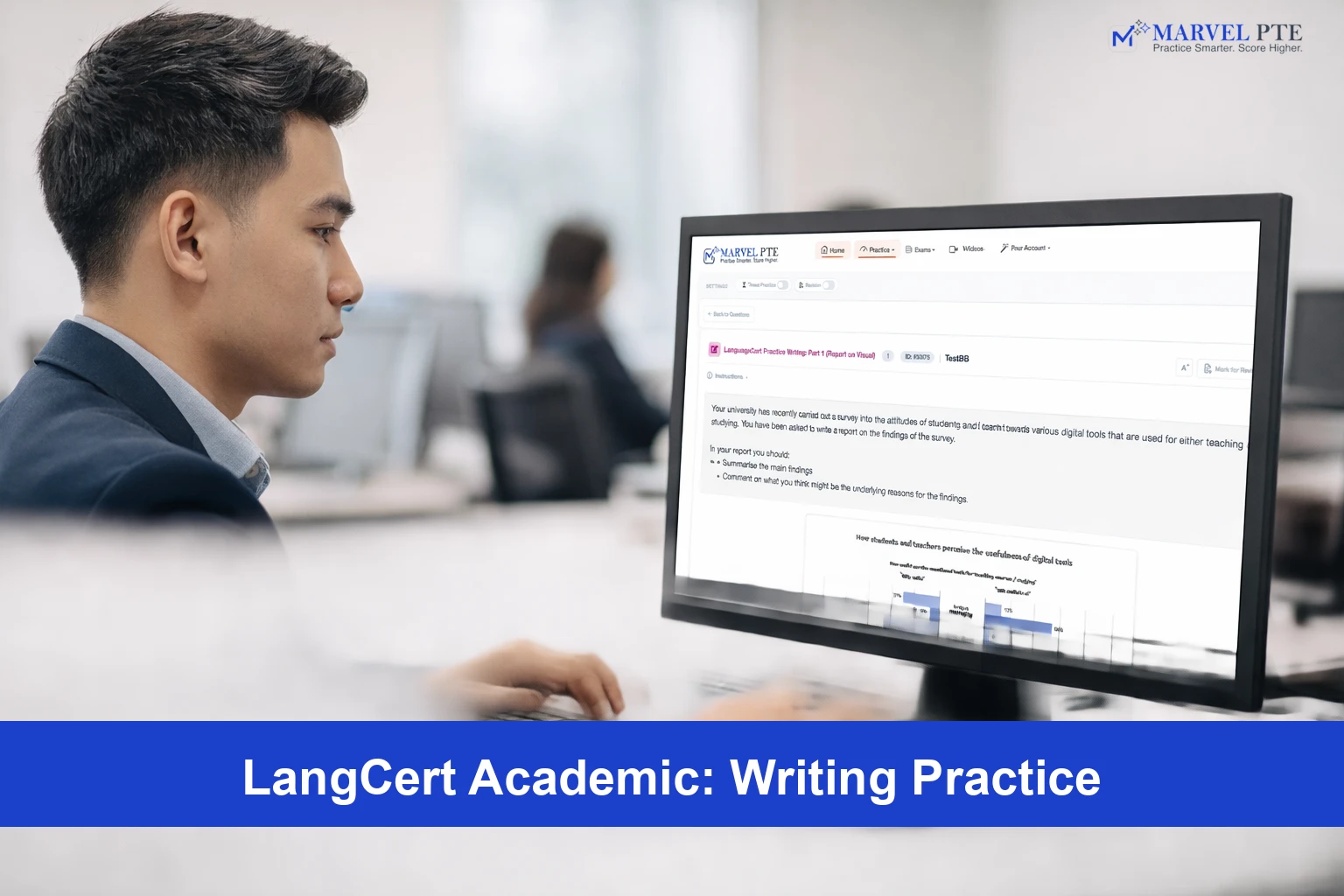
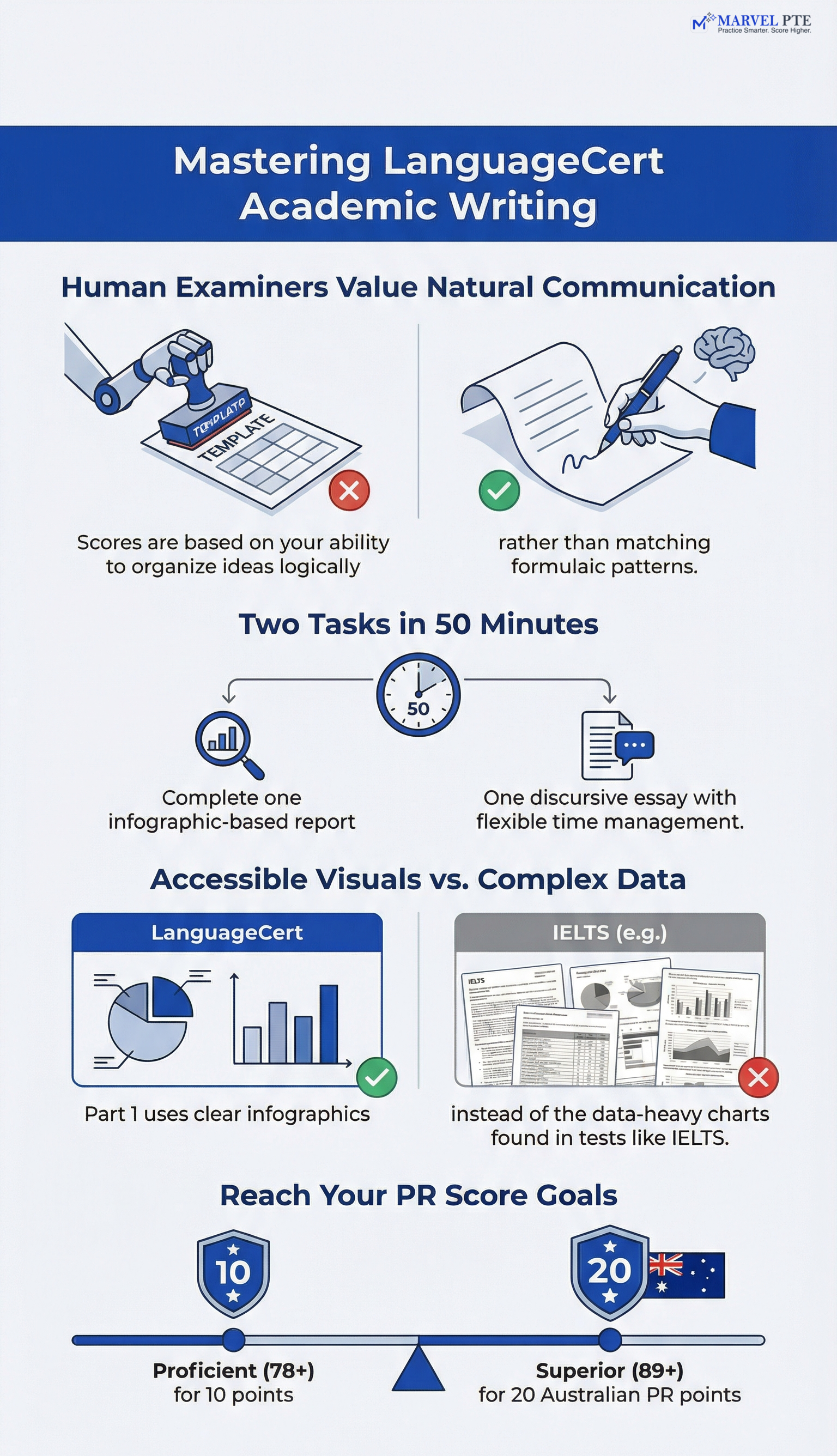
The LanguageCert Academic Writing section gives you 50 minutes to complete two tasks. Unlike PTE where AI scores your responses against specific patterns, LanguageCert uses human examiners who value clear, well-organised writing over memorised templates. For many candidates, this makes LanguageCert Writing feel more natural and less mechanical.
I worked with a student who had attempted PTE twice but struggled with the AI scoring. Her essays were well-structured but did not match the expected template patterns. When she switched to LanguageCert, she scored Proficient on her first attempt. The human examiner could appreciate her clear arguments even though her style was not formulaic.
This guide covers exactly what each writing task requires, how the scoring works, and why many test-takers find LanguageCert Writing more approachable than IELTS or PTE.
Before examining individual tasks, here is the structure you will encounter:
| Aspect | Details |
|---|---|
| Total Duration | 50 minutes |
| Number of Tasks | 2 |
| Time Allocation | Flexible (you decide the split) |
| Scoring Method | Human examiner |
| Word Limits | Part 1: 150-200, Part 2: ~250 |
The Writing section starts after Listening and Reading. Once you begin Writing, you cannot return to earlier sections. A 15 minute warning appears before time runs out.
The flexible time allocation is a significant advantage. You can spend more time on the task you find challenging rather than being locked into fixed intervals. Most candidates allocate roughly 20 minutes for Part 1 and 30 minutes for Part 2, but adjust based on your strengths.
Key Advantage: Human examiners assess your actual communication ability, not how well you match a template. Write naturally and focus on clarity.
Write a practice report or essay and see how it compares to exam standards.
Part 1 asks you to write a report or article based on an infographic or chart. Your task is to summarise the main findings and comment on what might be the underlying reasons, expressing stance and justification as appropriate.
| Format Detail | Value |
|---|---|
| Word Limit | 150-200 words |
| Suggested Time | 20 minutes |
| Source | Infographic or chart |
| Focus | Summarise findings + comment on reasons |
You will see an infographic on an academic topic. This might show statistics, trends, or comparisons. Your response should explain the main points from the visual in clear, organised prose.
Unlike IELTS Task 1 which often requires analysing complex line graphs or bar charts with multiple data points, LanguageCert infographics typically present information in a more accessible format. The visual is designed to be interpreted rather than just described numerically.
Many candidates find Part 1 easier than IELTS Task 1 for several reasons:
Examiners assess:
| Aspect | LanguageCert Part 1 | IELTS Task 1 | PTE SWT |
|---|---|---|---|
| Source | Infographic | Graph/chart/process | Reading passage |
| Focus | Summarise + interpret | Describe data trends | Summarise text |
| Skills | Interpretation | Data analysis | Paraphrasing |
| Challenge | Selecting key points | Identifying trends | Word limit (5-75) |
LanguageCert wins for candidates who struggle with numerical data interpretation. If you find describing graphs stressful, the infographic format offers a more accessible alternative.
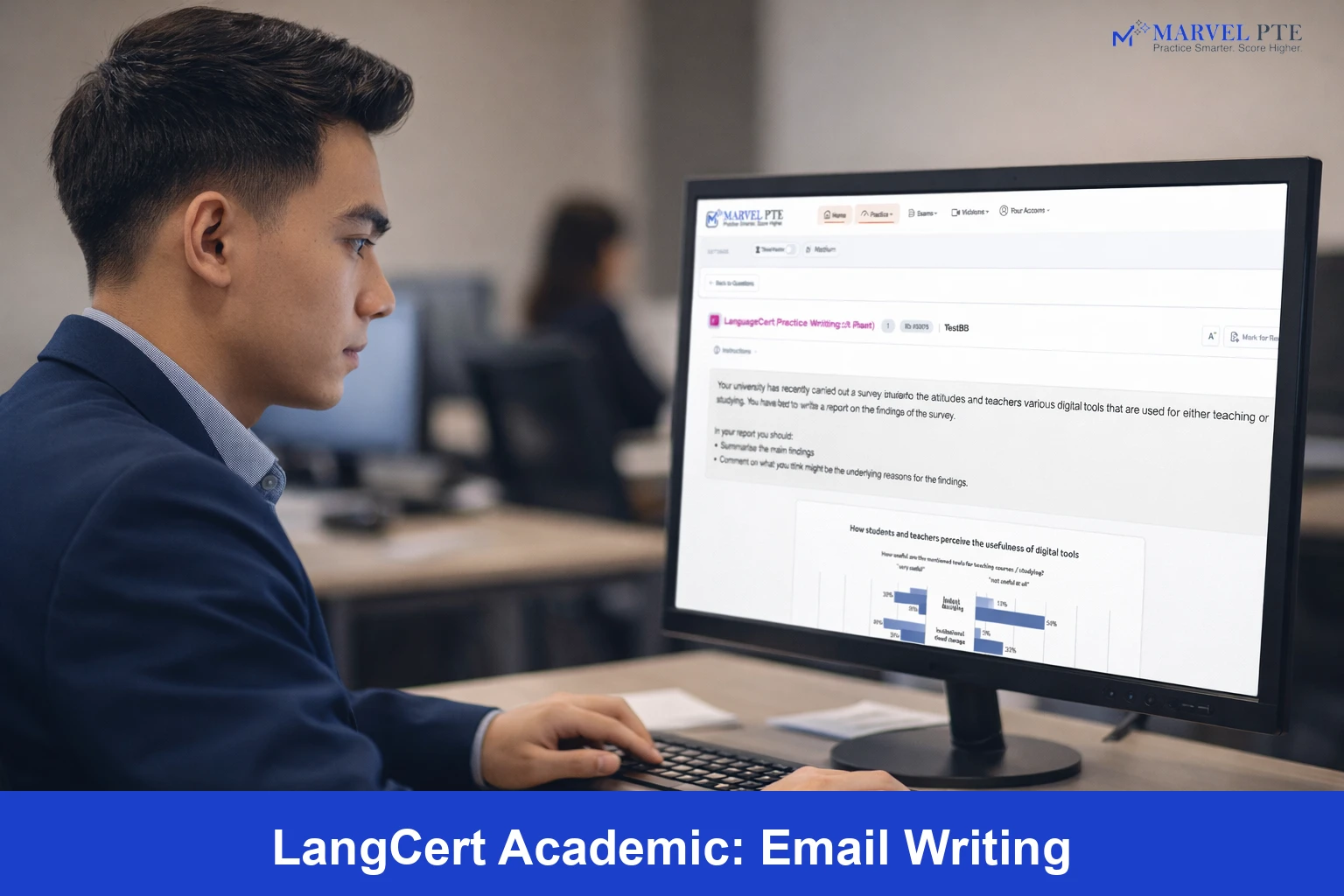
Complete a full mock writing section with timed conditions.
Part 2 requires you to write a discursive essay on an academic or general interest topic. You present your position on a question and support it with reasoning.
| Format Detail | Value |
|---|---|
| Word Limit | ~250 words |
| Suggested Time | 30 minutes |
| Types | Opinion, discussion, problem-solution |
| Focus | Clear argument and support |
You receive a statement or question on a topic. Your task is to present a clear position and develop your argument with relevant examples and reasoning. Topics are drawn from general academic areas, not specialist knowledge.
Common question types include:
Part 2 is shorter than IELTS Task 2 (which requires 250 words minimum, with most successful responses closer to 280-300). LanguageCert rewards quality over quantity:
Examiners look for:
| Aspect | LanguageCert Part 2 | IELTS Task 2 | PTE Essay |
|---|---|---|---|
| Length | ~250 words | 250+ words | 200-300 words |
| Scoring | Human examiner | Human examiner | AI scoring |
| Time | ~30 minutes | 40 minutes | 20 minutes |
| Style | Natural writing | Academic register | Template-friendly |
LanguageCert and IELTS both use human examiners, but LanguageCert is shorter and more forgiving of simple language. PTE uses AI scoring, which rewards specific structural patterns that many test-takers find unnatural.
LanguageCert Writing is assessed by trained human examiners using CEFR-aligned criteria. Your score reflects your ability to communicate effectively in written English.
| Criterion | What It Means |
|---|---|
| Task Fulfilment | Addressed all parts of the task completely |
| Organisation | Clear structure with logical paragraphing |
| Grammar | Accurate sentence construction |
| Vocabulary | Appropriate word choice for academic contexts |
A significant advantage of LanguageCert is that minor grammatical errors do not devastate your score if your meaning is clear. Examiners focus on your overall communicative competence rather than counting mistakes.
This contrasts with AI scoring systems where a single error in a key sentence can significantly impact your score. Human examiners understand that non-native speakers may make occasional slips while still demonstrating strong English ability.
Access our full library of writing prompts with model answers.
For many candidates, LanguageCert Writing offers genuine advantages over IELTS and PTE:
| Advantage | Why It Matters |
|---|---|
| Predictable tasks | You know exactly what to expect: infographic summary + essay |
| No data-heavy analysis | Part 1 uses accessible infographics, not complex graphs |
| Human scoring | Natural writing valued over template matching |
| Shorter length | Achievable word counts without padding |
| Flexible time | Allocate more time to your weaker task |
LanguageCert Writing particularly suits:
Struggling to know if your writing meets exam standards? Marvel Edu provides targeted preparation for both LanguageCert Writing tasks.
| Feature | How It Helps |
|---|---|
| Task-specific practice | Separate modules for Part 1 infographics and Part 2 essays |
| Model answers | See high-scoring responses with examiner annotations |
| Timed practice mode | Build stamina for the 50 minute section |
| Feedback on structure | Identify organisation issues before the exam |
Our practice materials match the actual exam format. You will work with realistic infographics and essay prompts, building familiarity with what examiners expect. The model answers show you how to structure responses without relying on rigid templates.
With 50 minutes for two tasks, time management matters. Follow this approach:
Do not obsess over exact word counts. Focus on fully addressing the task:
Examiners assess content quality, not word count precision.
For Part 1:
For Part 2:
You do not need complex rhetorical devices. Clear, logical organisation demonstrates competence.
Before test day, confirm you can answer yes to these questions:
If you are taking LanguageCert for Australian immigration, here are the Writing scores you need:
| Level | Writing Score | PR Points |
|---|---|---|
| Competent | 64 | 0 |
| Proficient | 78 | 10 |
| Superior | 89 | 20 |
Competent level meets the minimum English requirement but does not add points. Proficient adds 10 points, and Superior adds 20 points to your Expression of Interest.
What is the primary advantage of LanguageCert Writing over PTE Writing for many test-takers?
How much time is allocated for the entire LanguageCert Academic Writing section?
What is the word limit for Part 1 of the LanguageCert Writing section?
What type of visual information is typically provided in LanguageCert Writing Part 1?
Which statement best describes how LanguageCert Writing marking differs from IELTS?
How long is the LanguageCert Academic Writing section?
50 minutes total for both tasks.
How many writing tasks are in the LanguageCert Academic exam?
2 tasks: Part 1 (report/article) and Part 2 (discursive essay).
What is the word limit for Writing Part 1?
150-200 words.
What is the word limit for Writing Part 2?
Around 250 words.
How is LanguageCert Writing scored?
By human examiners, not AI.
What type of content is Part 1 based on?
An infographic or chart on an academic topic.
What type of essay is required in Part 2?
A discursive essay presenting and supporting an argument.
Can you allocate time flexibly between the two tasks?
Yes, 50 minutes total with flexible allocation (typically 20 + 30).
What does LanguageCert Writing reward more than IELTS?
Clarity and task fulfilment over linguistic complexity.
Do you need memorised templates for LanguageCert Writing?
No, human examiners value natural writing over formulaic responses.
Watch expert strategies for report and essay organisation.

LanguageCert Academic Speaking Part 2 tests your ability to handle real conversations in academic settings. …
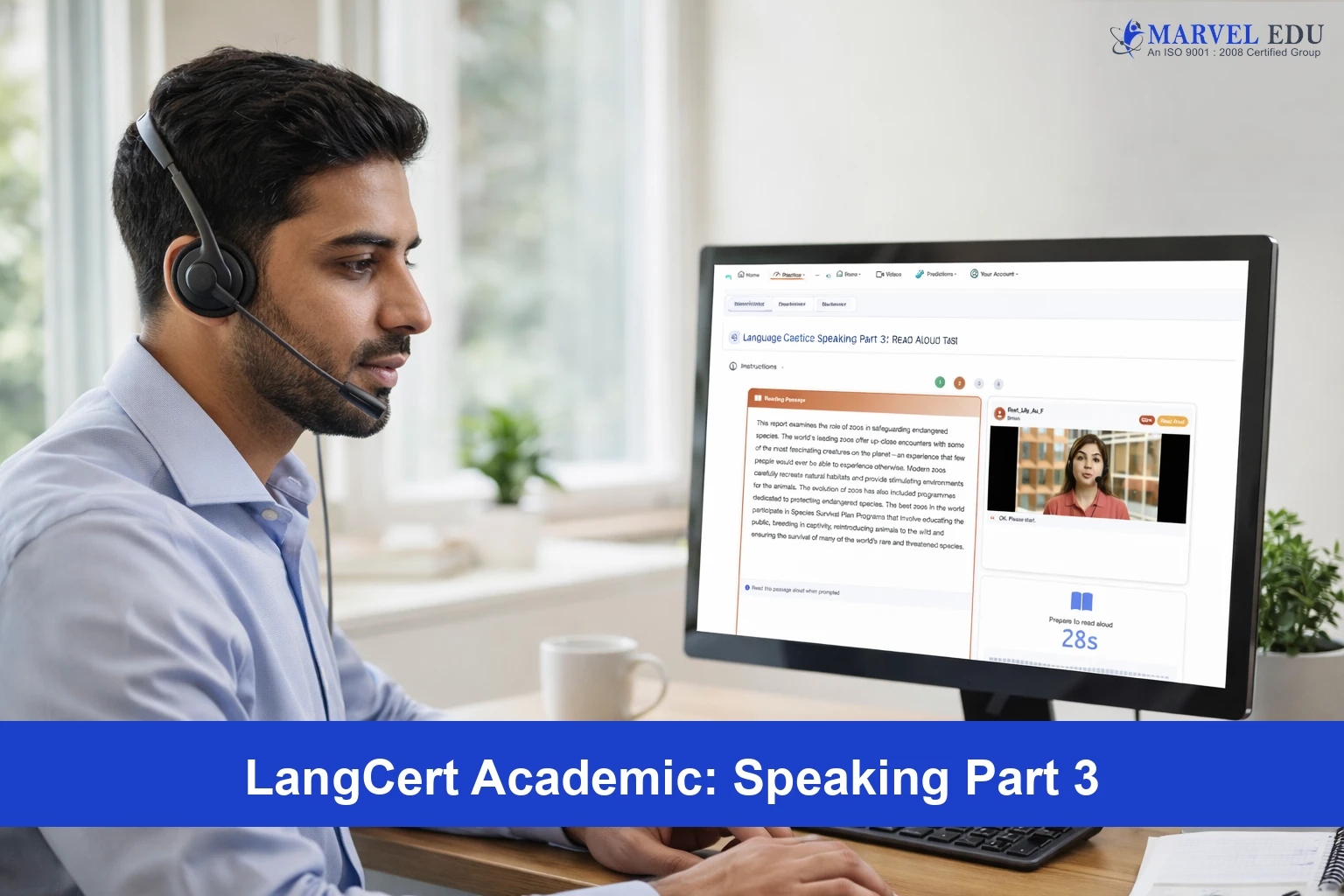
LanguageCert Academic Speaking Part 3 tests two skills in one task: reading aloud and expressing an opinion. …

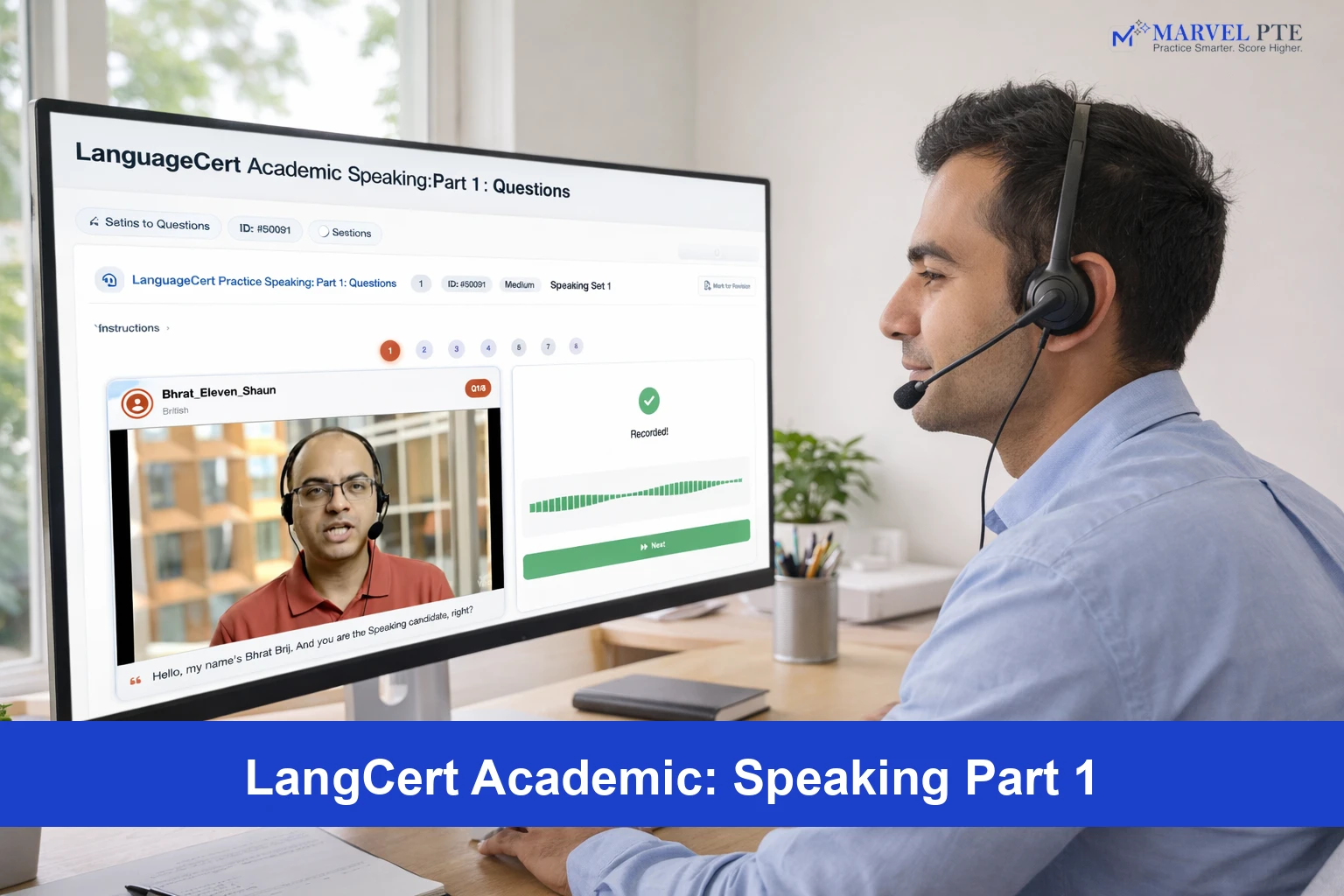
LanguageCert Academic Speaking Part 1 is the opening section of the speaking test, where the examiner asks you …
