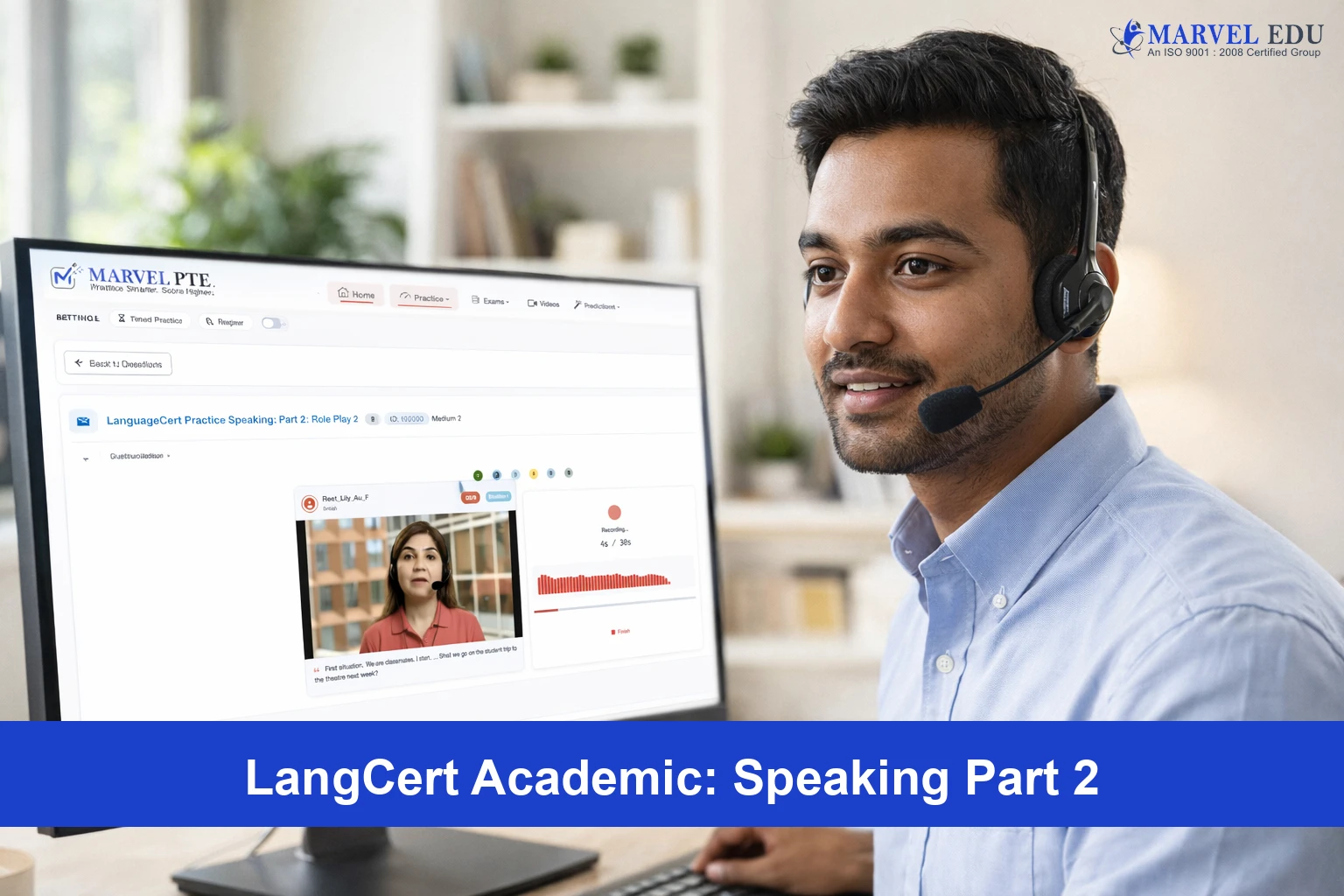
LanguageCert Academic
LanguageCert Academic Speaking Part 2: Role Play Task Format, Scoring, and Strategies
LanguageCert Academic Speaking Part 2 tests your ability to handle real conversations in academic settings. …

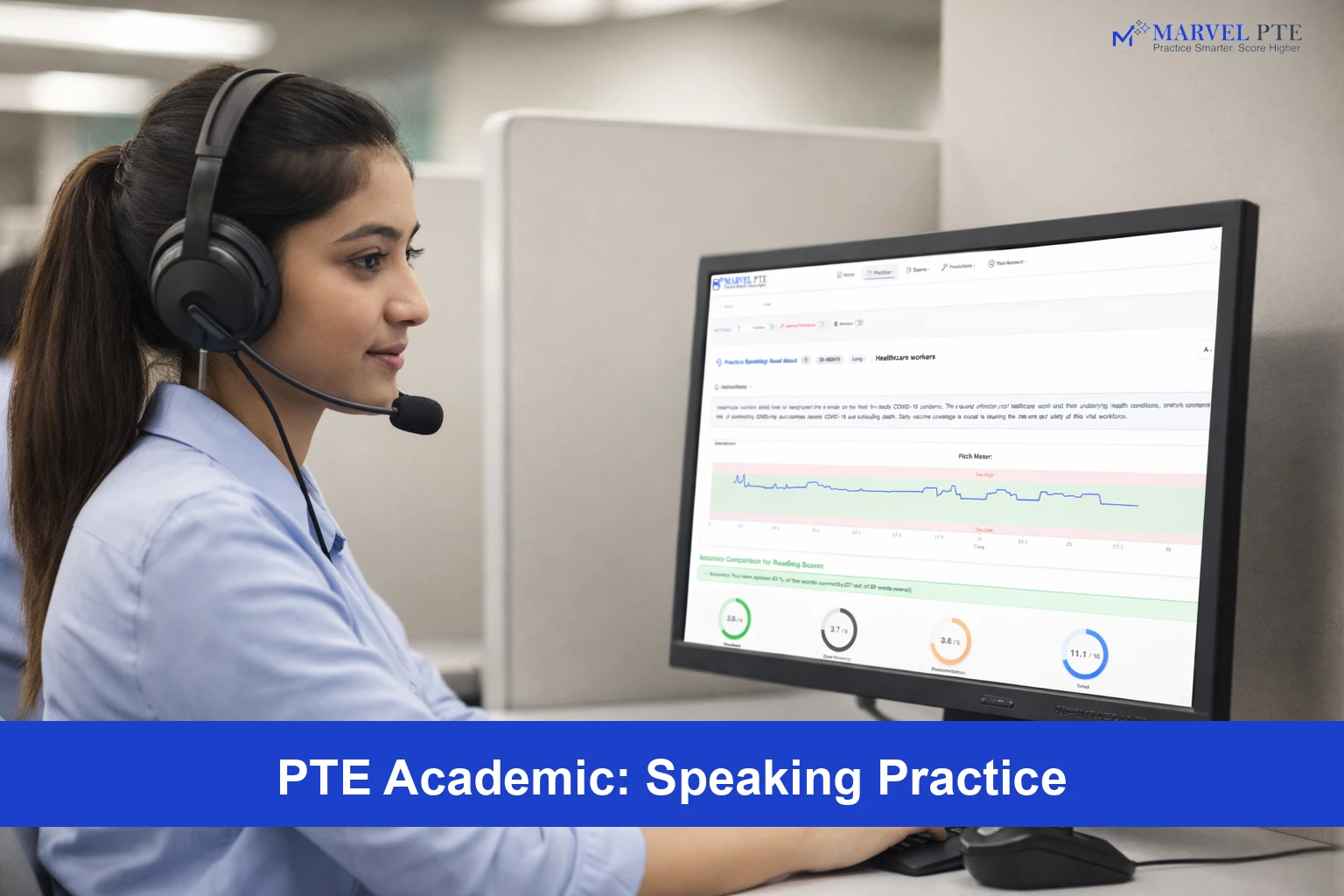
The PTE Speaking section is where many test takers either boost their overall score or struggle unexpectedly. Unlike a conversation with a human examiner, you are speaking to a computer, and the AI listens for very specific patterns. Understanding what the system actually measures, rather than what you assume it wants, makes a significant difference in your preparation.
This guide covers everything you need to know about PTE Speaking: the exact format, how scoring works, what each task type demands, and how to practise effectively. We will also compare PTE Speaking with LanguageCert Speaking so you can decide which exam suits your speaking style better.
The PTE Speaking section assesses your ability to produce clear, fluent English in an academic context. This applies to both PTE Academic and PTE Core, though the speaking skills assessed differ slightly between the two versions. What makes the PTE speaking test different from other exams is that every response is recorded and evaluated by an AI system combined with human assessment.
The section lasts approximately 30 to 35 minutes and contains several task types. Your performance here does not only affect your Speaking score. Due to integrated scoring, tasks like Repeat Sentence and Retell Lecture also contribute to your Listening score. This means a strong Speaking performance can lift your overall result in ways you might not expect.
For visa applicants, the Speaking section often requires the highest scores. Australian immigration requires 54 for Competent English, 76 for Proficient (10 PR points), and 88 for Superior (20 PR points). These are skill-specific requirements, so you cannot compensate for a low Speaking score with a higher Reading or Listening score.
Try real PTE Speaking questions with AI-powered feedback on fluency and pronunciation.
The Speaking section follows a fixed structure. You work through each task type in order, with no ability to return to previous questions. The audio for listening-based tasks plays only once, and your microphone records automatically when prompted.
Here is the complete breakdown:
| Task Type | Questions | Time Per Response | What It Tests |
|---|---|---|---|
| Personal Introduction | 1 | 30 seconds | Not scored (familiarisation only) |
| Read Aloud | 6-7 | 30-40 seconds | Pronunciation, fluency |
| Repeat Sentence | 10-12 | 15 seconds | Memory, reproduction |
| Describe Image | 3-4 | 40 seconds | Spontaneous speech |
| Retell Lecture | 2-3 | 40 seconds | Comprehension, summary |
| Answer Short Question | 5-6 | 10 seconds | Quick recall |
| Summarize Group Discussion | 2-3 | Up to 2 minutes | Summary skills |
| Respond to a Situation | 1-2 | 40 seconds | Contextual response |
Your microphone setup matters more than most candidates realise. Background noise, inconsistent volume levels, or poor microphone positioning can affect how clearly the AI captures your speech. Test your equipment before the actual exam.
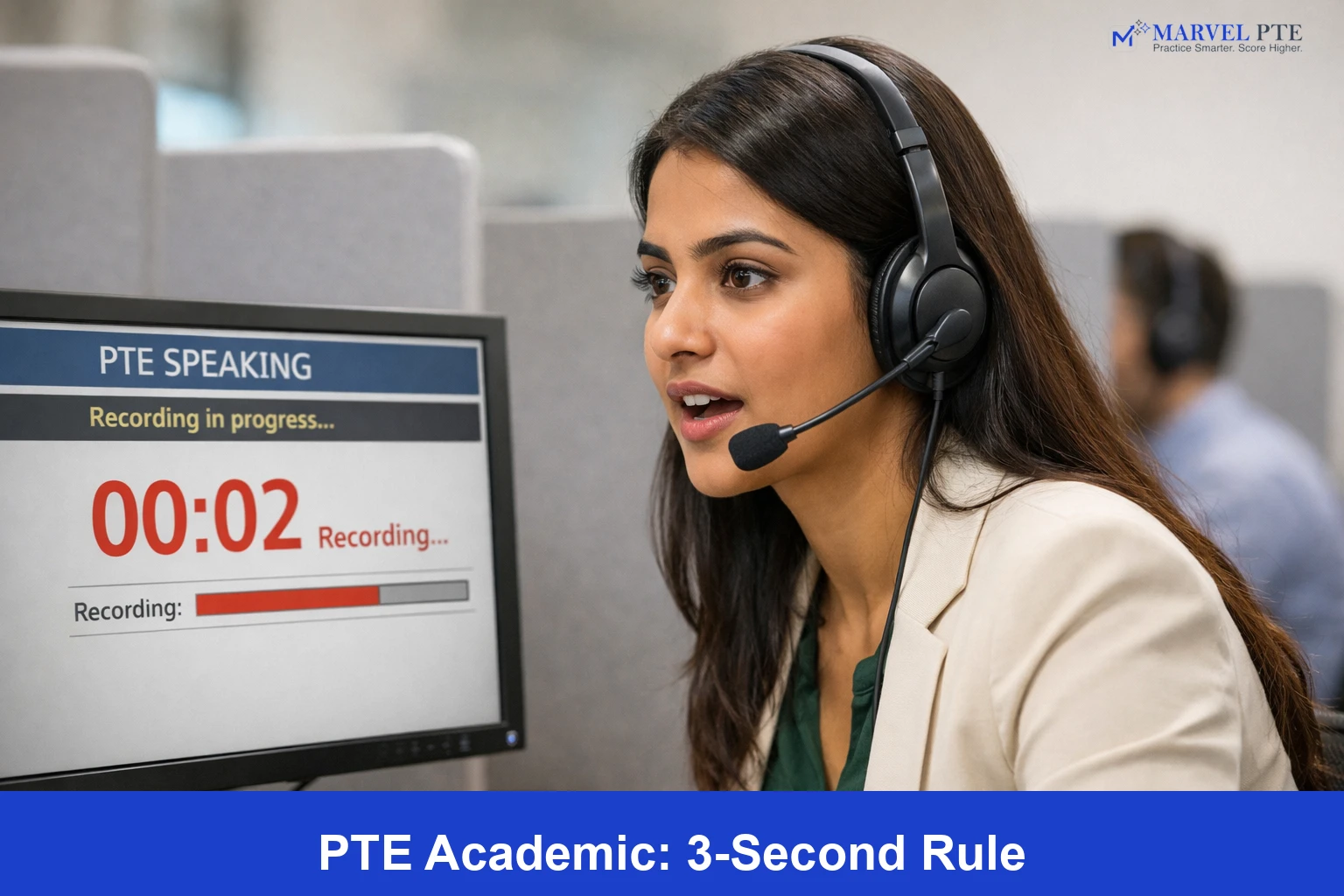
If you do not start speaking within 3 seconds of the recording starting, the microphone closes and your response is not recorded.
This catches many candidates off guard. The system interprets silence as “no response” and moves on. Even if you speak perfectly after that initial silence, nothing gets captured.
| Scenario | What Happens | Result |
|---|---|---|
| Start speaking within 3 seconds | Recording captures full response | Normal scoring |
| Silent for 3+ seconds then speak | Microphone already closed | Zero score |
| Start speaking, then pause 3+ seconds | Recording may cut off early | Partial or zero score |
How to avoid this:
Warning: This 3-second cutoff also applies mid-response. If you pause for too long while speaking, the system may assume you have finished and close the recording early. Keep your speech continuous with only brief natural pauses.
Take a full mock test and see exactly where you stand on each speaking task.
Personal Introduction is the first task you encounter, but it does not contribute to your score. You have 25 seconds to prepare and 30 seconds to record a brief introduction about yourself. This task helps you get comfortable with the test technology and provides a voice sample for identity verification. Treat it as a warm-up opportunity.
Read Aloud presents a text passage that you must read naturally. The AI evaluates your pronunciation of individual words, your pacing between phrases, and your overall fluency. Speaking too quickly reduces clarity; speaking too slowly creates unnatural pauses. Aim for a conversational reading pace.
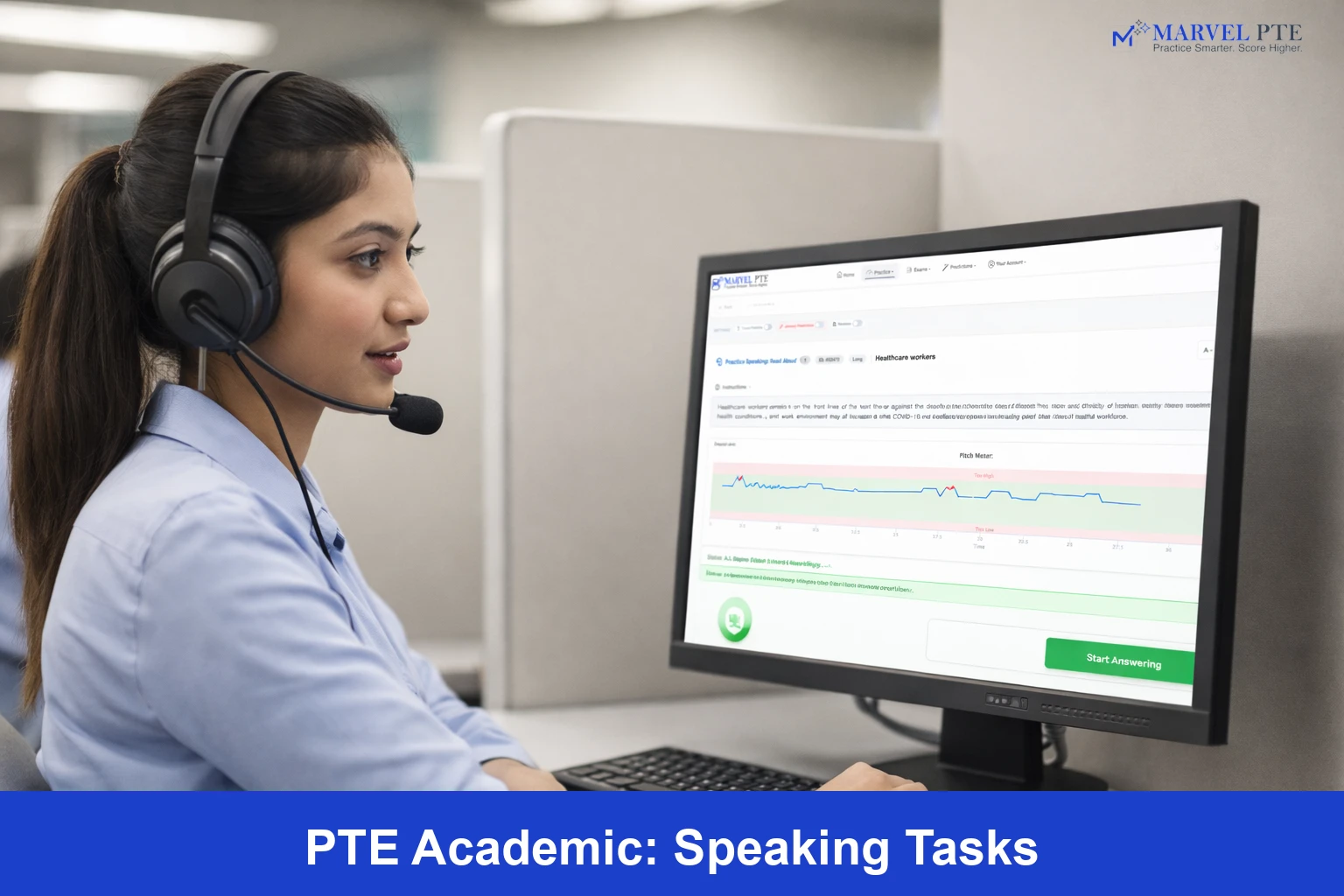
Repeat Sentence plays an audio sentence that you must reproduce exactly. This task is heavily weighted for the Listening score as well. The challenge is holding the entire sentence in memory while maintaining the original rhythm and stress patterns.
Describe Image shows you a graph, chart, photograph, or diagram. After 25 seconds of preparation, you have 40 seconds to describe the key features. Structure is critical here: introduction, main points, and conclusion. The AI rewards organised responses over rambling descriptions.
Retell Lecture plays an academic lecture with an accompanying image. You take notes, then summarise the main points in 40 seconds. Focus on capturing keywords rather than full sentences during the lecture.
Answer Short Question requires single-word or brief phrase answers to factual questions. Speed matters here. If you hesitate too long, your score drops regardless of accuracy. This task only contributes to your Listening score, not Speaking.
Summarize Group Discussion is one of the newer task types. You listen to a discussion between three speakers for up to three minutes, then summarise the key points in your own words. You have 10 seconds to prepare after the audio ends and up to two minutes to speak. Take notes on the erasable whiteboard while listening. This task contributes to both Listening and Speaking scores.
Respond to a Situation is the final speaking task. You read and listen to a description of an everyday situation, then describe what you would say in that context. After 10 seconds of preparation, you have 40 seconds to respond. Focus on providing a natural, appropriate response rather than a formal answer. This task only contributes to your Speaking score.
PTE Speaking uses three main criteria for most tasks:
| Criterion | What AI Measures | What Scores Well |
|---|---|---|
| Fluency | Pacing, rhythm, hesitation | Smooth, continuous speech without excessive pauses or repetitions |
| Pronunciation | Sound clarity, word stress | Intelligible speech (accents are fine); clear consonants and syllable emphasis |
| Content | Task completion | Covering key elements; relevant information only |
Key Point: Grammar accuracy is less critical in PTE Speaking than in other exams. The AI prioritises fluency and pronunciation over perfect sentence construction. A minor grammatical error delivered fluently scores better than a grammatically perfect sentence delivered haltingly.
Access our complete question bank with prediction files updated monthly.
PTE uses integrated scoring, meaning your Speaking performance affects multiple skill scores. This table shows exactly how each task contributes to your results:
| Task Type | Speaking Score | Listening Score |
|---|---|---|
| Describe Image | 31% | — |
| Summarize Group Discussion | 19% | 20% |
| Repeat Sentence | 16% | 17% |
| Retell Lecture | 13% | 13% |
| Respond to a Situation | 13% | — |
| Read Aloud | 8% | — |
| Answer Short Question | — | 4% |
Pro Tip: If your Speaking score is stuck at a plateau, focus heavily on Describe Image. Improving from average to strong performance on this task alone can add several points to your result.
Effective PTE Speaking practice looks different from general English conversation practice. You are training for a specific scoring system, not for natural communication. Whether you are using free PTE practice tests or paid PTE preparation courses, the approach matters more than the resources.
| Task | Focus Area | Key Technique |
|---|---|---|
| Read Aloud | Chunking and pacing | Read silently first, identify pause points, then speak |
| Repeat Sentence | Auditory memory | Listen for rhythm and stress, not just words |
| Describe Image | Structure | Introduction → main trends → conclusion |
| Retell Lecture | Note-taking | Capture keywords, not full sentences |
| Answer Short Question | Speed | Build general knowledge, respond instantly |
A PTE speaking practice test helps you experience real exam conditions. Most free practice tests give you a sense of the question types, but a full PTE mock test with AI scoring provides more accurate feedback on your actual performance.
When choosing practice questions, focus on variety. Each question type tests different skills assessed by the Pearson test system. Practice questions for Read Aloud develop different abilities than those for Describe Image or Retell Lecture.
The prompt length varies by task. Read Aloud prompts are typically 60 words, while Describe Image gives you visual information to interpret. Understanding these differences helps you allocate preparation time appropriately.
Consider taking a PTE practice test weekly during your PTE preparation phase. Track your PTE score improvements across sessions. Many candidates see the most progress when they review their common mistakes systematically rather than simply repeating practice questions.
If you are comparing exam options, the Speaking section differences between PTE and LanguageCert are significant.
The fundamental difference is who evaluates you. PTE uses AI combined with human assessment. LanguageCert uses a live human interlocutor during a video call. This changes everything about how you should prepare and what gets rewarded.
| Factor | PTE Academic | LanguageCert Academic |
|---|---|---|
| Examiner | AI + Human assessment | Human interlocutor (live) |
| Longest response | 40-60 seconds | Up to 2 minutes (Part 4) |
| Self-correction | Penalised by AI | Accepted naturally |
| Speaking duration | 30-35 minutes | 14 minutes |
| Superior score | 88/90 | 89/100 |
Key Differences:
Which exam suits you better?
| If You… | Consider |
|---|---|
| Have a strong accent | LanguageCert (human examiner) |
| Tend to self-correct | LanguageCert (not penalised) |
| Prefer conversational flow | LanguageCert (natural interaction) |
| Like predictable, structured tasks | PTE (consistent format) |
| Want systematic preparation | PTE (clear expectations) |
MarvelPTE’s Speaking practice is designed around actual PTE Academic speaking formats and AI scoring patterns. The platform functions as a comprehensive PTE exam preparation tool.
| Feature | What It Does | Why It Matters |
|---|---|---|
| Timed Practice | Mirrors real exam conditions (40s for DI, 15s for RS) | Builds time management under pressure |
| AI Feedback | Identifies hesitation, unclear pronunciation, pacing issues | Shows exactly what the scoring system detects |
| Prediction Files | Monthly updates on frequently appearing questions | Focus practice on high-probability content |
| Performance Tracking | Identifies your weakest speaking tasks | Target preparation where it helps most |
The skills you develop on MarvelPTE remain useful even if you decide to switch exams. Fluency, pronunciation clarity, and organised responses benefit any English proficiency test.
Several patterns cause candidates to underperform in PTE Speaking. Understanding these common mistakes helps you avoid them during your PTE exam:
| Mistake | Why It Hurts | Fix |
|---|---|---|
| Speaking too slowly | AI interprets pauses as hesitation | Use natural conversational pacing |
| Speaking too fast | AI cannot recognise words clearly | Balance fluency with clarity |
| Overthinking grammar | Causes hesitation, which is penalised | Keep speaking; minor errors are fine |
| Inconsistent audio setup | Recording quality affects recognition | Test microphone position before exam |
| No score feedback | Cannot identify AI-specific issues | Use scored practice tests |
| Ignoring trends | Repeat same mistakes | Track weak tasks, focus practice there |
For Australian permanent residency, Speaking scores determine your English proficiency classification:
| Level | Speaking Score | PR Points |
|---|---|---|
| Competent | 54 | 0 |
| Proficient | 76 | 10 |
| Superior | 88 | 20 |
Important points:
Before your exam, verify these elements:
Technical setup:
Daily routine:
Mock test conditions:
Score review:
The PTE Speaking section rewards prepared candidates who understand what the AI actually measures. Focus your practice on fluency, clarity, and task structure rather than perfect grammar or sophisticated vocabulary.
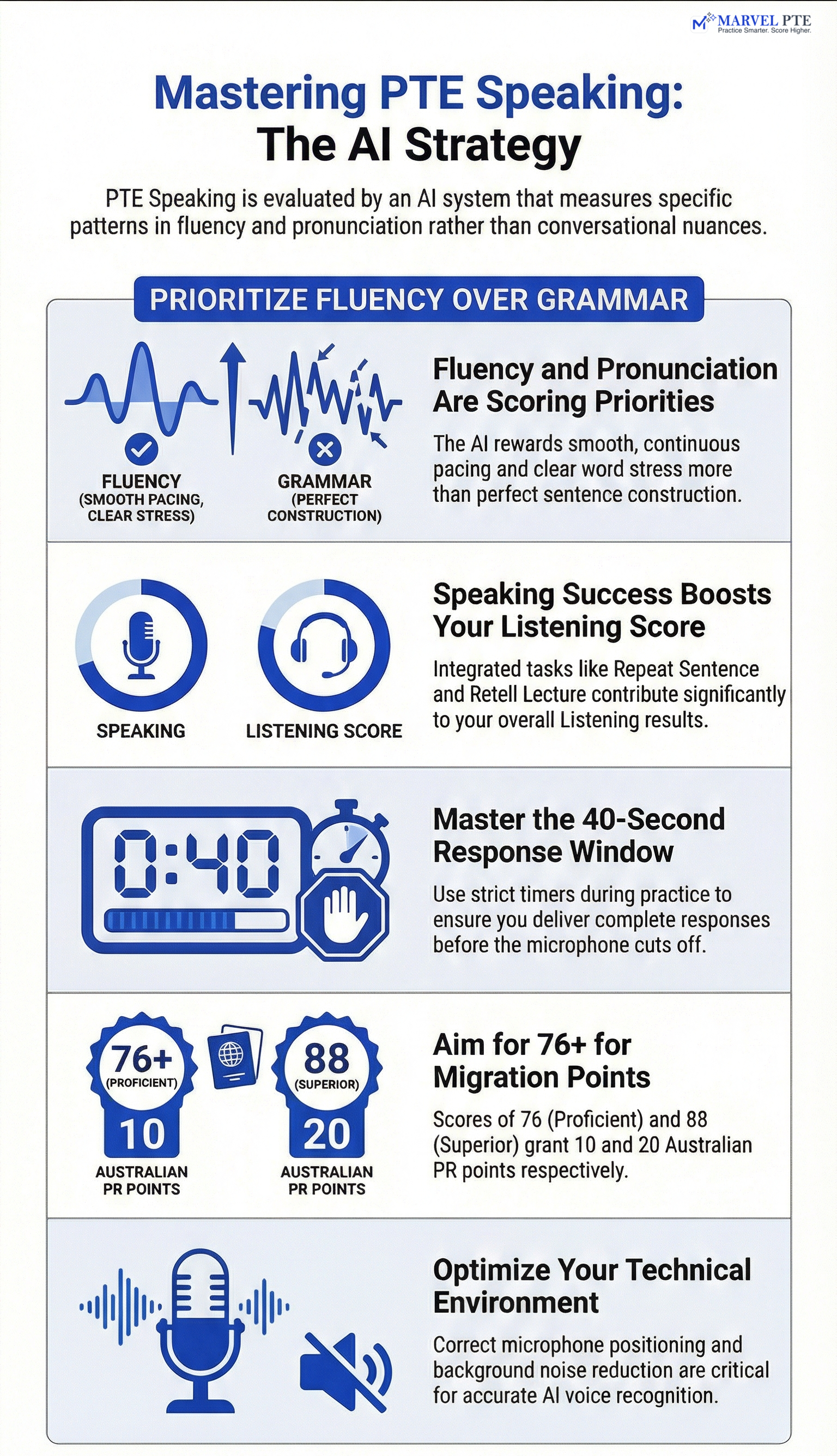
Which specific English skill, besides Speaking, is significantly influenced by your performance in the Repeat Sentence and Retell Lecture tasks?
To achieve 'Superior English' for Australian immigration purposes, what minimum score must a candidate obtain in the PTE Speaking section?
When evaluated by the PTE AI, how is a minor grammatical error in a highly fluent response typically treated compared to a grammatically perfect but halting response?
What does the PTE AI prioritise when assessing a candidate's pronunciation?
How does the approach to 'self-correction' differ between the PTE and the LanguageCert Speaking exams?
Who evaluates the recordings in the PTE Speaking section?
An AI system combined with human assessment.
Approximately how long is the PTE Speaking section?
30 to 35 minutes.
Which task types in the Speaking section contribute to the Listening score?
Repeat Sentence and Retell Lecture.
What PTE Speaking score is required for 'Superior' English for Australian immigration?
88.
In the 'Repeat Sentence' task, how long do you have for each response?
15 seconds.
What is the primary challenge of the 'Repeat Sentence' task?
Maintaining memory while reproducing rhythm and stress patterns.
How does the evaluation of self-correction differ between PTE and LanguageCert?
PTE penalises it via AI, whereas LanguageCert accepts it naturally.
What should a candidate do if they struggle with the AI scoring of PTE?
Consider an alternative like LanguageCert which uses human examiners.
What is the response duration for 'Read Aloud' questions?
30-40 seconds.
Why is content irrelevant for the 'Answer Short Question' score if you hesitate?
The system penalises speed of recall regardless of accuracy.
Video lessons, templates, and unlimited practice for every speaking task type.

LanguageCert Academic Speaking Part 2 tests your ability to handle real conversations in academic settings. …
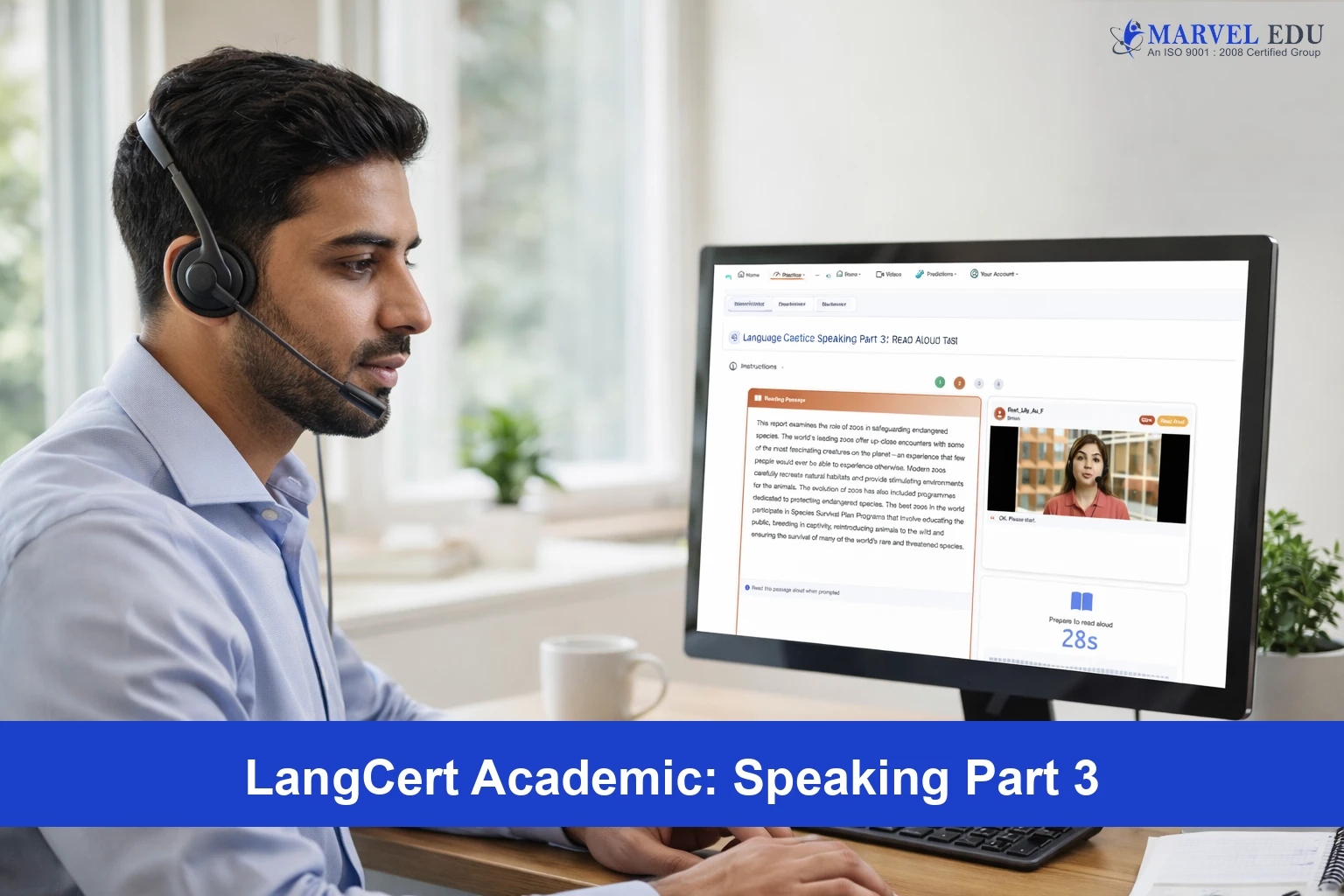
LanguageCert Academic Speaking Part 3 tests two skills in one task: reading aloud and expressing an opinion. …

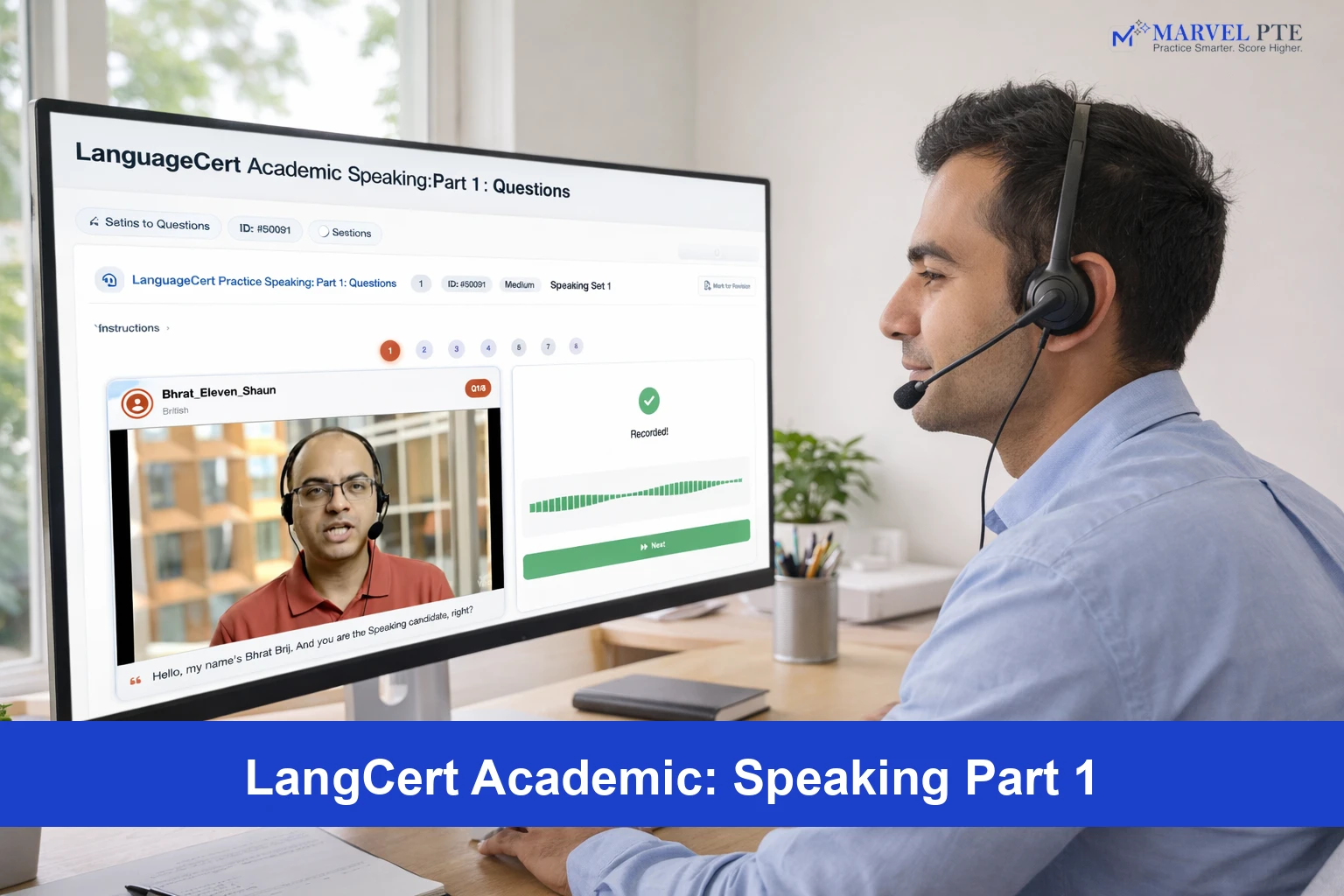
LanguageCert Academic Speaking Part 1 is the opening section of the speaking test, where the examiner asks you …
