Question Prompt
Do you prefer classes where teachers do all the talking, or where students are allowed to speak to?
Use specific examples and reasons to explain your opinion.
Why this answer struggles
some text here
Global vs question-specific notes
- A Topic Sentence (also known as TS) is an important part of a templated essay. It is a short sentence that states the main idea of the essay using words from the essay topic. The TS fits into a fixed structure where most of the content is already written. This sentence uses positive or neutral words only. A good TS avoids using pronouns and negations and tries to highlight the importance of the topic in context of the essay.
- The Topic Sentence (The TS) is a clear and short statement that uses the main words of an essay. It fits into a specific structure where rest of the essay is already written, so only the TS needs to be created. This helps keep the essay on track and makes sure it stays positive or neutral. The TS uses important words from the essay topic and is designed to be simple, avoiding tricky words or negative phrases.
- A TS, or Topic Sentence, is an important part of a templated essay. It is a clear and short sentence that tells what the main idea of the essay is. The TS is created using words from the essay topic and fits into a set structure that is already written. It also makes sure that the essay sounds positive or neutral. The TS is the only part that needs to be changed for each essay in order to get full content score.
- A Topic Sentence (also known as TS) is a concise statement that introduces the main argument in a templated essay. In this way, most of the essay content is fixed, and only the TS needs to be written. The TS ensures the essay stays focused on the topic while maintaining a positive or neutral tone.
- A TS (short form of Topic Sentence) is a vital part of a templated essay. It uses key terms from the essay prompt and fits into a fixed structure, helping to easily cover the content score criteria. The TS must remain positive or neutral in tone and is the only sentence that needs to be customized for each essay.
- In PTE’s templated essays, the Topic Sentence (TS) is the only sentence that you need to create. It is a brief statement that repeats the main topic, using keywords from the essay question. This allows the essay to maintain consistency and focus without altering the pre-written sections.
- The Topic Sentence (The TS) is special because it should always keep a positive or neutral tone. It avoids using pronouns and negative words, making it clear and easy to understand. By doing this, the TS helps everyone see the importance of the topic in a simple way. In a templated essay, the TS is the only part that needs to be written from scratch, while the rest of the essay is already prepared. The TS uses important phrases from the essay topic.
- A TS, or Topic Sentence, is a concise statement that directly addresses the main topic of the essay. It is crucial in a templated essay because it introduces the main argument or viewpoint without altering the fixed parts of the essay. The TS should be neutral or positive and should include key terms from the essay prompt.
- A Topic Sentence (also known as TS) is a crucial element in a templated essay, as it directly addresses the main topic while keeping rest of the essay’s structure fixed. It highlights words from the essay topic in a positive or neutral tone, ensuring the essay fulfils the content score criteria.
- The Topic Sentence (The TS) is a crucial part of a templated essay that you have to write using words from essay topic. It is positive or neutral in tone and uses key terms from the prompt to ensure that the essay satisfies relevance criteria for content score.
90-Points (9 Bands) Sample Answer for Essay
- *Warning! Important change in status after November 2024 update!
- Warning! Things have changed as a result of the November 2024 update.
- Caution! Due to the November 2024 update, templates currently differ from before.
- Notice! In light of the November 2024 update, the status of templates has been altered.
- Alert! The template has to be modified according to the November 2024 update.
- Be aware! The November 2024 update has affected this template, and it is now changed.
- Important! This template doesn’t reflects the changes introduced by the November 2024 update.
- Take note! The November 2024 update has impacted the status, resulting in need of newer templates.
- Be informed! As per the November 2024 update, this template has undergone a change.
- Attention! The template should be adjusted in line with the November 2024 update.
The debate on whether classes where teachers do all the talking are preferred encompasses diverse viewpoints, revealing its advantages and drawbacks. This essay critically assesses these perspectives.
There are myriad arguments in favour of my stance. Recent research not only outlines the significance of studies as well as people, but also points out the importance of education and coping with vicissitudes. Besides, it provides a brief overview of expanding cultural understanding, followed by enhancing global perspectives. Examples of this can be seen all over the world, especially in affluent nations. Further, the implications of technological advancements on these views are significant, justifying widespread support for the idea that classes where teachers do all the talking are preferred.
However, there are some arguments against the aforementioned view. Besides, its impact is far-reaching indeed as its influence extends to various facets of society, shaping not only individual experiences but also impacting the academic research landscape. Therefore, it is apparent why many are against the notion that classes where teachers do all the talking are preferred.
In conclusion, while the viewpoint that classes where teachers do all the talking are preferred presents a complex array of advantages and disadvantages, my analysis leads me to firmly support the notion that its benefits substantially outweigh the drawbacks.
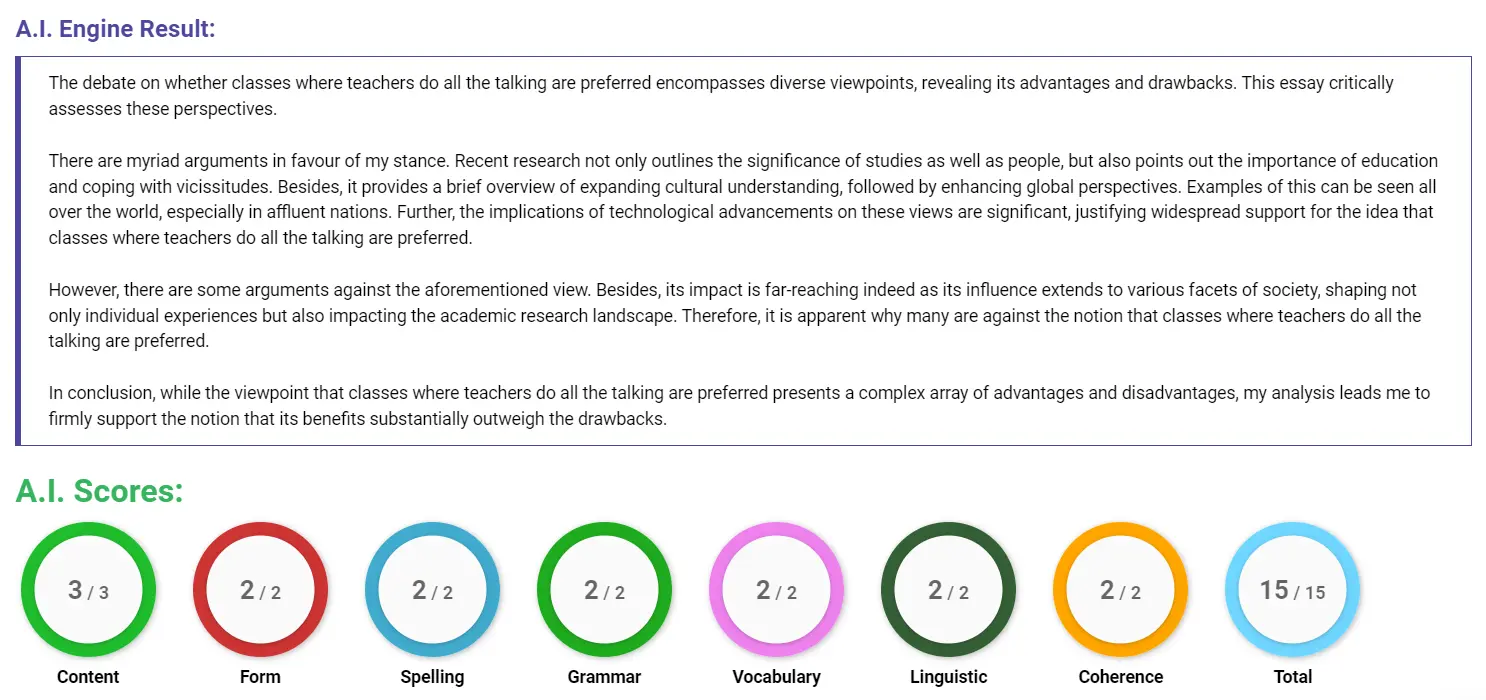
Will I be able to score with this PTE Academic Essay Sample Answer?
So, sadly… no.
Template used in this Essay Sample Answer
You can also attempt to memorize the entire template before typing it. Here is the template for the AGBS essay type. There are two kinds of PTE essays: AGBS and PS. Both templates share a similar structure, with some variations in text to make the content more appropriate for the essay type.
Before you start typing, consider memorizing the whole template. Here is the template for the AGBS essay type. You know that PTE essays come in two forms: AGBS and PS. Both templates have a similar structure but differ slightly in text to suit each essay type.
There are two types of PTE essays: AGBS and PS. Both templates have a similar structure with slight text differences to better fit the essay type. You might even try memorizing the entire template before typing it. Here is the template for the AGBS essay type.
You can even try memorising the whole template before typing it. Here is the template for AGBS essay-type. There are two types of PTE essays: AGBS and PS. Both templates have similar structure, with some differences in text to make the content more suitable to the essay-type.
Why not try memorizing the whole template before you begin typing? Here's the template for the AGBS essay type. There are two types of PTE essays: AGBS and PS. They both have similar structures but with some text differences to better suit each essay type.
Ever thought about memorizing the entire template before typing it? Here is the template for the AGBS essay type! PTE essays come in two types: AGBS and PS. Both templates share a similar structure, with some differences in text to fit the essay type.
Memorizing the whole template before typing is like having a roadmap for your essay. Here's the template for the AGBS essay type. PTE essays include two types: AGBS and PS. Both templates are built on a similar framework, with slight text variations to suit each essay type.
Consider memorizing the entire template before you start typing. Below is the template for the AGBS essay type. PTE essays are categorized into two types: AGBS and PS. While both templates share a similar structure, they have some text differences to make the content more appropriate for each essay type.
To help with your preparation, you might try memorizing the whole template before typing it. The template for the AGBS essay type is provided here. There are two types of PTE essays: AGBS and PS. Both templates have similar structures but differ slightly in text to better suit the essay type.
Why not memorize the entire template right now before you begin typing? Here is the AGBS essay-type template. The PTE essays consist of two types: AGBS and PS. While both templates share a similar structure, they have some text differences to make the content more fitting for each essay type.
AGBS
UsedThe debate on whether TS* encompasses diverse viewpoints, revealing its advantages and drawbacks. This essay critically assesses these perspectives.
There are myriad arguments in favour of my stance. Recent research not only outlines the significance of studies as well as people, but also points out the importance of education and coping with vicissitudes. Besides, it provides a brief overview of expanding cultural understanding, followed by enhancing global perspectives. Examples of this can be seen all over the world, especially in affluent nations. Further, the implications of technological advancements on these views are significant, justifying widespread support for the idea that TS*.
However, there are some arguments against the aforementioned view. Besides, its impact is far-reaching indeed as its influence extends to various facets of society, shaping not only individual experiences but also impacting the academic research landscape. Therefore, it is apparent why many are against the notion that TS*.
In conclusion, while the viewpoint that TS* presents a complex array of advantages and disadvantages, my analysis leads me to firmly support the notion that its benefits substantially outweigh the drawbacks.
PS
The debate on whether TS* encompasses diverse viewpoints, revealing its challenges. This essay critically assesses these perspectives.
There are myriad reasons in favour of my stance. Recent research not only outlines the significance of studies as well as people, but also points out the importance of education and coping with vicissitudes. Besides, it provides a brief overview of expanding cultural understanding, followed by enhancing global perspectives. Examples of this can be seen all over the world, especially in affluent nations. Further, the implications of technological advancements on these views are significant, justifying widespread support for the idea that TS*.
However, there are some solutions against the aforementioned view. The primary one stems from the fact that by ensuring the implementation of set rules and policies, government authorities can help a nation thrive. Besides, its impact poses challenges that extend to various facets of society, shaping not only individual experiences but also impacting the academic research landscape. Therefore, it is apparent why many advocate for solutions addressing the notion that TS*.
In conclusion, while the viewpoint that TS* presents a complex array of challenges, my analysis leads me to firmly support the notion that its solutions substantially outweigh those challenges.
What is TS?
A TS needs to include words that are related to the essay topic, and here is a list of such words and phrases you can use to create your own TS. All of these are directly connected to the essay prompt, giving you several ideas for crafting your TS.
To make your own TS, which should contain words related to the essay topic, here is a list of such words and phrases. These words are directly drawn from the essay prompt, providing you with several ideas for your TS.
We’ve provided a list of words and phrases that are related to the essay topic to help you create your own TS. All of these words are directly linked to the essay prompt, giving you multiple ideas for composing your TS.
A TS needs to have words that are related to the essay-topic, and here is a list of such words and phrases that you can use to make your own TS. All of these words and phrases are directly related to the text of essay prompt, thus giving you several ideas for creating your own TS.
Because a TS requires words related to the essay topic, we’ve compiled a list of such words and phrases for you to use in making your own TS. All these are directly associated with the essay prompt, offering you various ideas for making your TS.
When creating your own TS, you should include words related to the essay topic. Here is a list of such words and phrases. These are directly connected to the essay prompt, providing you with several ideas for your TS.
A TS must have words that relate to the essay topic, so here’s a list of words and phrases you can use to compose your own TS. All of these come directly from the essay prompt, giving you many ideas for creating your TS.
To assist you in crafting your own TS, we’ve provided a list of words and phrases. They all are directly linked to the essay prompt, offering several ideas for your TS. Means, you can easily use these words related to the essay topic.
You can use this list of words and phrases related to the essay topic to create your own TS. Since a TS needs to include words connected to the essay prompt, these will give you multiple ideas for your TS.
In order to make your own TS that contains words related to the essay topic, here is a list of such words and phrases. These are directly related to the essay prompt, providing you with several ideas for crafting your TS.
Example TS for the current essay:
classes where teachers do all the talking are preferred
Important Words for Relevancy + Content Scores
| Term | Definition |
|---|---|
| Class | A class is a group of students who meet to learn about a specific subject. For example, in a science class, students might conduct experiments to understand scientific principles. |
| Teacher | A teacher is a person who helps students learn by explaining concepts and providing guidance. For instance, a teacher in a mathematics class might show students how to solve equations. |
| Talk | To talk means to communicate by speaking. For example, during a class discussion, students and teachers talk about different ideas and share their thoughts. |
| Student | A student is someone who is learning in a school or educational setting. For example, a student may study history to learn about past events and their significance. |
| Allow | To allow means to give permission for something to happen. For instance, a teacher might allow students to work in groups to encourage teamwork. |
| Specific Example | A specific example is a particular instance that illustrates a point or idea clearly. For example, when discussing renewable energy, a specific example would be solar panels used to generate electricity. |
| Reason | A reason is an explanation for why something happens or why someone believes something. For example, a student might give a reason for preferring group work, saying it helps them learn from others. |
| Explain | To explain means to make something clear or easy to understand. For instance, a teacher might explain a difficult math problem step by step to help students grasp the concept. |
| Opinion | An opinion is a personal belief or judgement about something. For example, a student might express their opinion on the best way to study for a test. |
| Motivation | Motivation is the reason or desire to do something. For example, a student may feel motivated to study hard because they want to achieve good grades. |
| Practice | Practice means to do something repeatedly to improve skills. For instance, students practice their reading skills by reading books regularly. |
| Learn | To learn means to gain knowledge or skills through experience or education. For example, students learn about science by conducting experiments and observing results. |
| Experts | Experts are people who have a lot of knowledge or skill in a particular area. For example, a scientist might be an expert in biology, teaching students about living organisms. |
| Classroom | A classroom is a room where students learn and teachers instruct. For example, a classroom is often filled with desks, a whiteboard, and educational materials. |
| Amount of Teaching | The amount of teaching refers to how much instruction a teacher provides during a lesson. For example, a teacher might adjust the amount of teaching based on students' understanding of a topic. |
| Knowledge | Knowledge is the information, understanding, and skills that a person gains through education or experience. For example, students acquire knowledge in subjects like maths and history. |
| Doing | Doing refers to the act of performing an action or task. For example, doing homework helps students reinforce what they learned in class. |
| Understanding | Understanding is the ability to grasp the meaning or significance of something. For example, a student shows understanding of a concept when they can explain it in their own words. |
| Concepts | Concepts are general ideas or principles that help us understand the world. For example, the concept of gravity helps explain why objects fall to the ground. |
| Better | Better means improved or more effective. For example, a student might find that studying in a quiet place helps them learn better than in a noisy environment. |
| Enhancement | Enhancement refers to the process of improving or making something better. For example, using technology in the classroom can lead to the enhancement of learning experiences. |
| Skills | Skills are the abilities or expertise needed to perform tasks. For example, communication skills are important for students to express their ideas clearly. |
| Focusing on | Focusing on means directing attention to a particular subject or task. For example, focusing on reading can help students improve their literacy skills. |
| After Class | After class refers to the time following a class session. For instance, students might ask questions after class to clarify what they learned during the lesson. |
| Sufficient | Sufficient means enough to meet the needs or requirements. For example, having sufficient time to study can help students prepare well for exams. |
| While Learning | While learning refers to the activities and processes that occur during the act of gaining knowledge. For example, students might take notes while learning to help them remember important information. |
Attempt to create your own TS using these suggested words. Then fill in the above-mentioned template and submit it to our AI for evaluation. Keep making changes only in the TS until you achieve full scores. This is the fastest way for you to prepare for the writing section of the PTE Academic test.
Use these suggested words to craft your own TS. Then, complete the template provided above and submit it to our AI for evaluation. Continue refining only the TS until you get full marks. This is the quickest way to prepare for the writing section of the PTE Academic test.
Try making your own TS with these suggested words. Then fill out the above-mentioned template and submit it to our AI for evaluation. Keep adjusting just the TS until you obtain full scores. This is the fastest way for you to get ready for the PTE Academic test's writing section.
Try to make your own TS using these suggested words. Then fill the above-mentioned template, and submit to our AI for evaluation. Keep making changes only in the TS till you get the full scores. This is the fastest way for you to prepare for the writing section of PTE Academic test.
Try crafting your own TS using these suggested words. Then, fill in the template above and submit it to our AI for evaluation. Keep modifying only the TS until you get full scores. This is the fastest way to prepare for the writing section of the PTE Academic exam.
Why not try creating your own TS with these suggested words? Then complete the above-mentioned template and submit it to our AI for evaluation. Keep editing just the TS until you achieve full marks. This is the quickest way for you to prepare for the PTE Academic test's writing section.
Consider making your own TS using these suggested words. Then fill out the template provided above and submit it to our AI for evaluation. Keep refining only the TS until you receive full scores. This is the fastest way to get ready for the writing section of the PTE Academic test.
To prepare, try crafting your own TS using these suggested words. Next, complete the template above and submit it to our AI for evaluation. Continue adjusting only the TS until you get full marks. This is the quickest method to prepare for the PTE Academic test's writing section.
Create your own TS with these suggested words. Then, fill in the template mentioned above and submit it to our AI for evaluation. Keep modifying only the TS until you achieve full scores. This is the fastest way to prepare for the writing section of the PTE Academic exam.
By attempting to make your own TS using these suggested words, and then filling out the above template and submitting it to our AI for evaluation, you can quickly prepare for the PTE Academic test's writing section. Just keep changing only the TS until you get full scores.